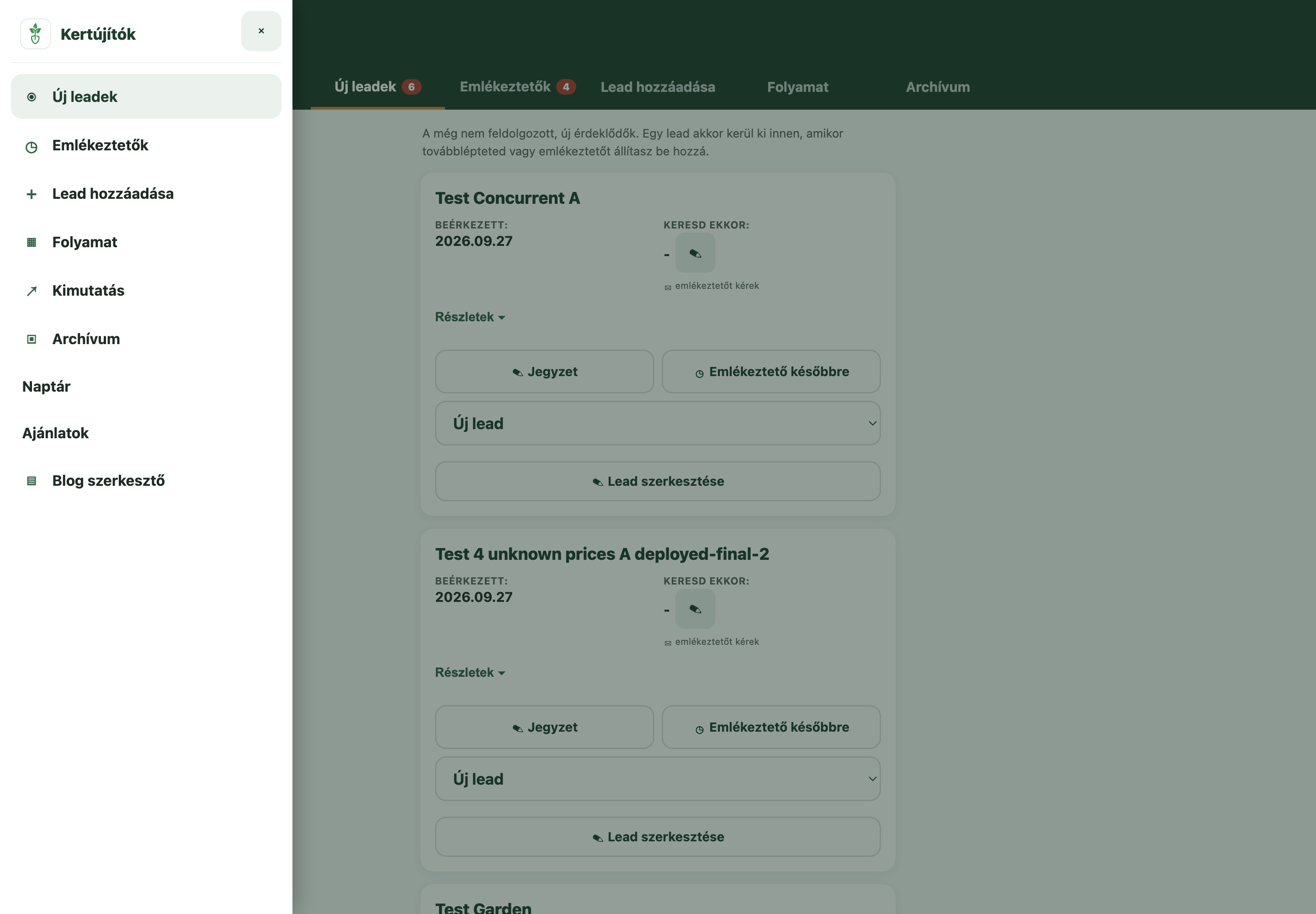
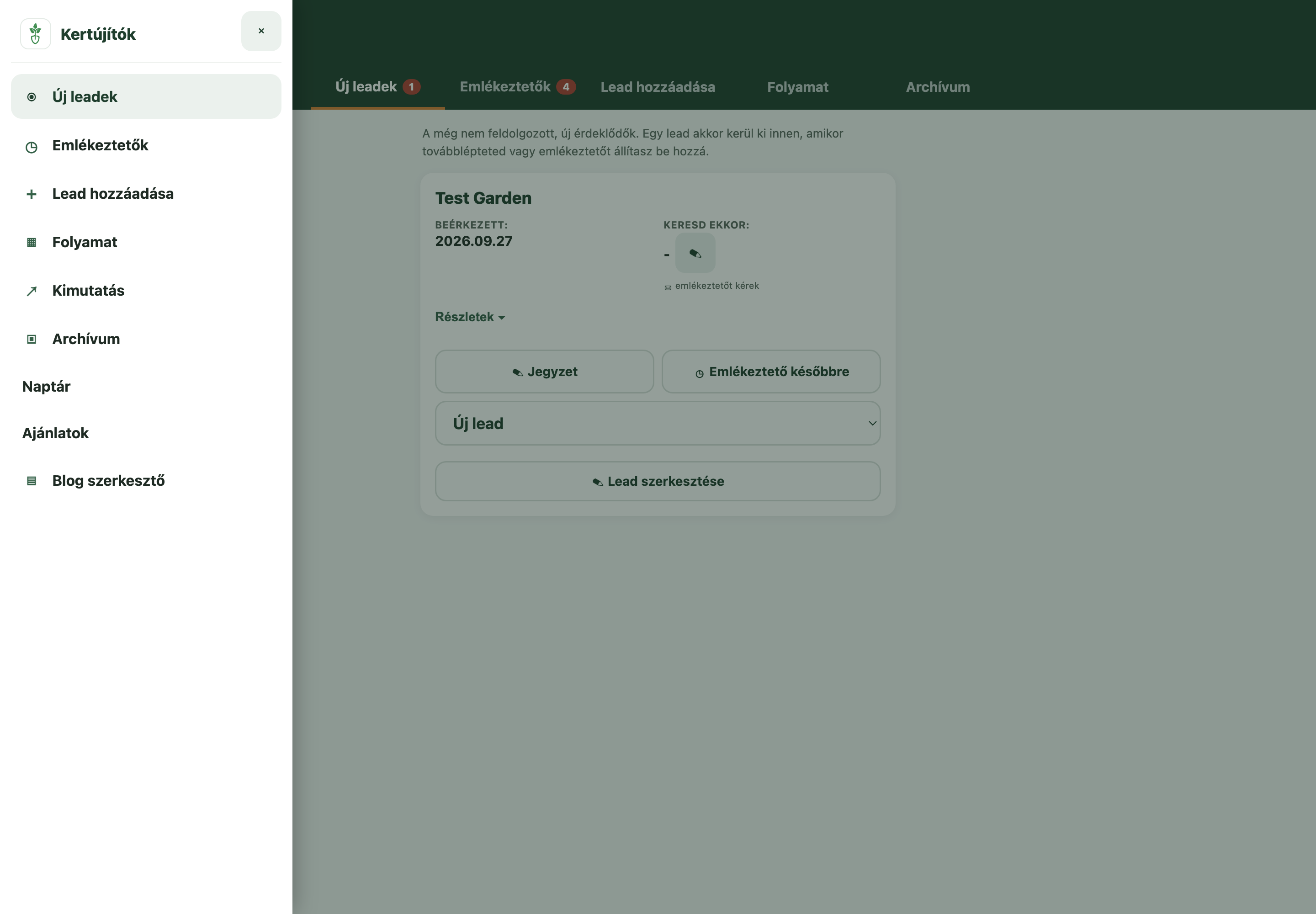
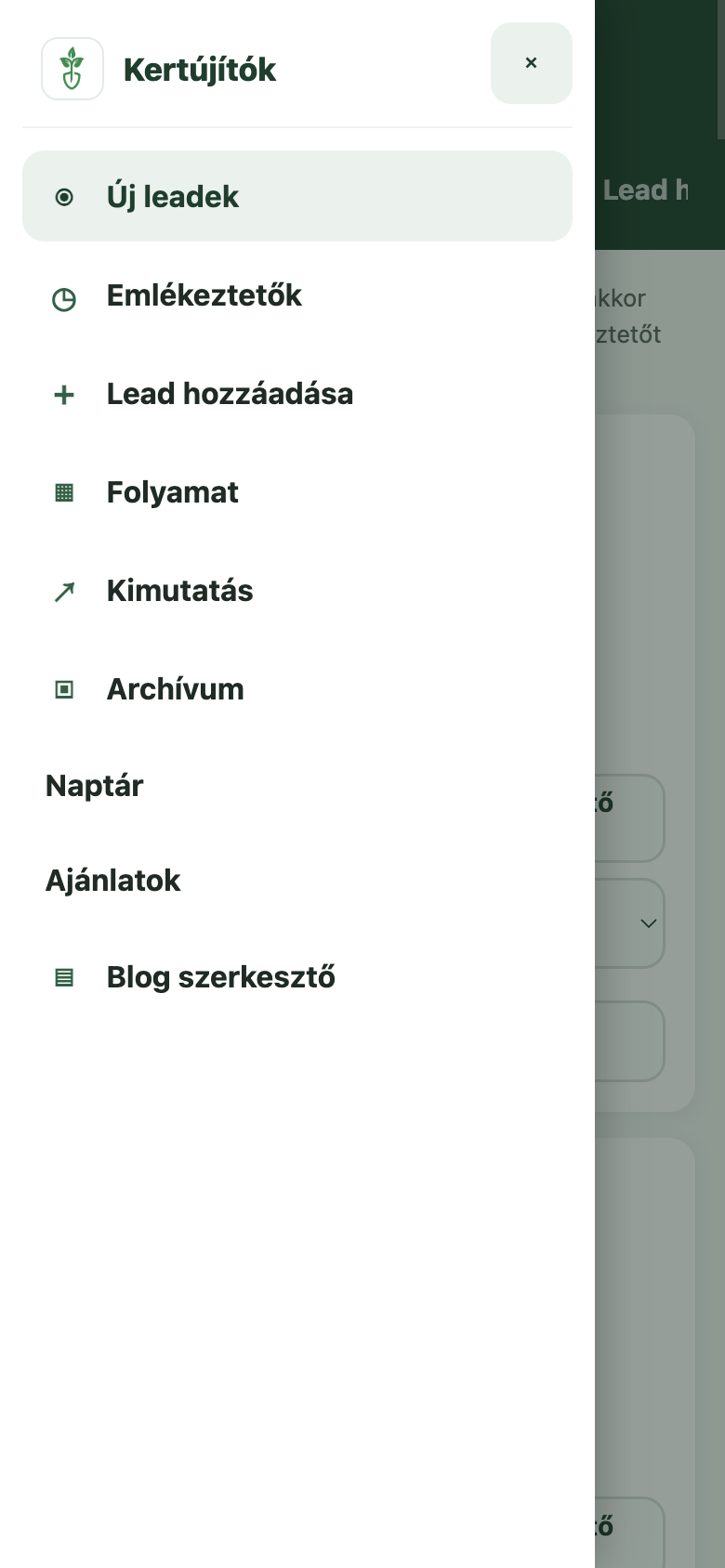
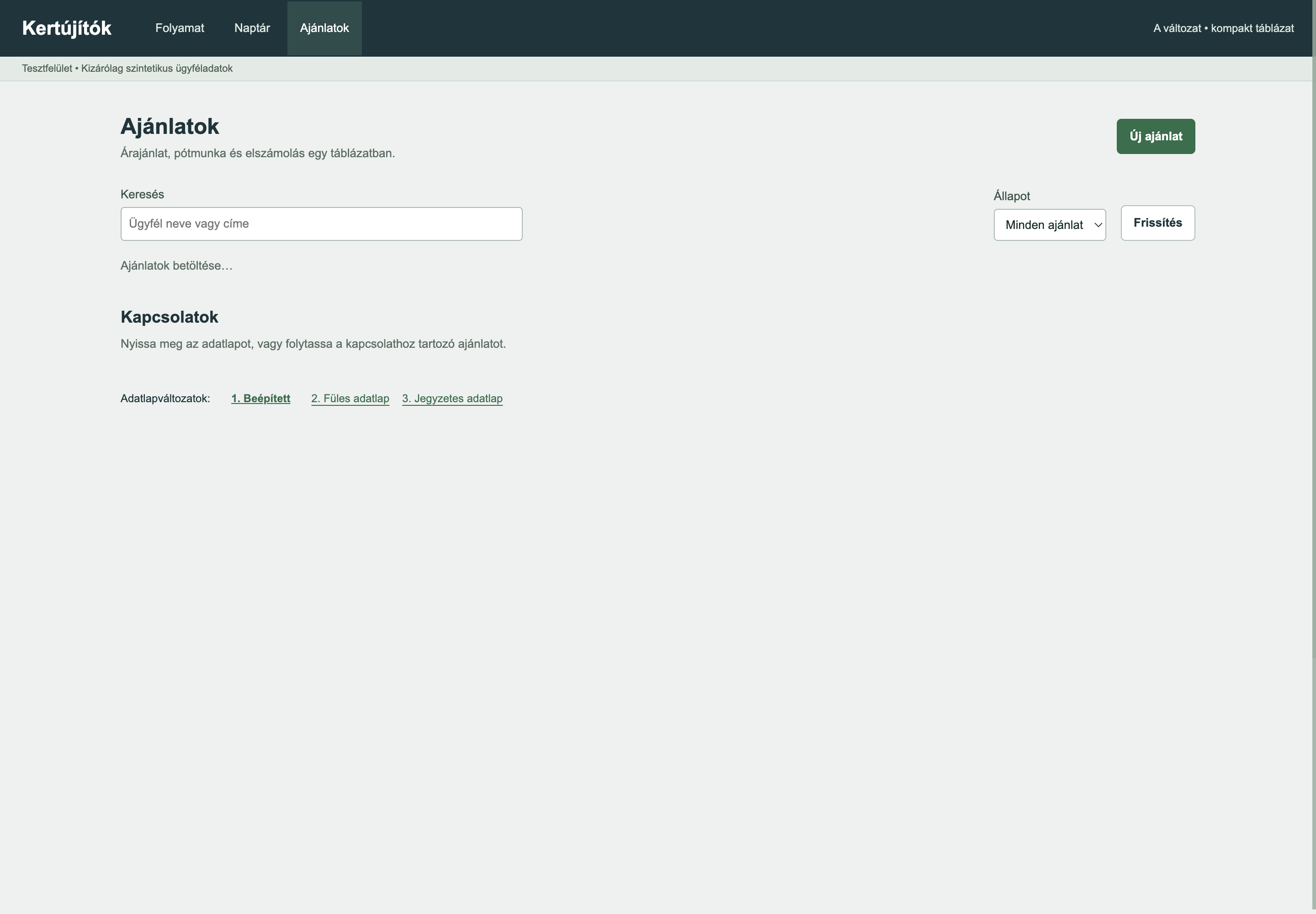
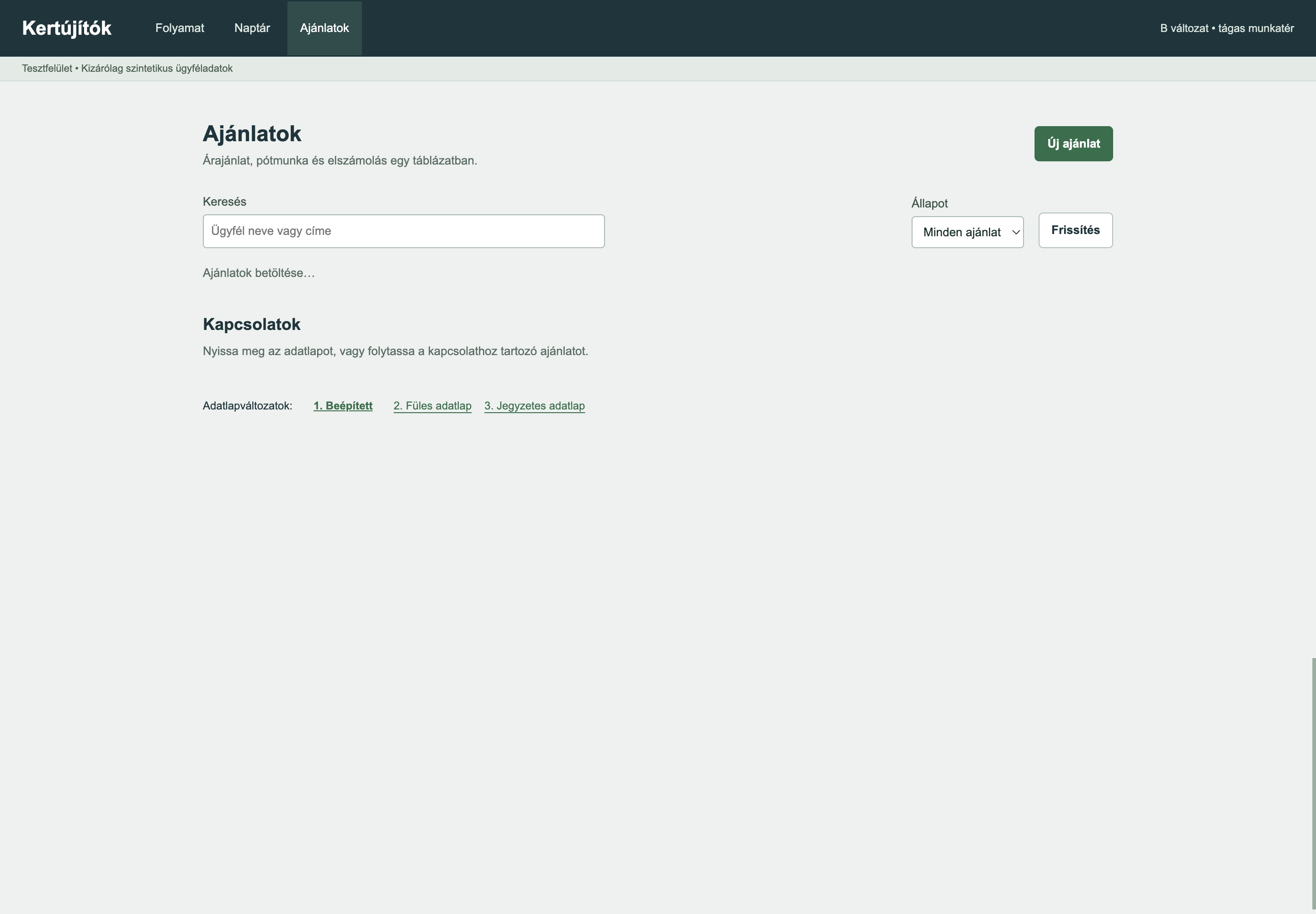
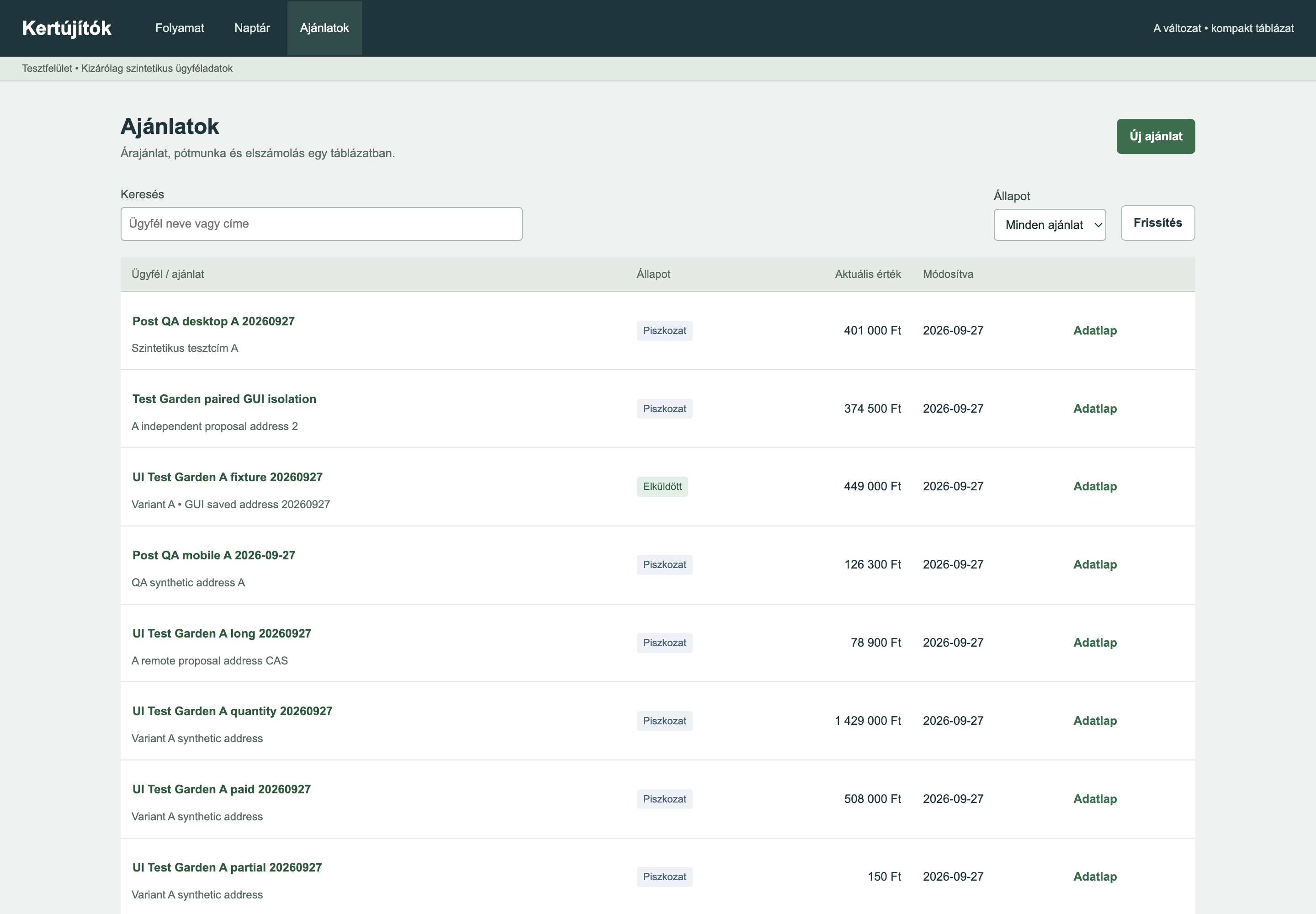
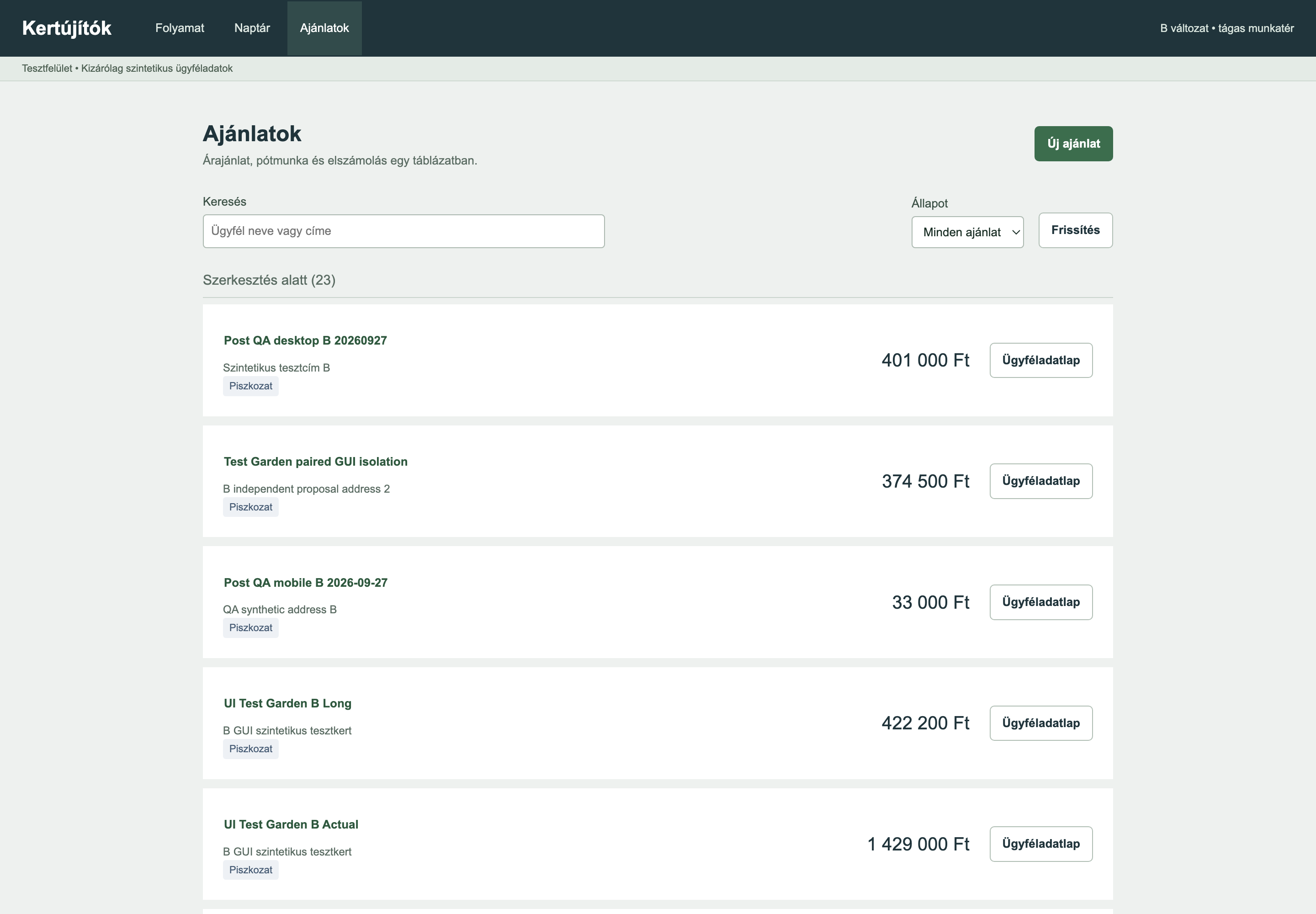
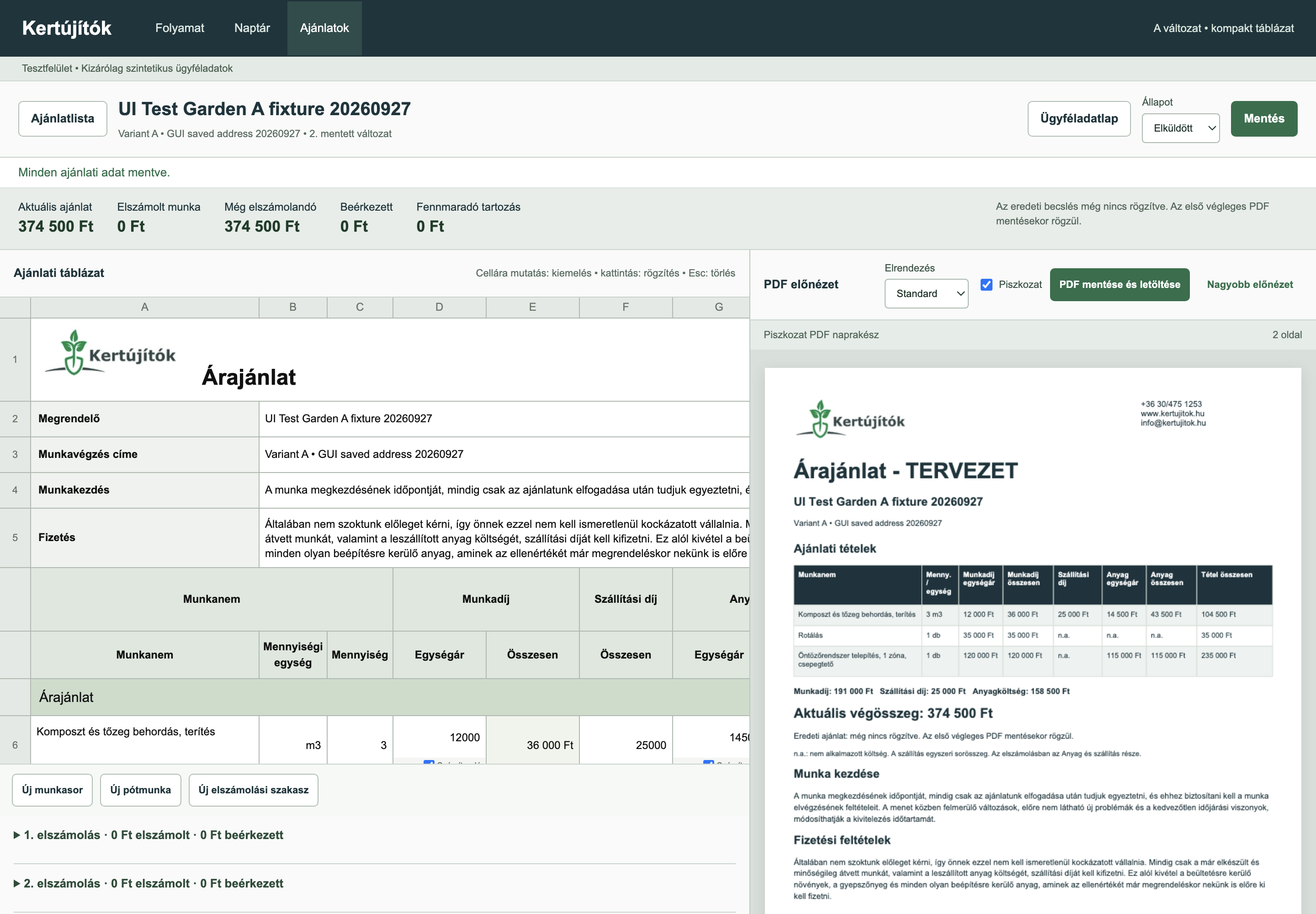
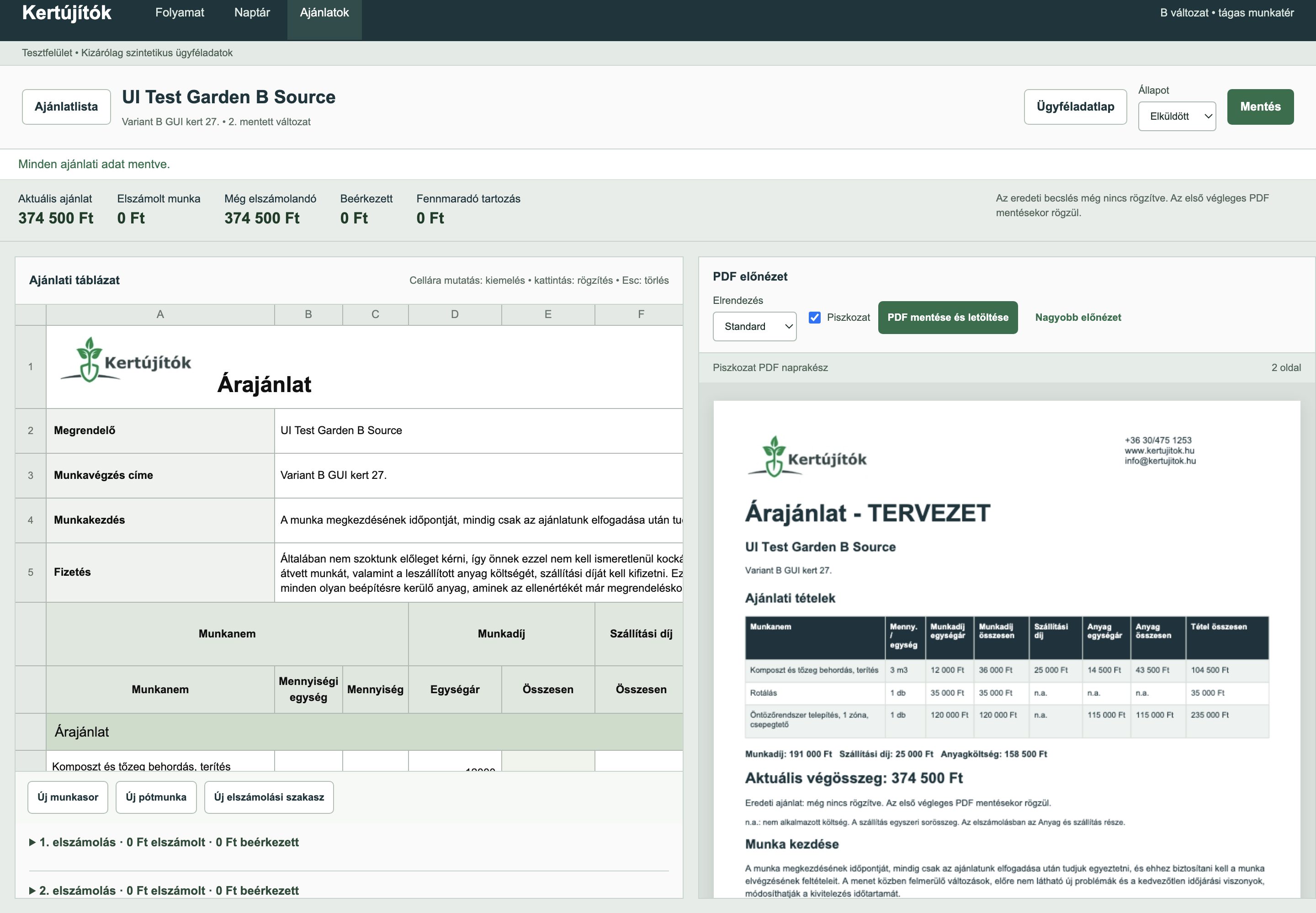
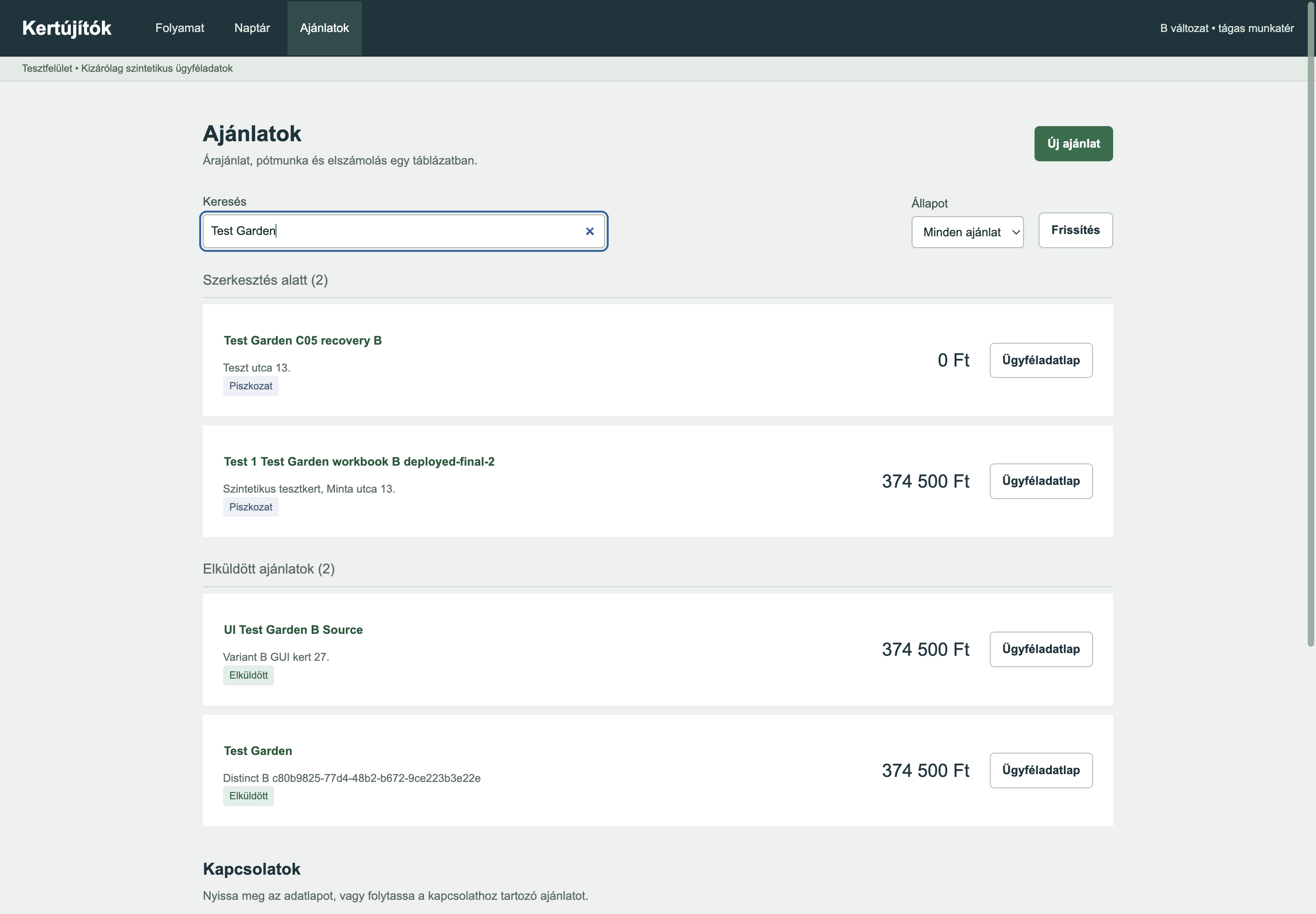
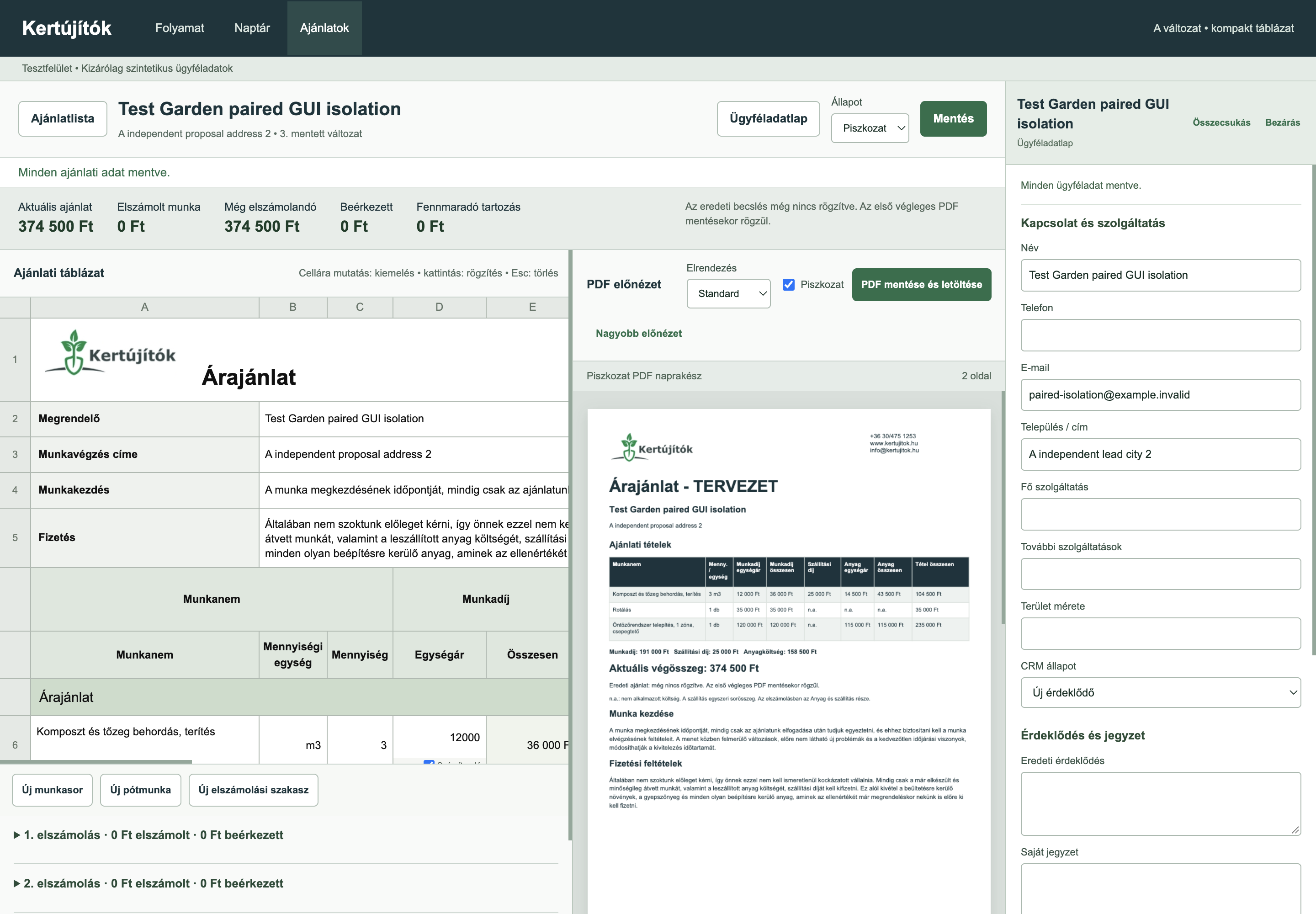
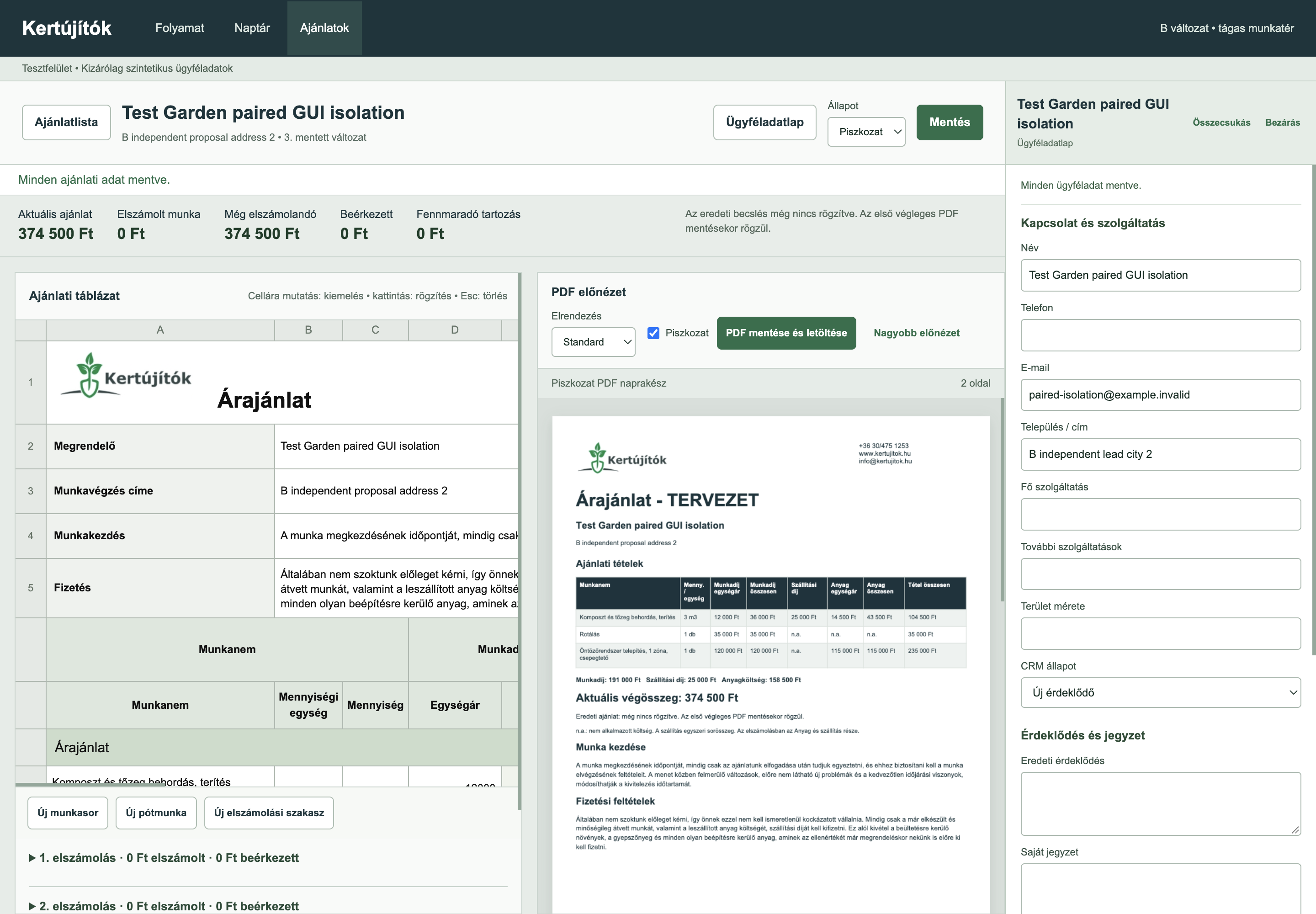
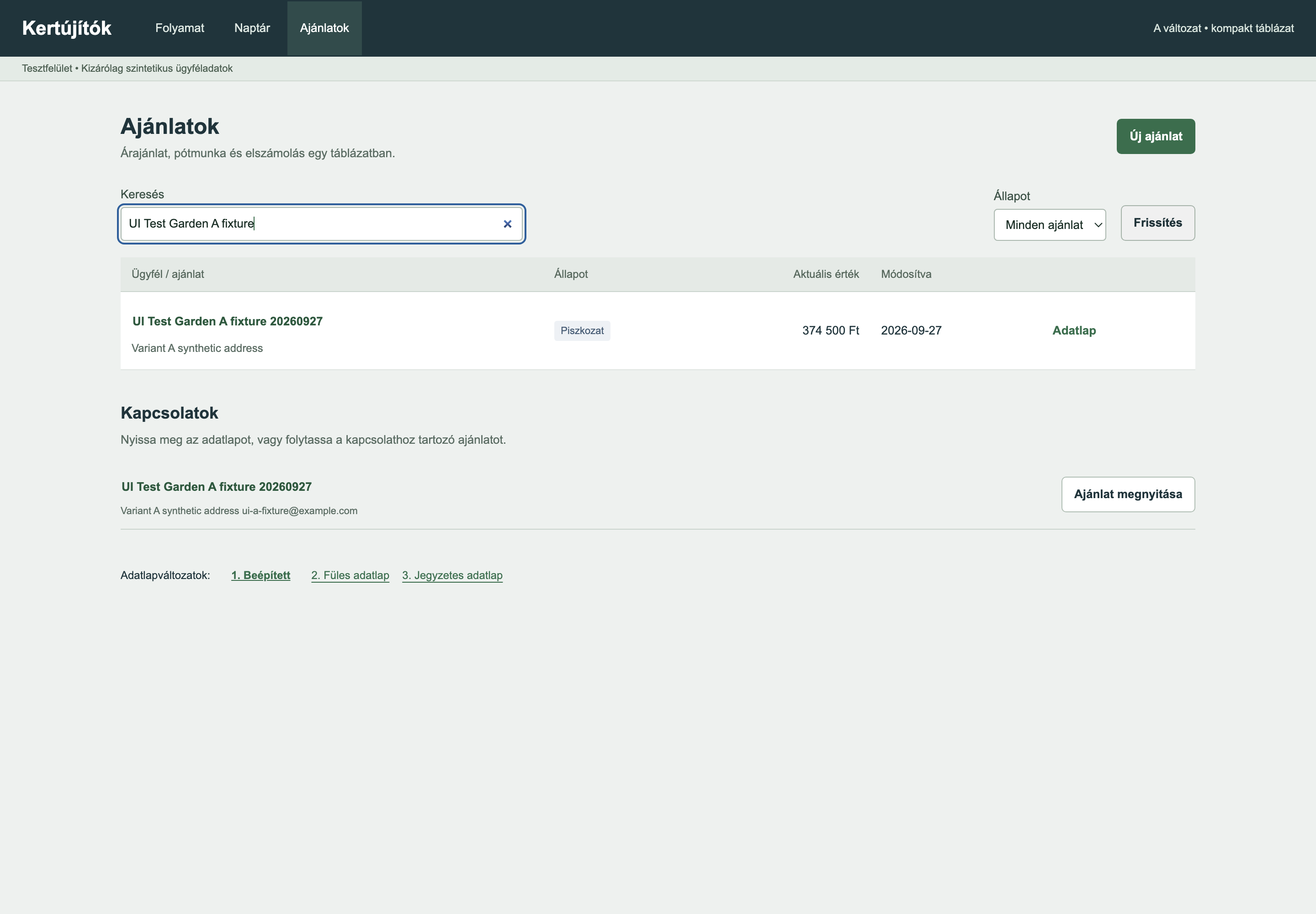
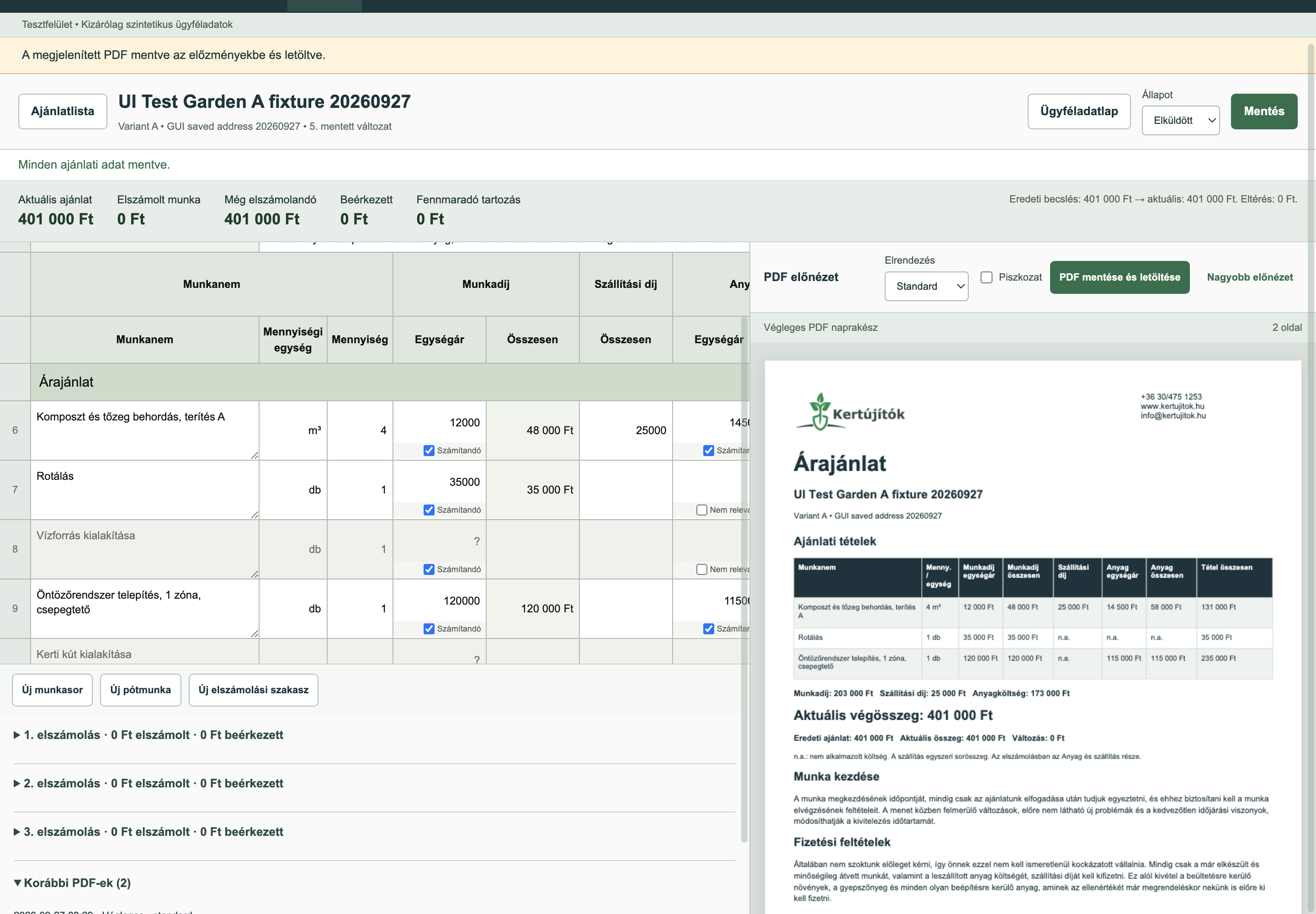
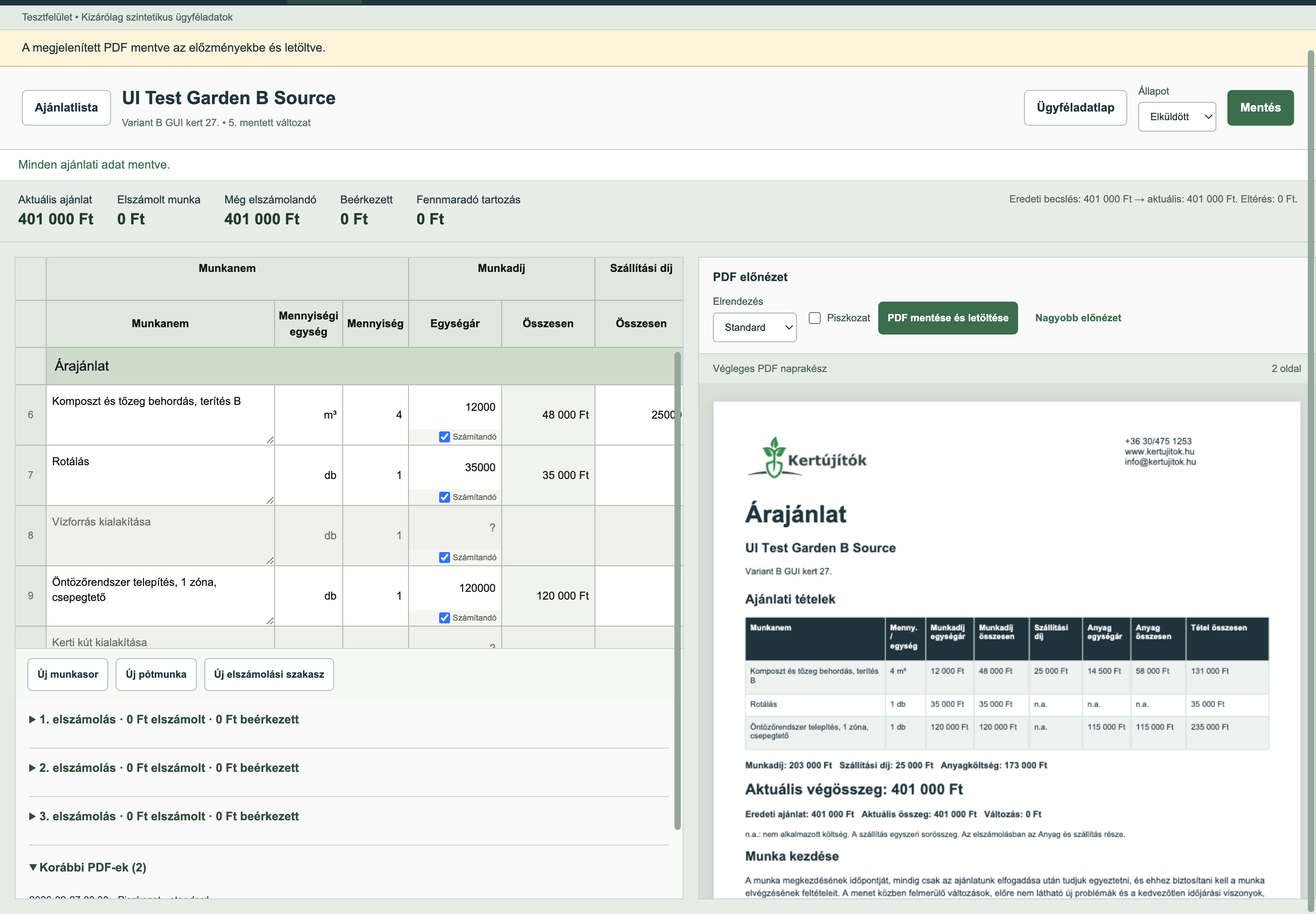
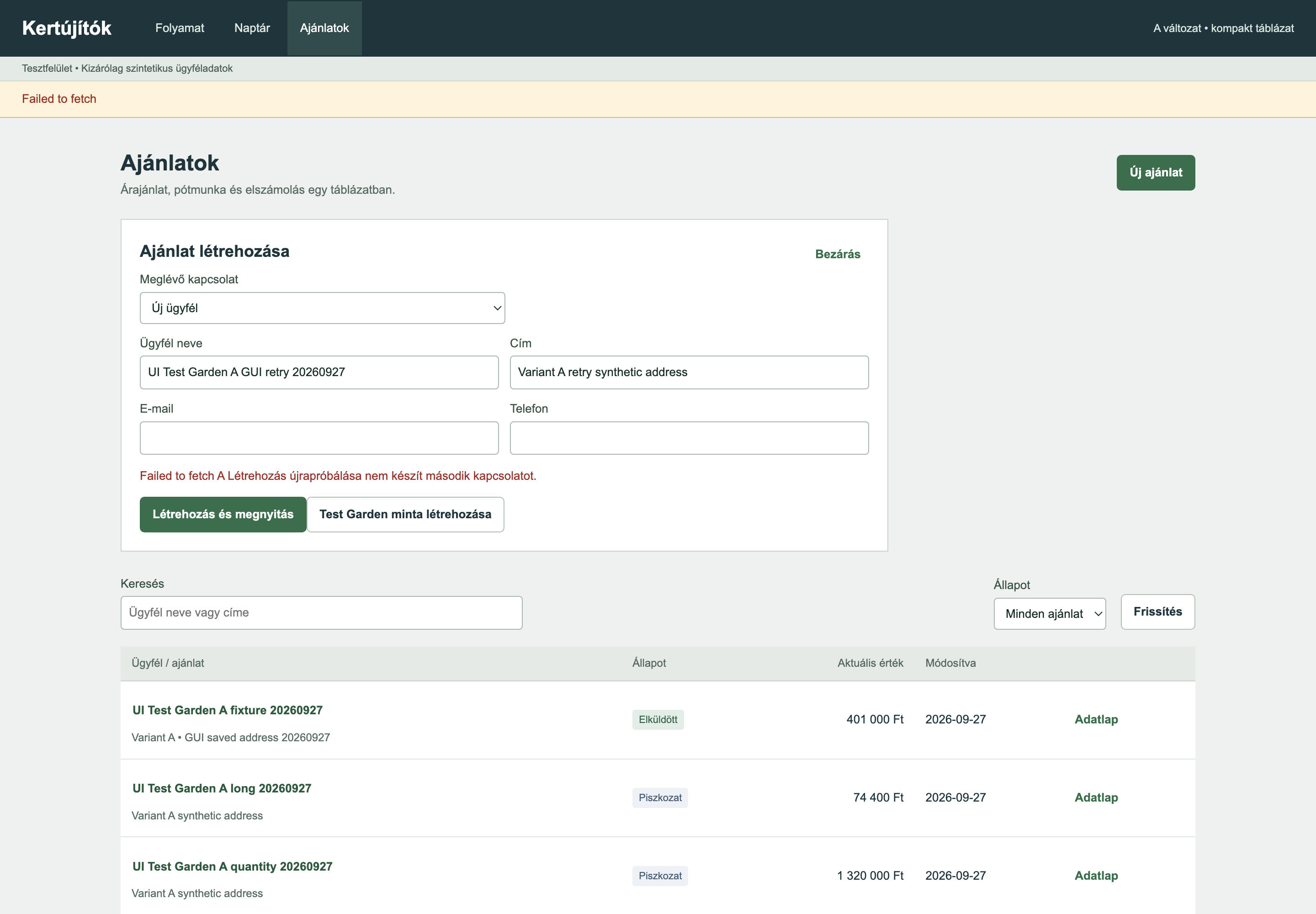
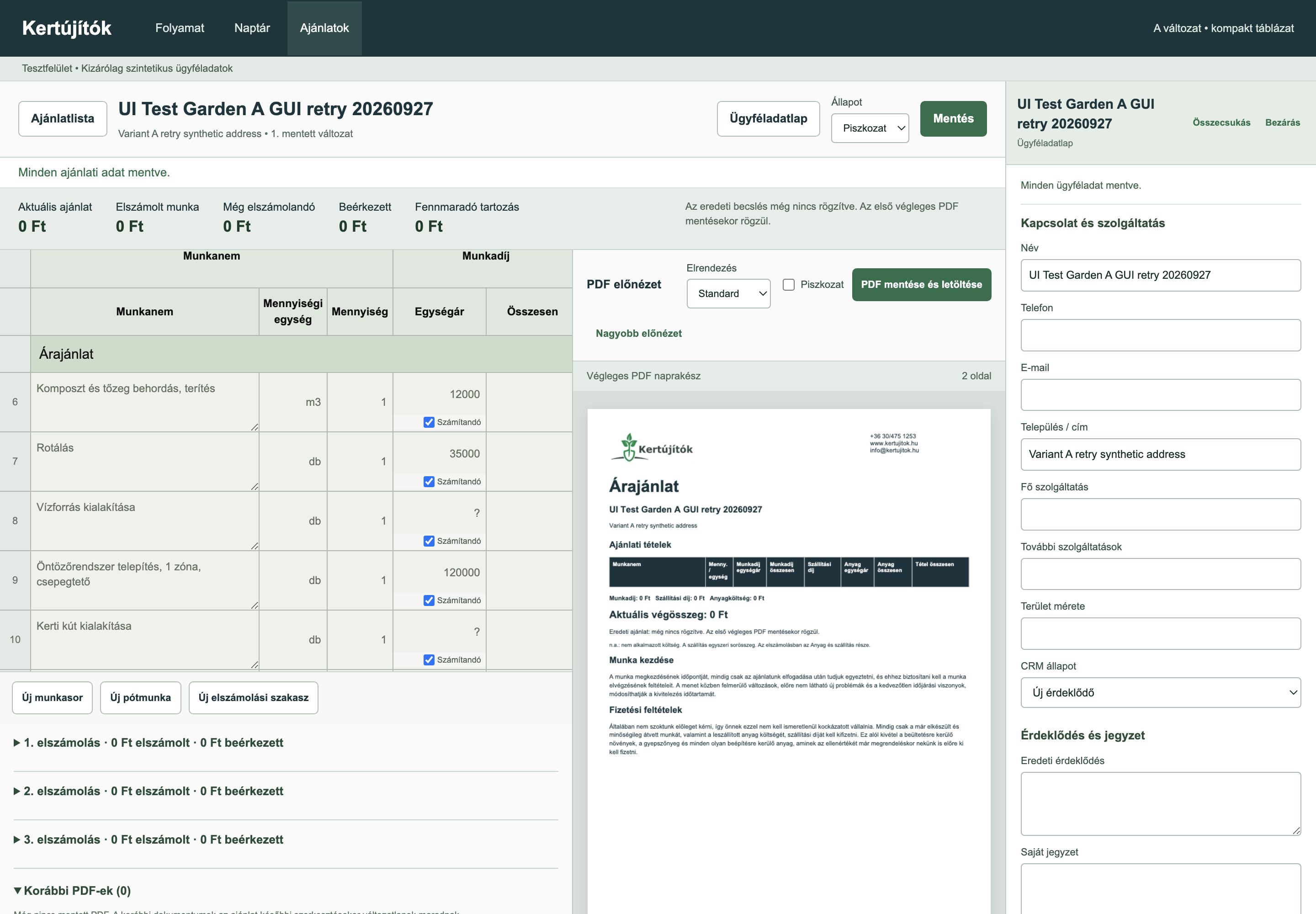
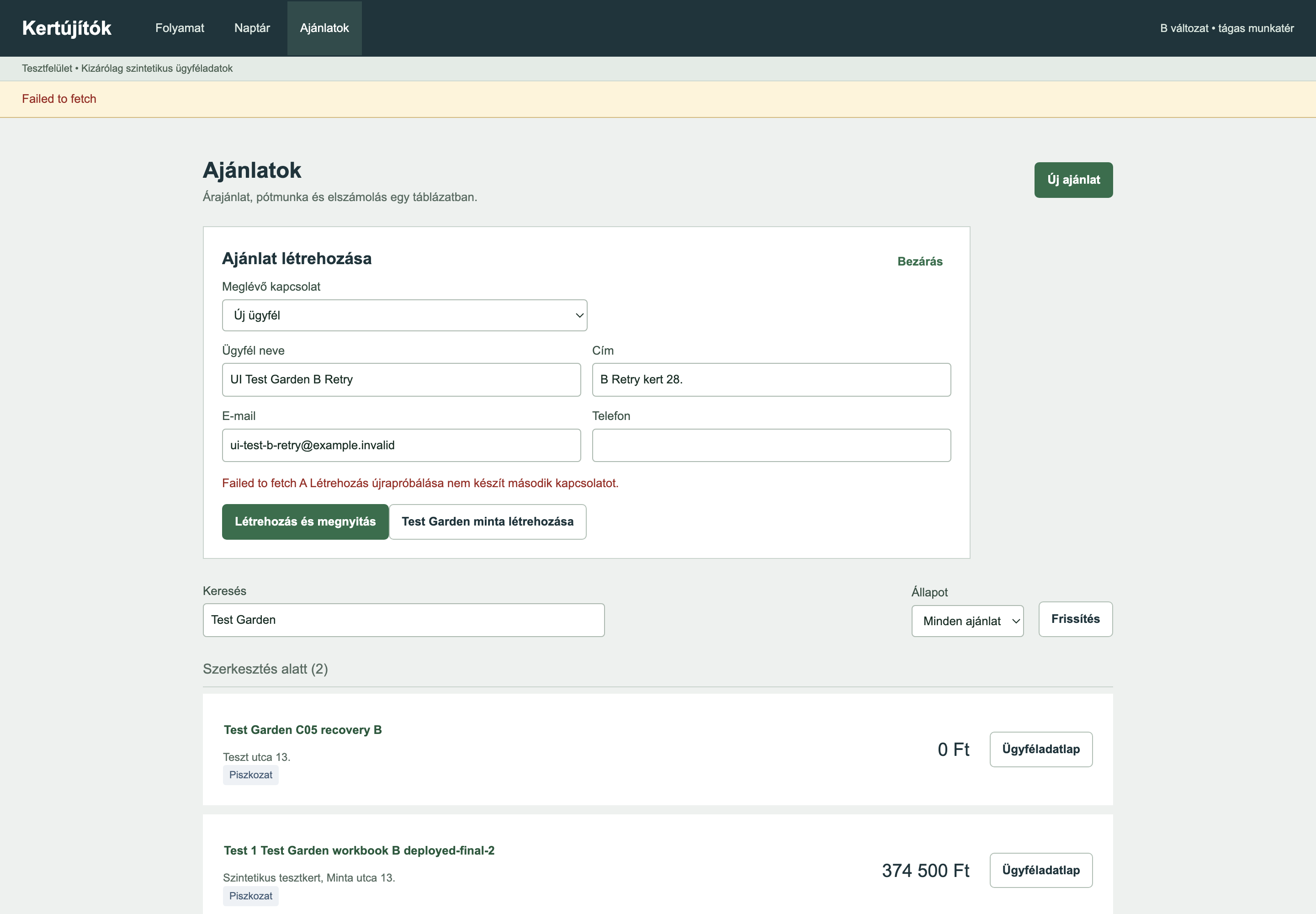
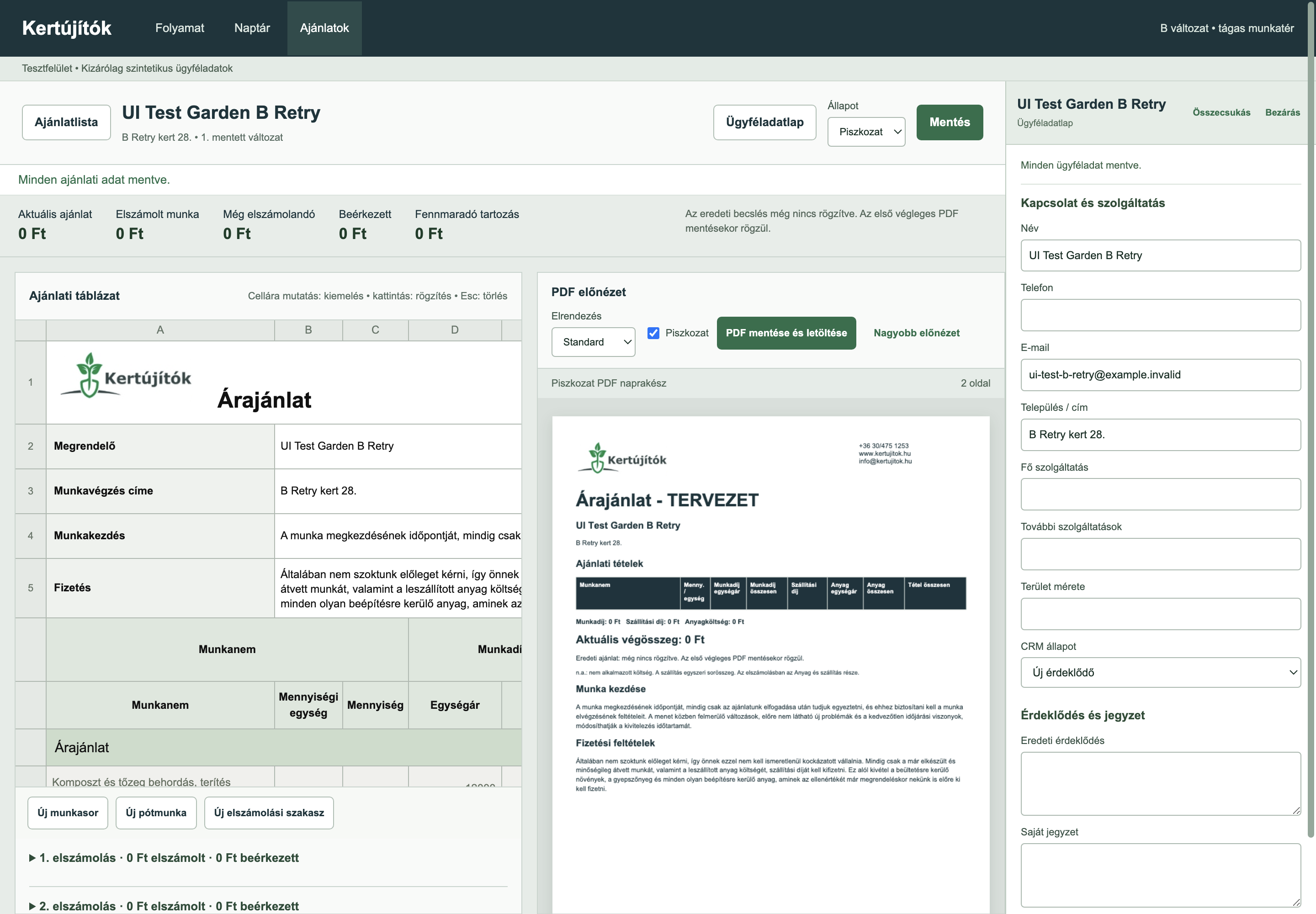
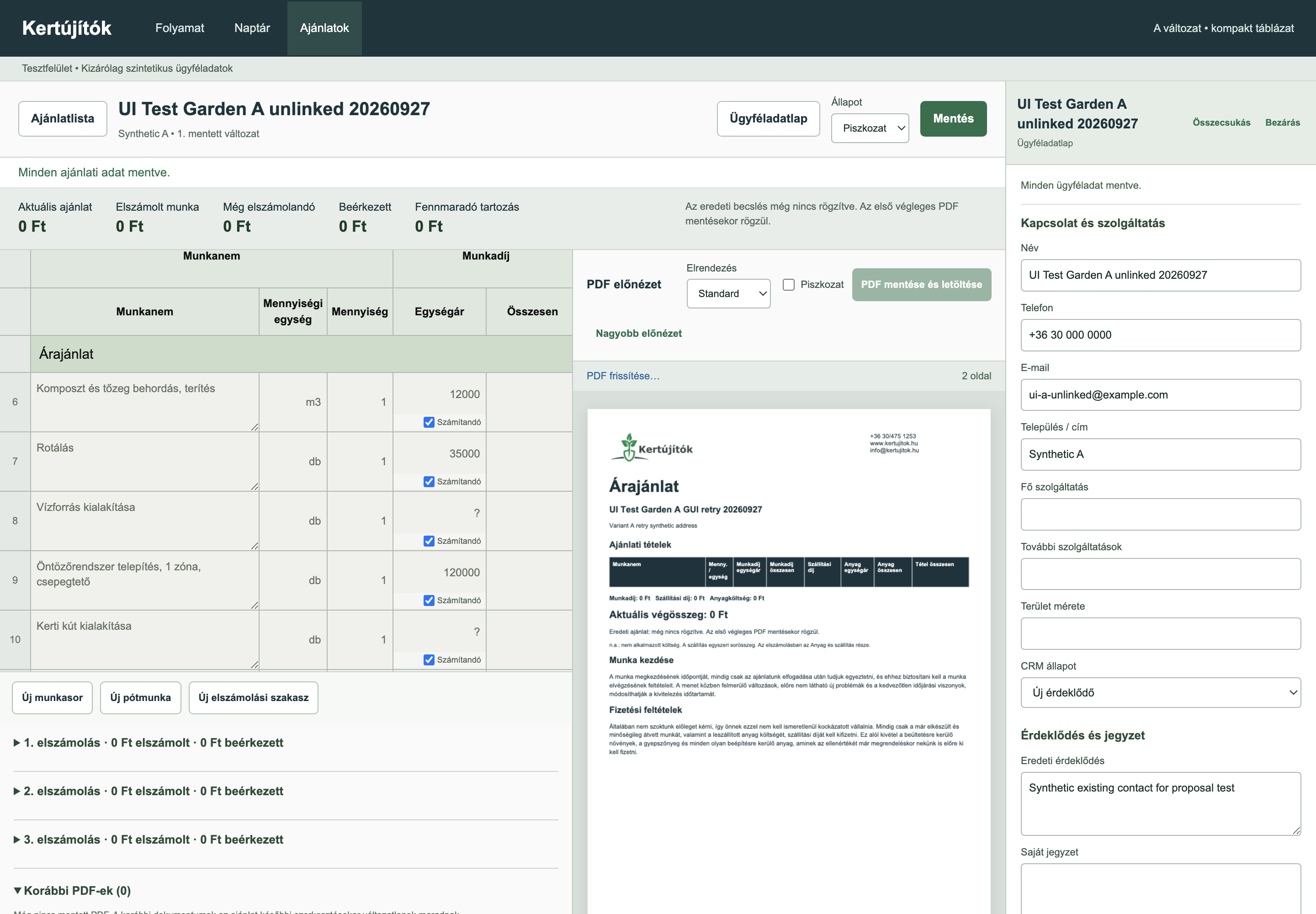
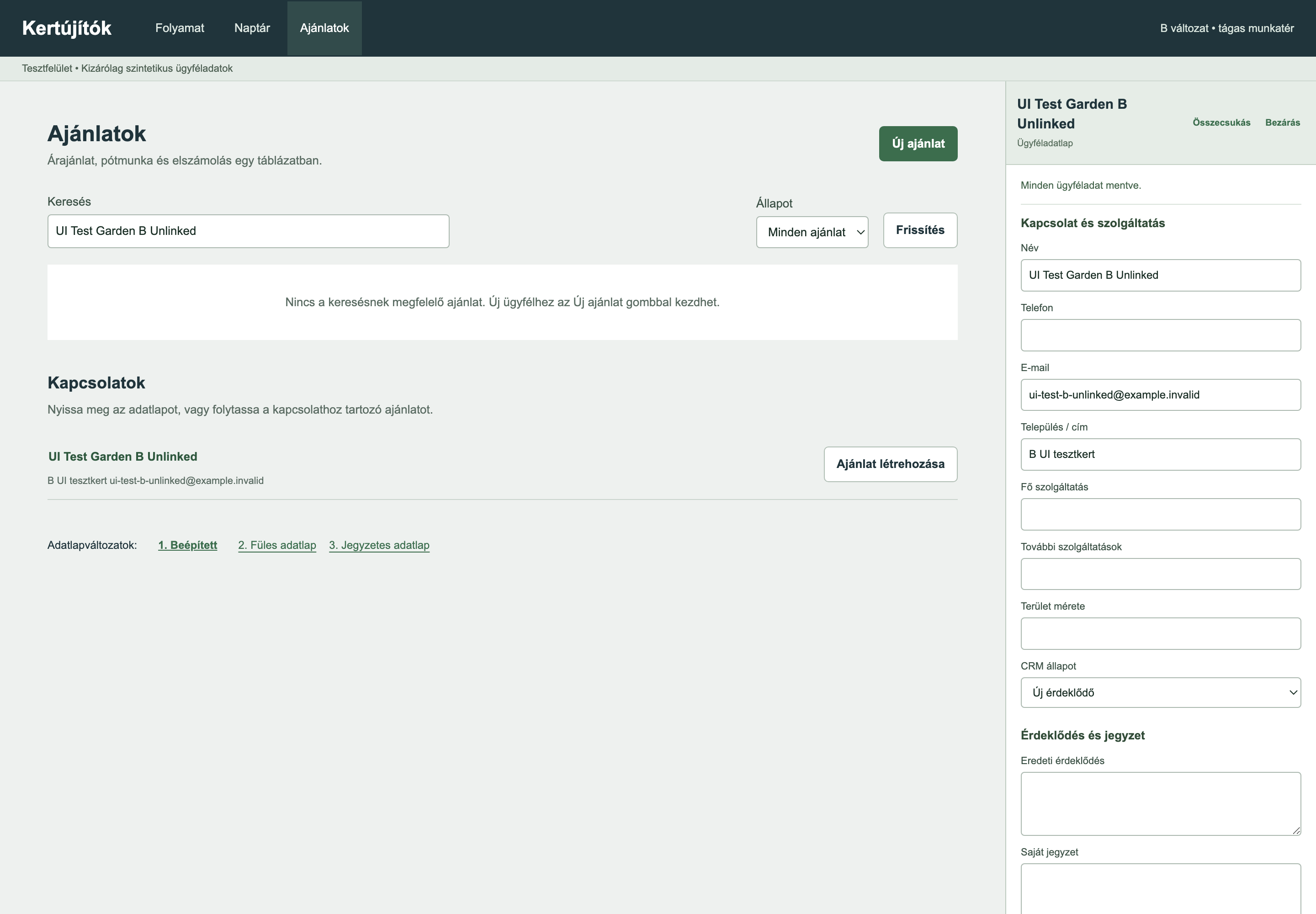
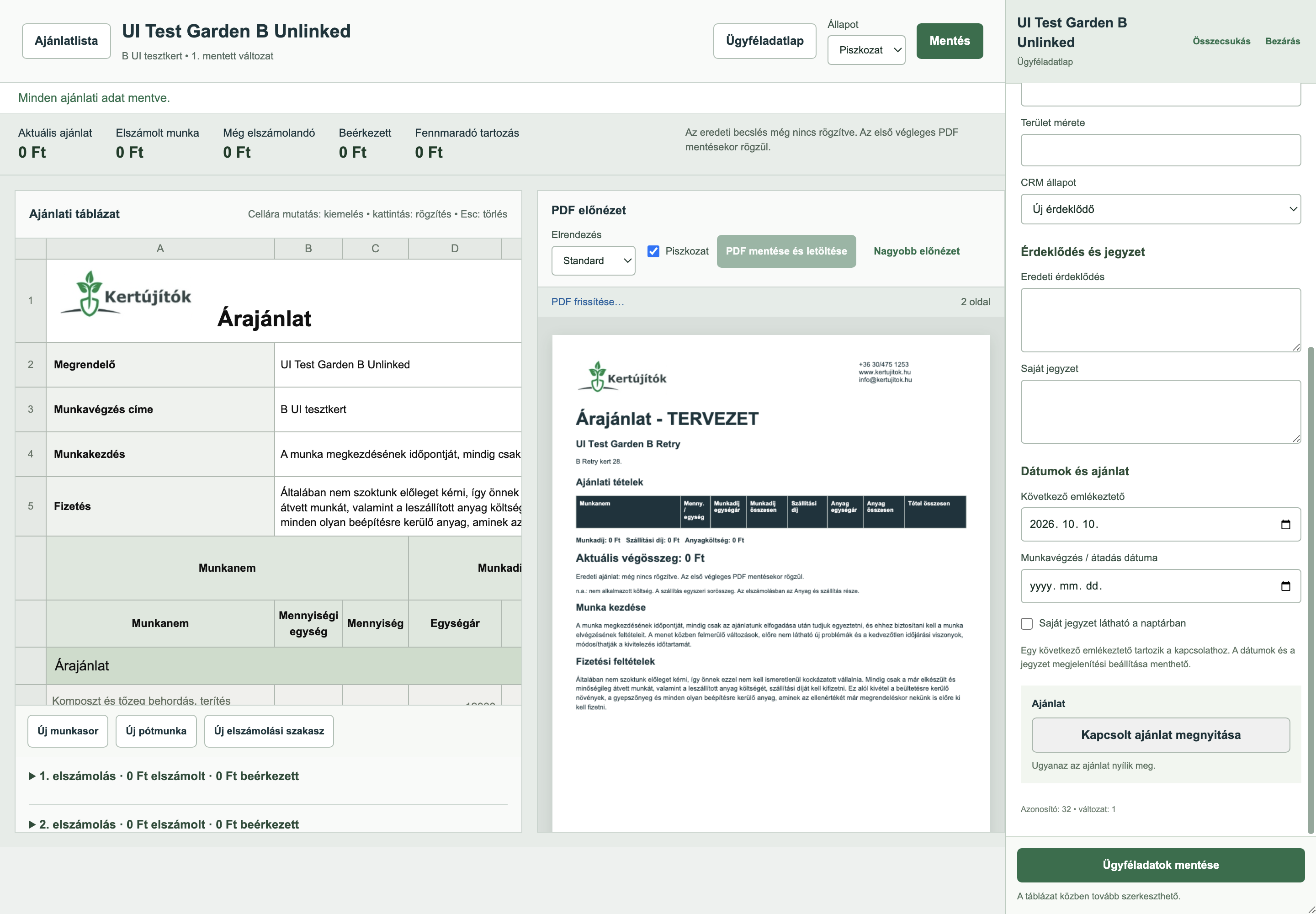
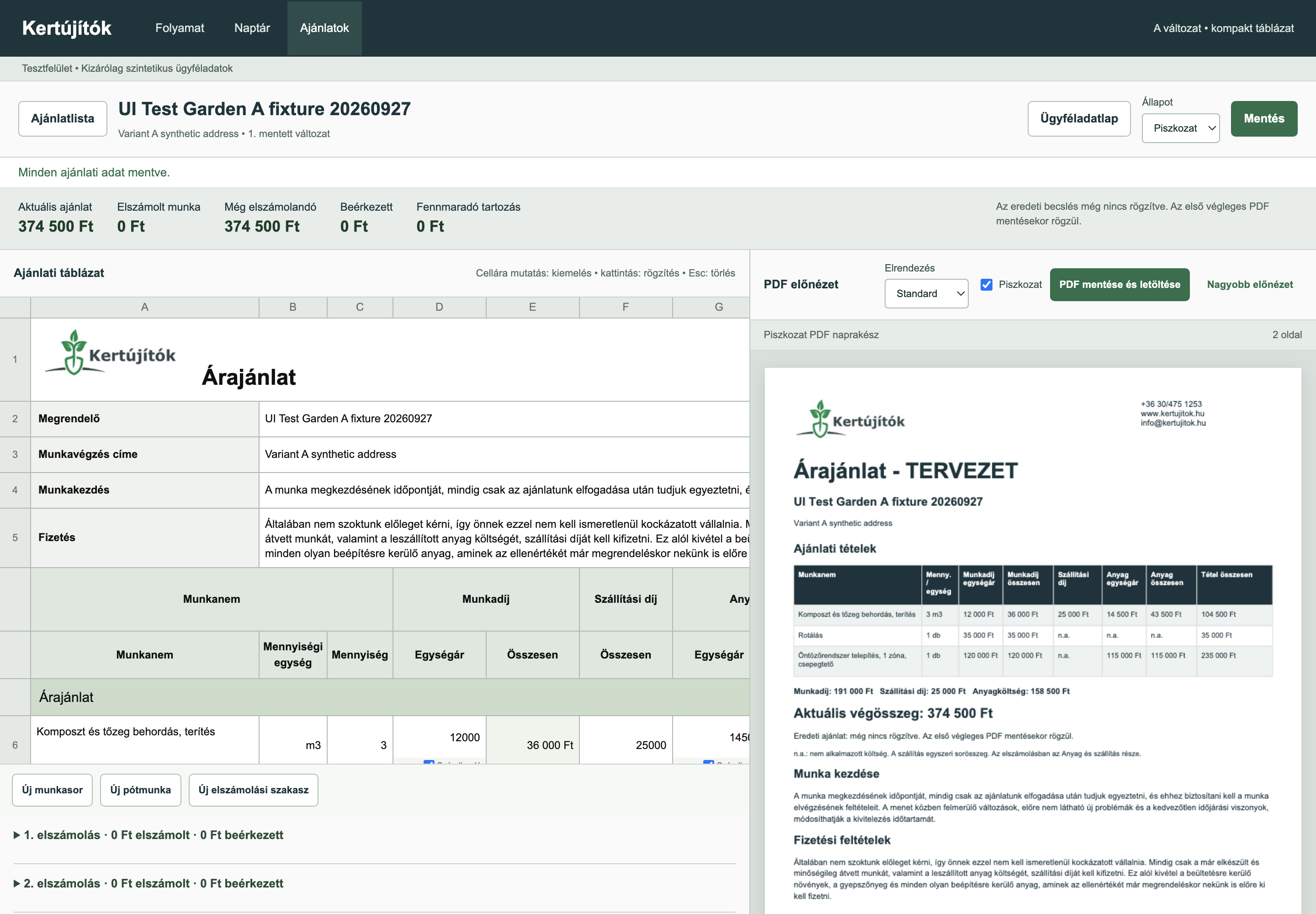
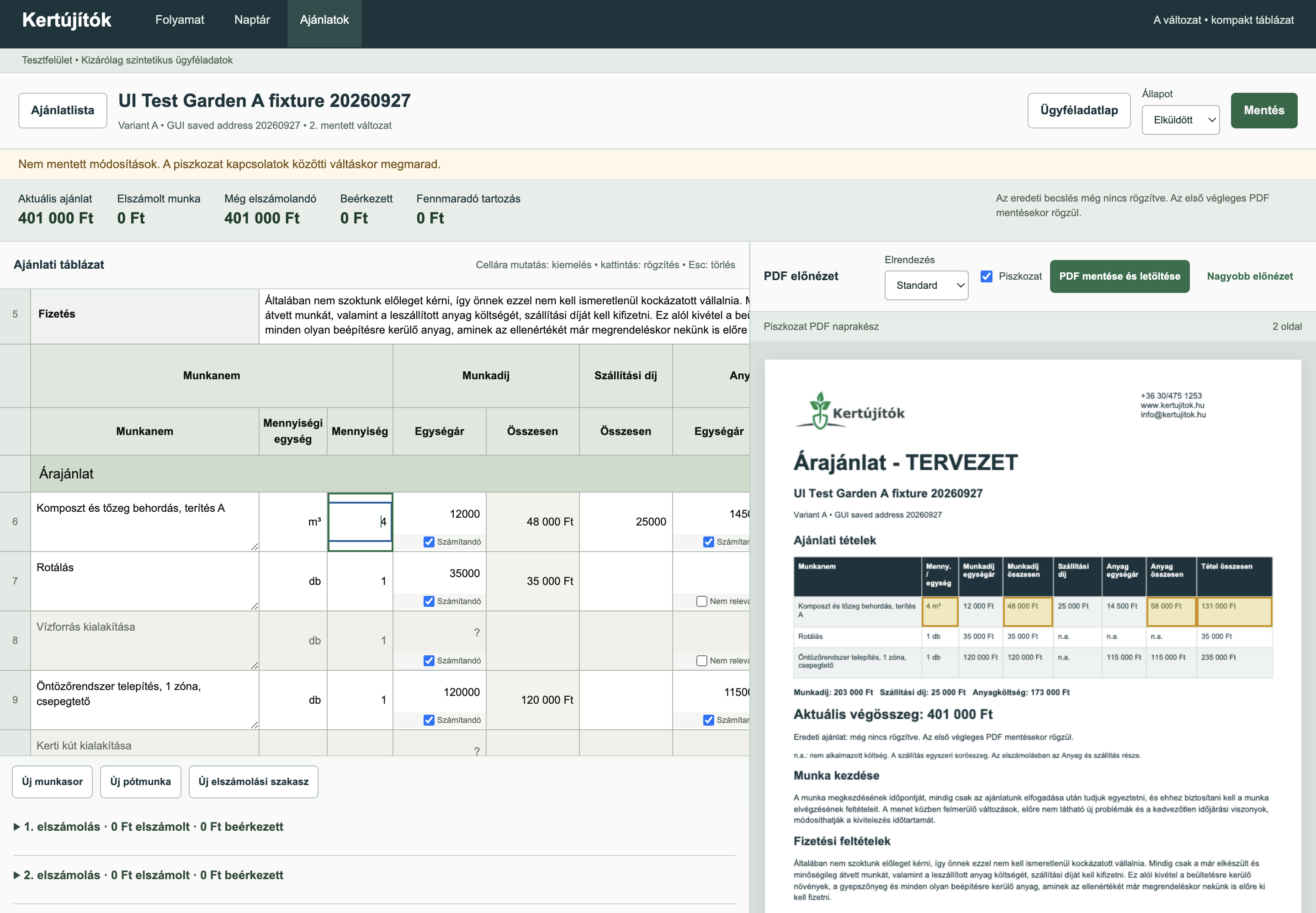
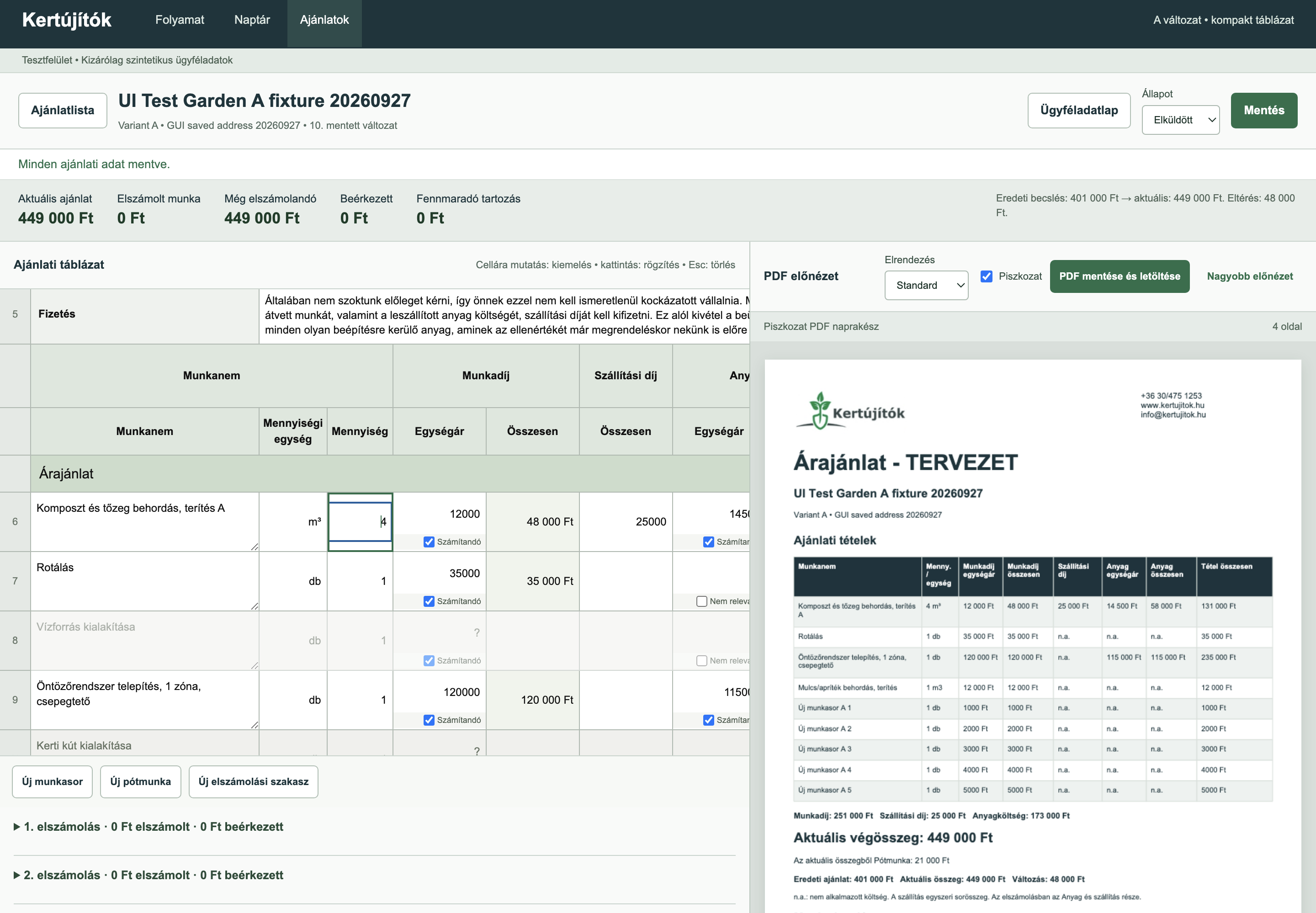
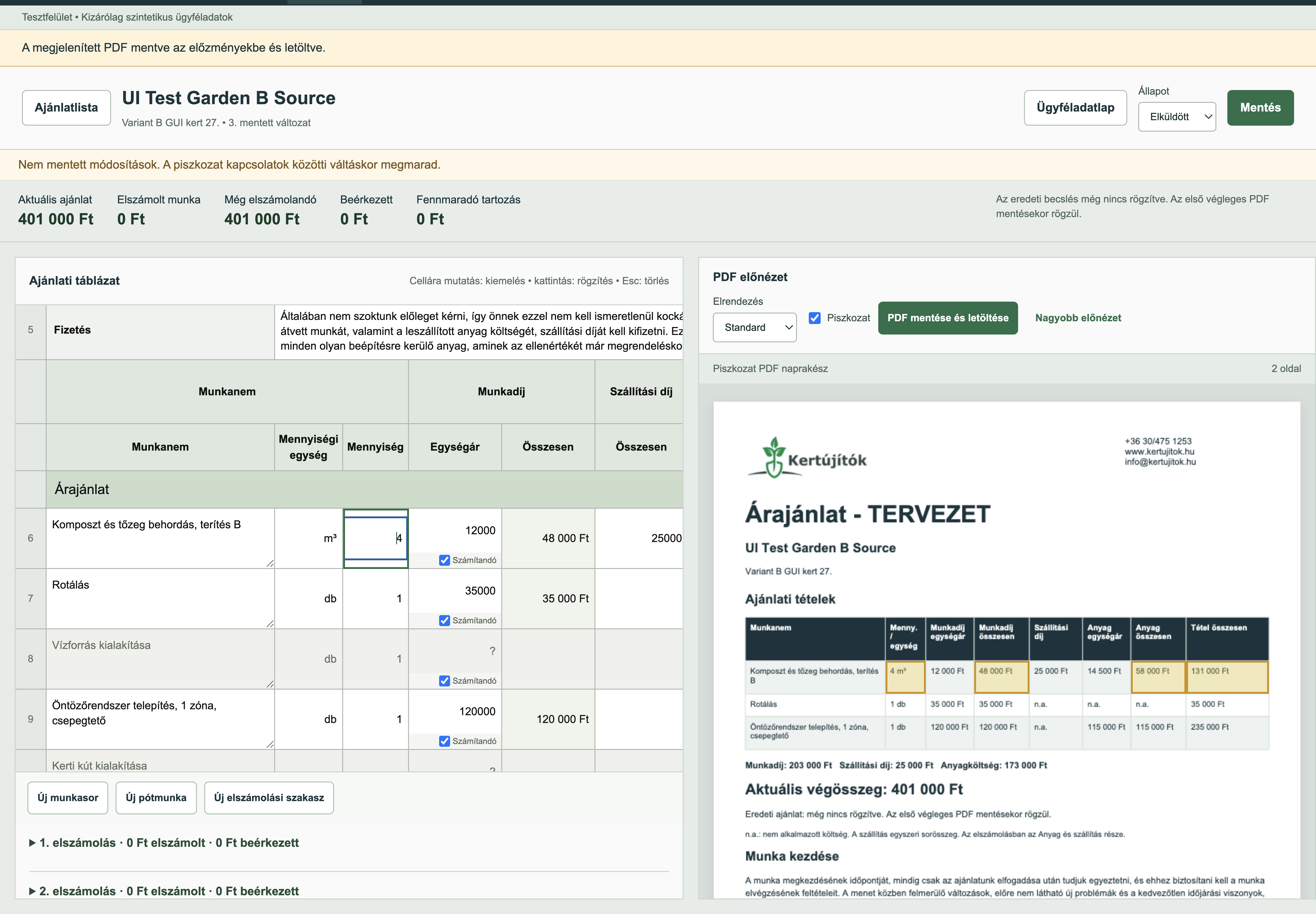
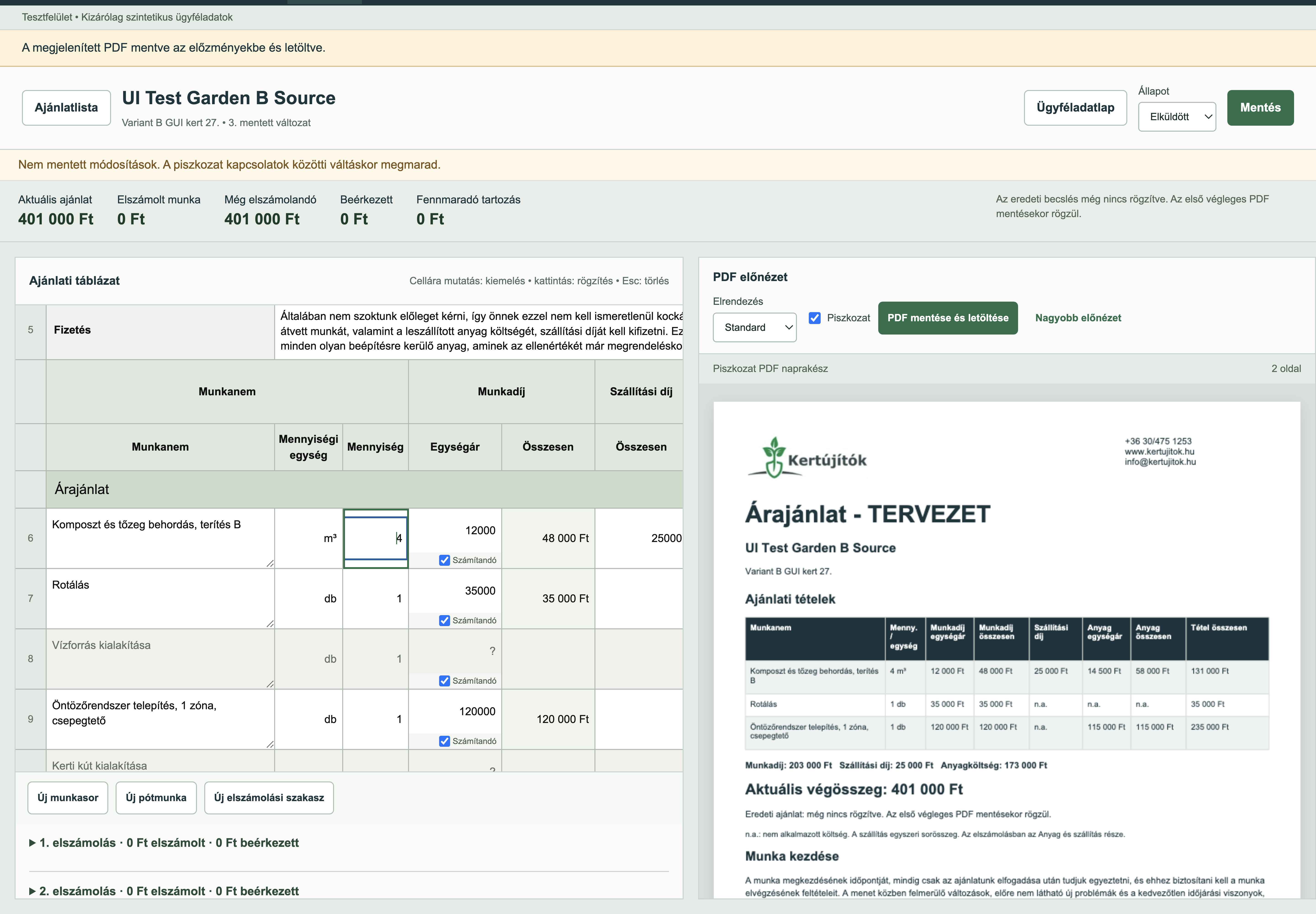
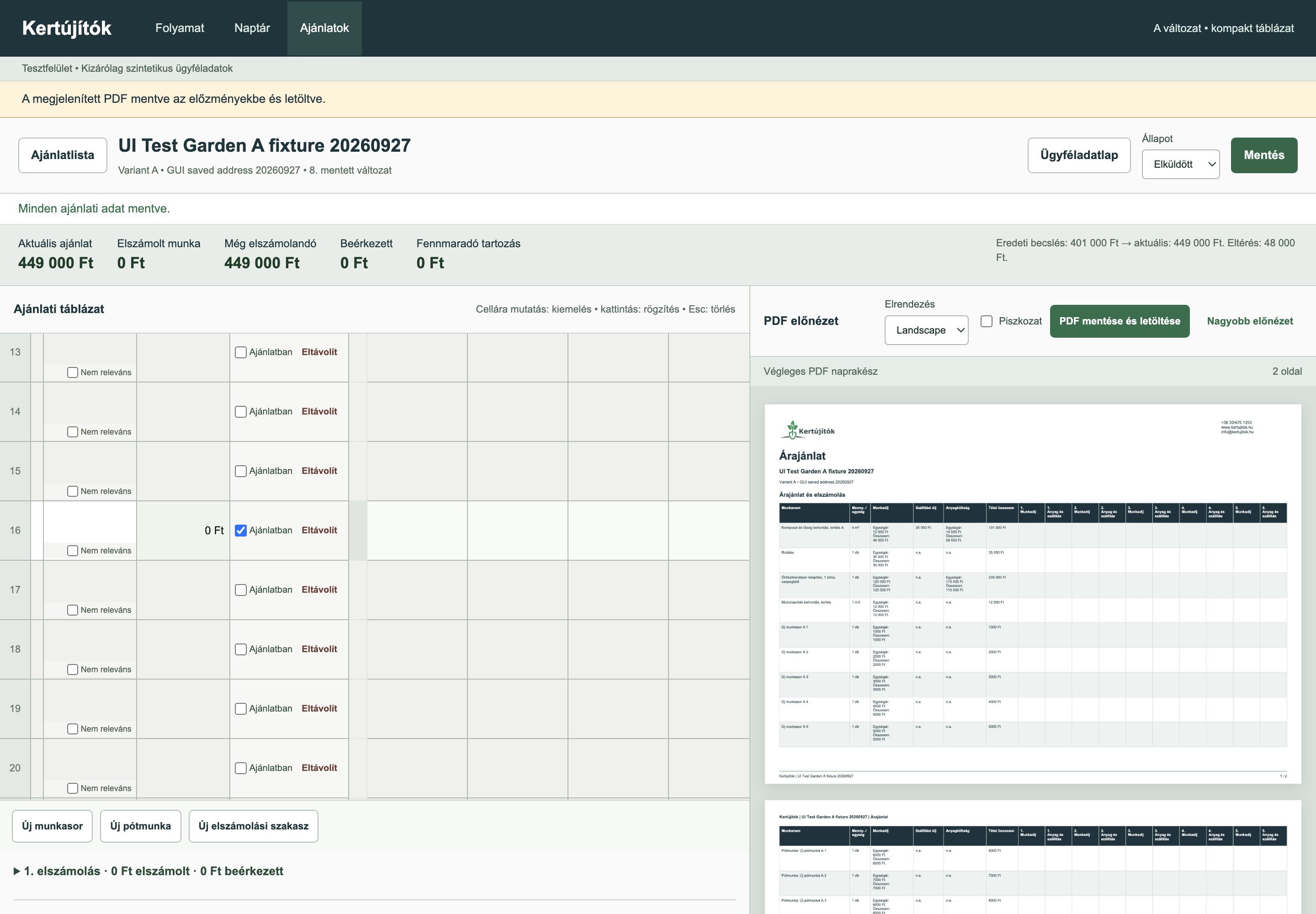
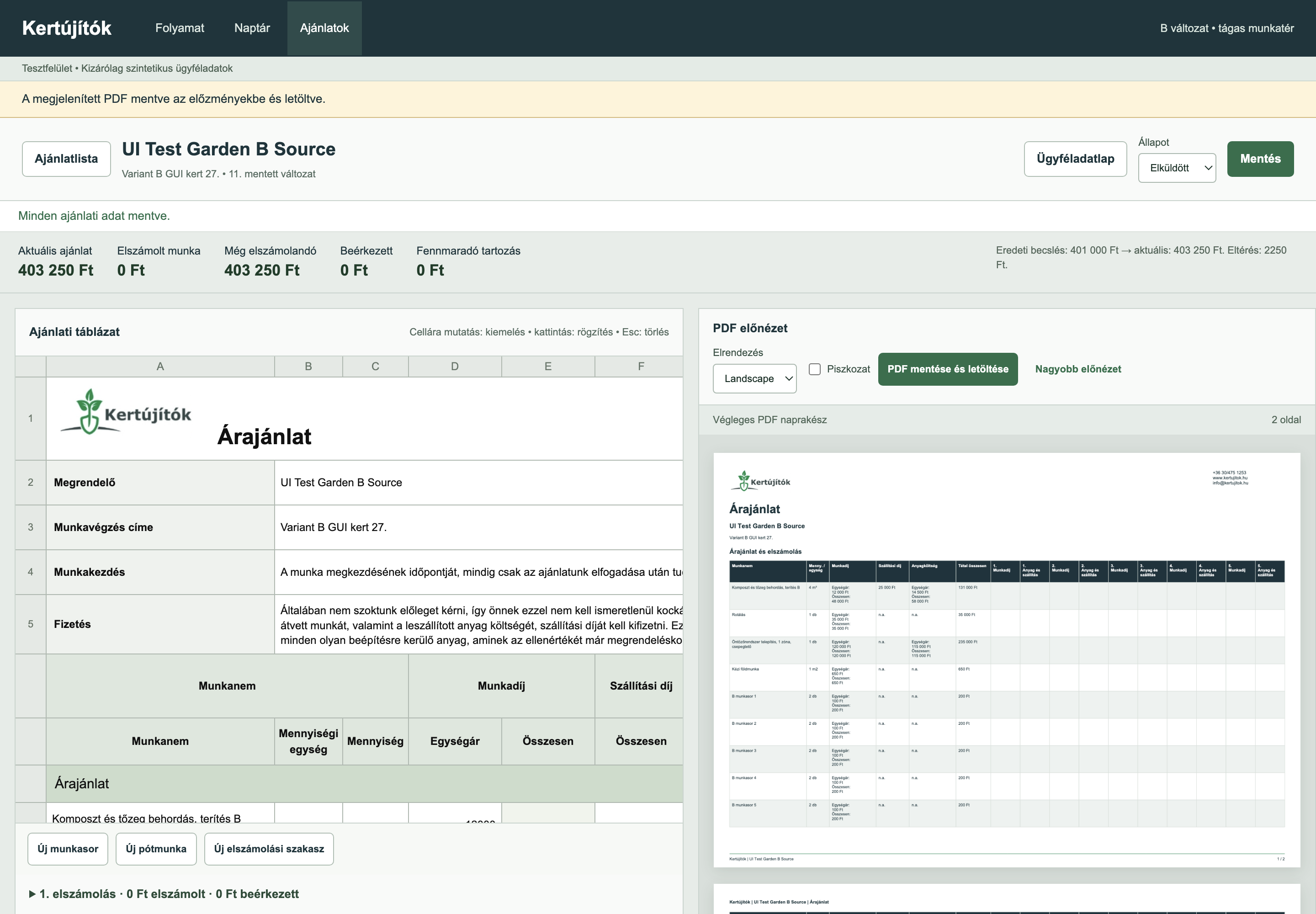
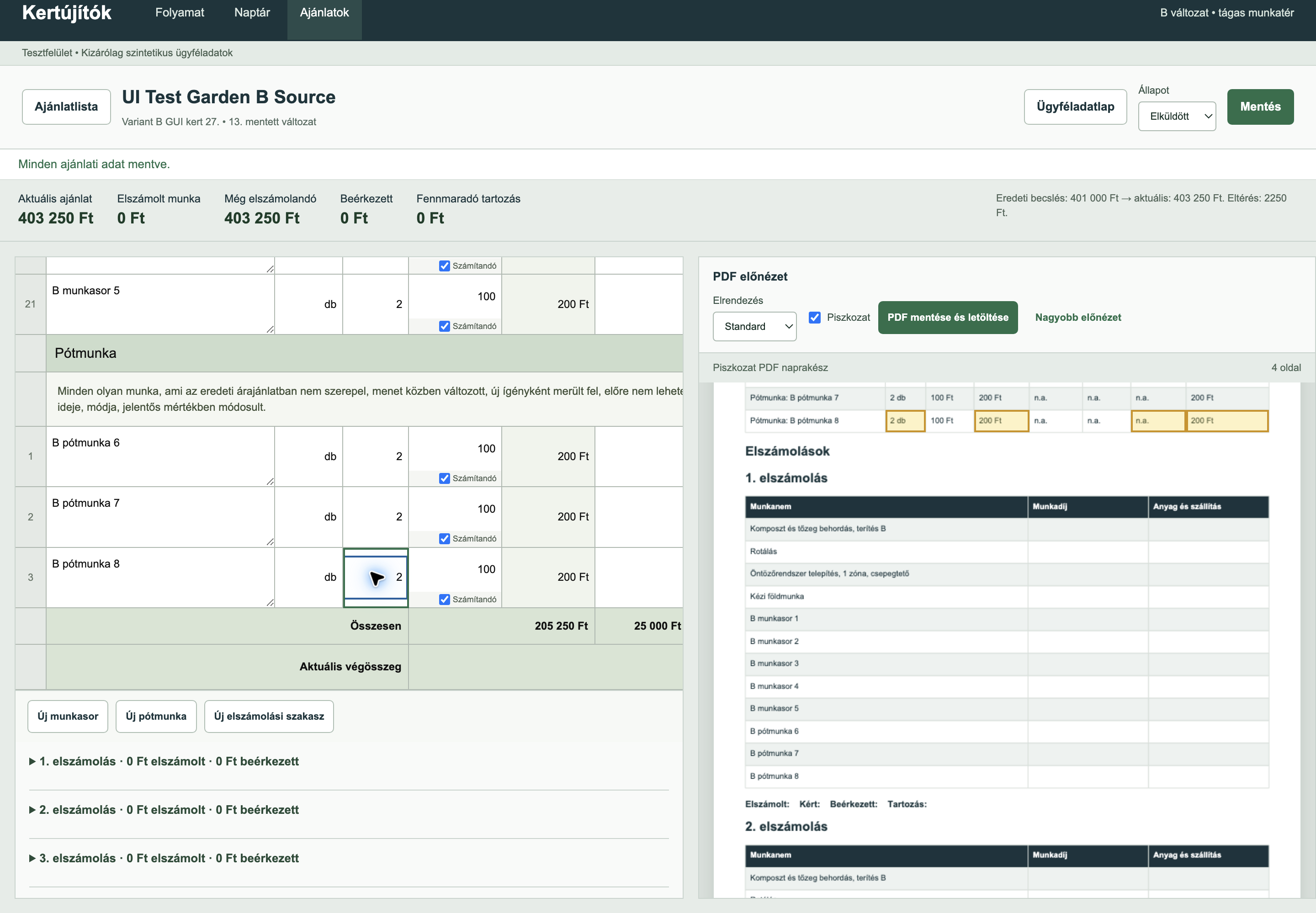
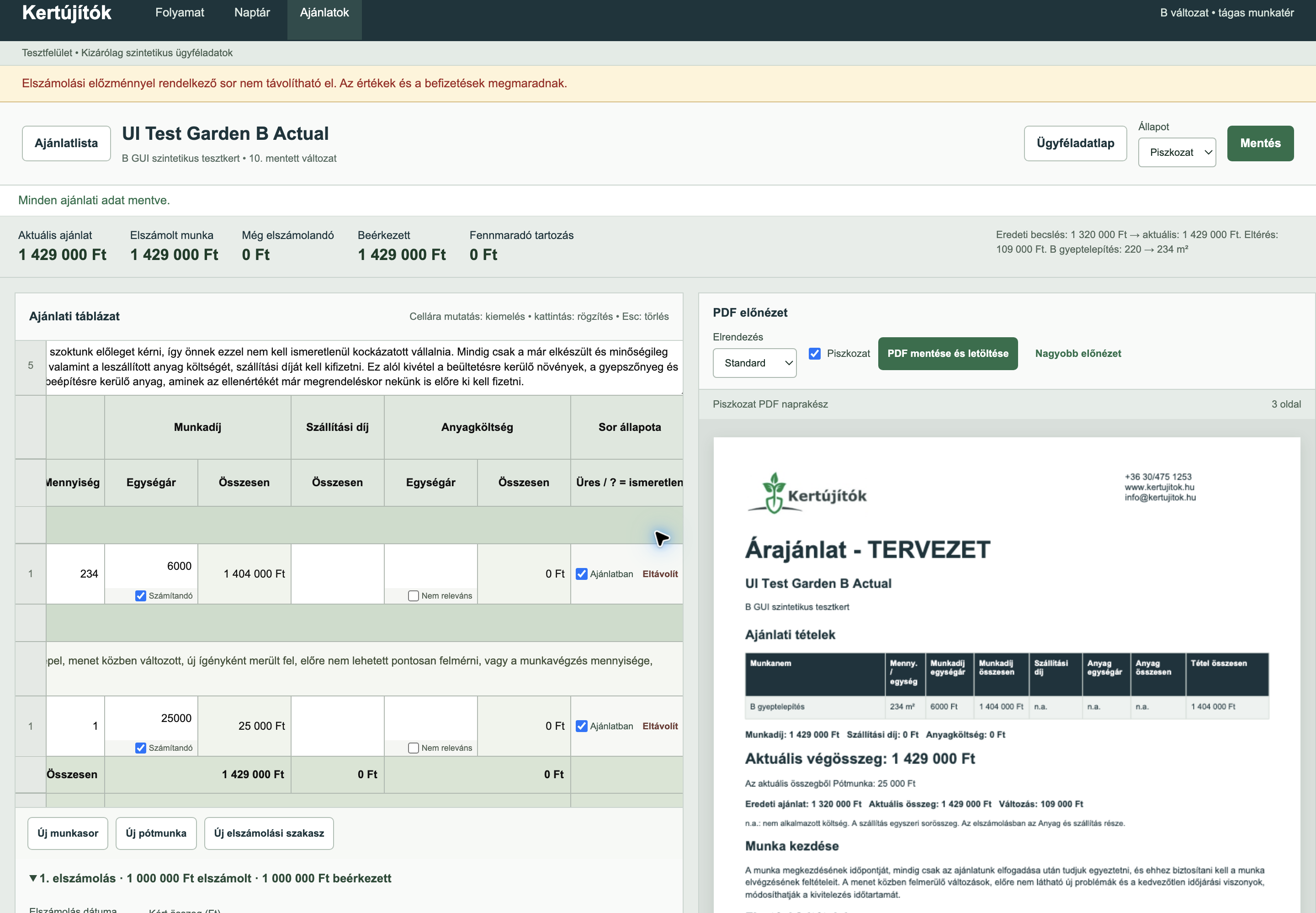
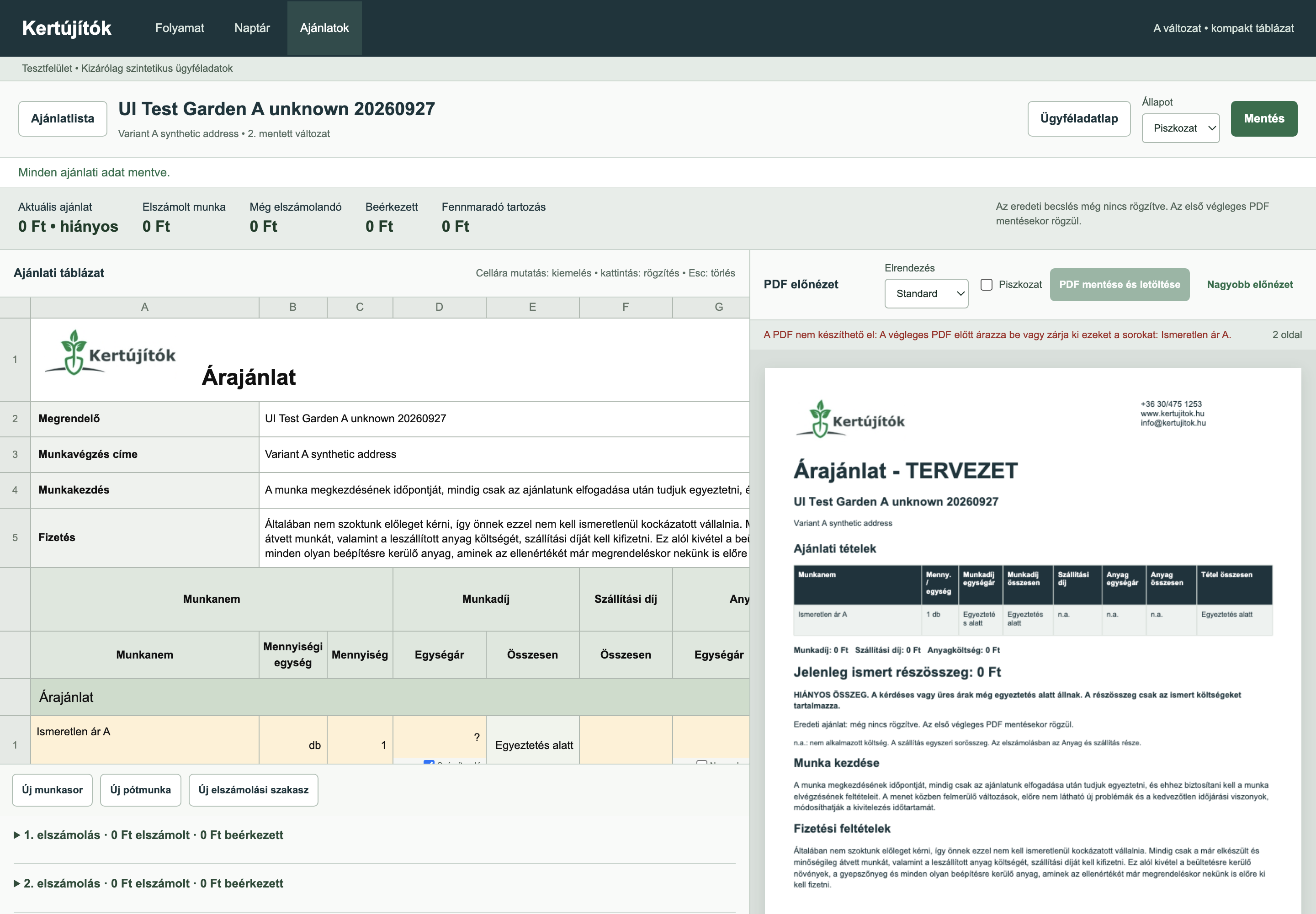
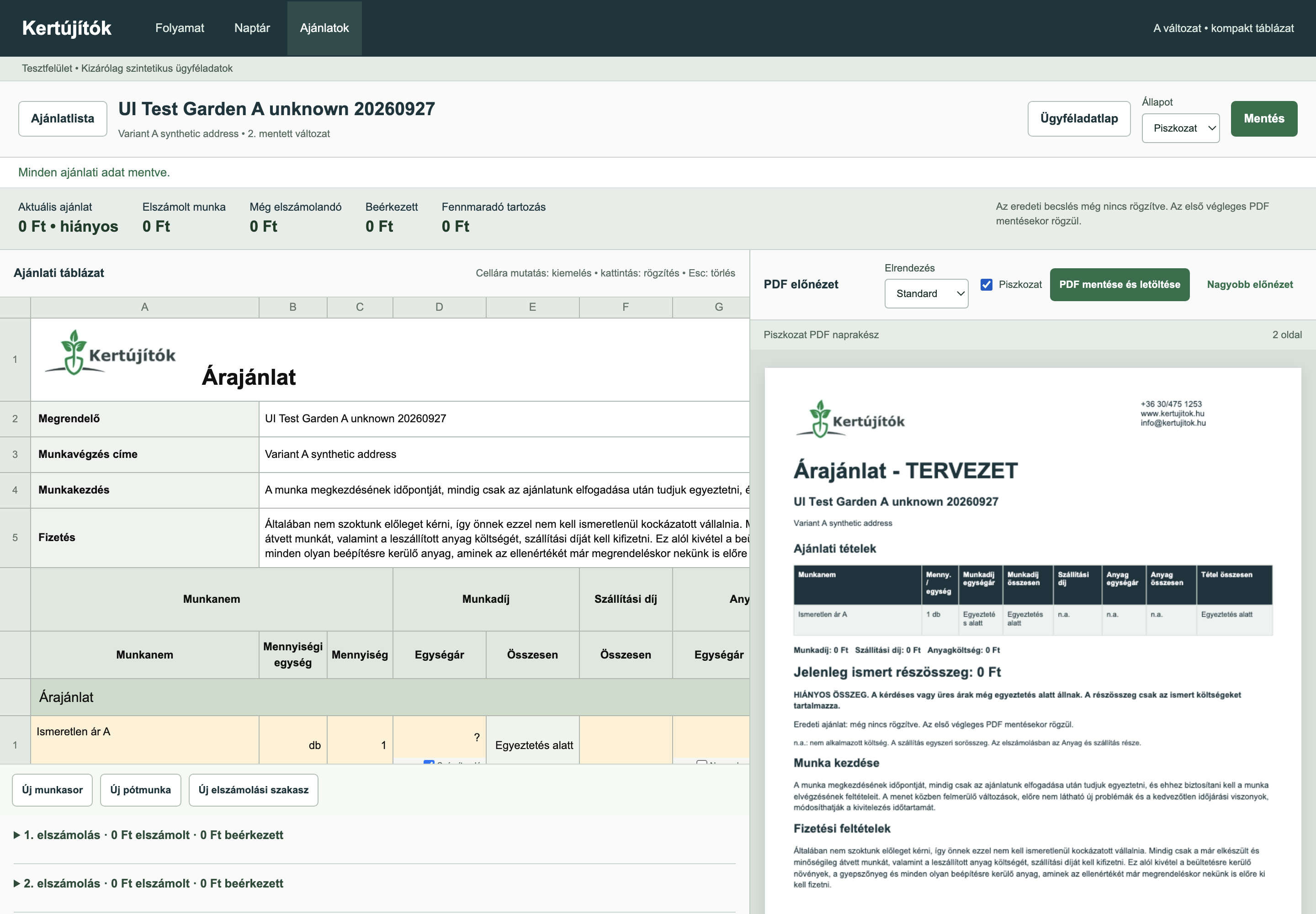
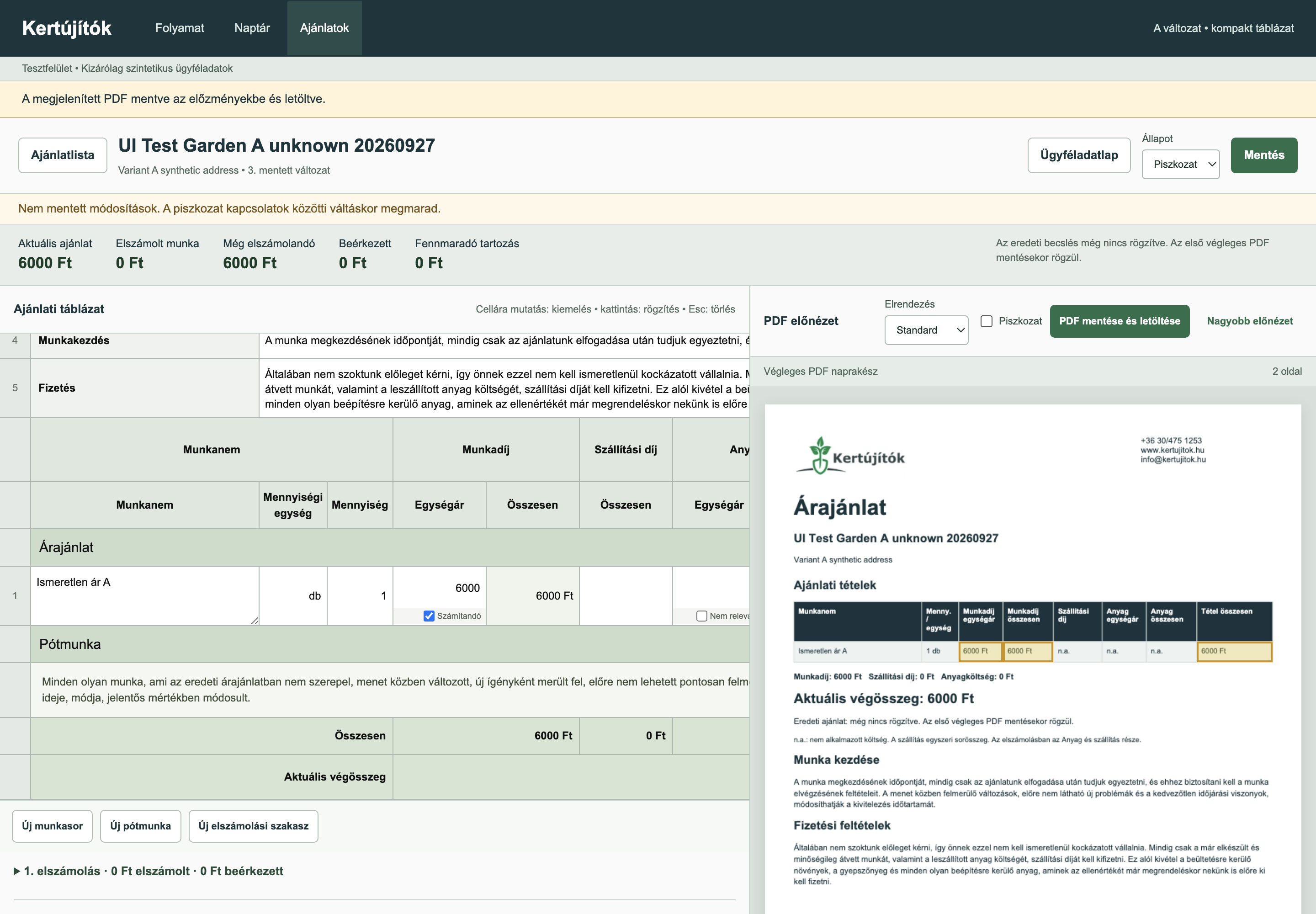
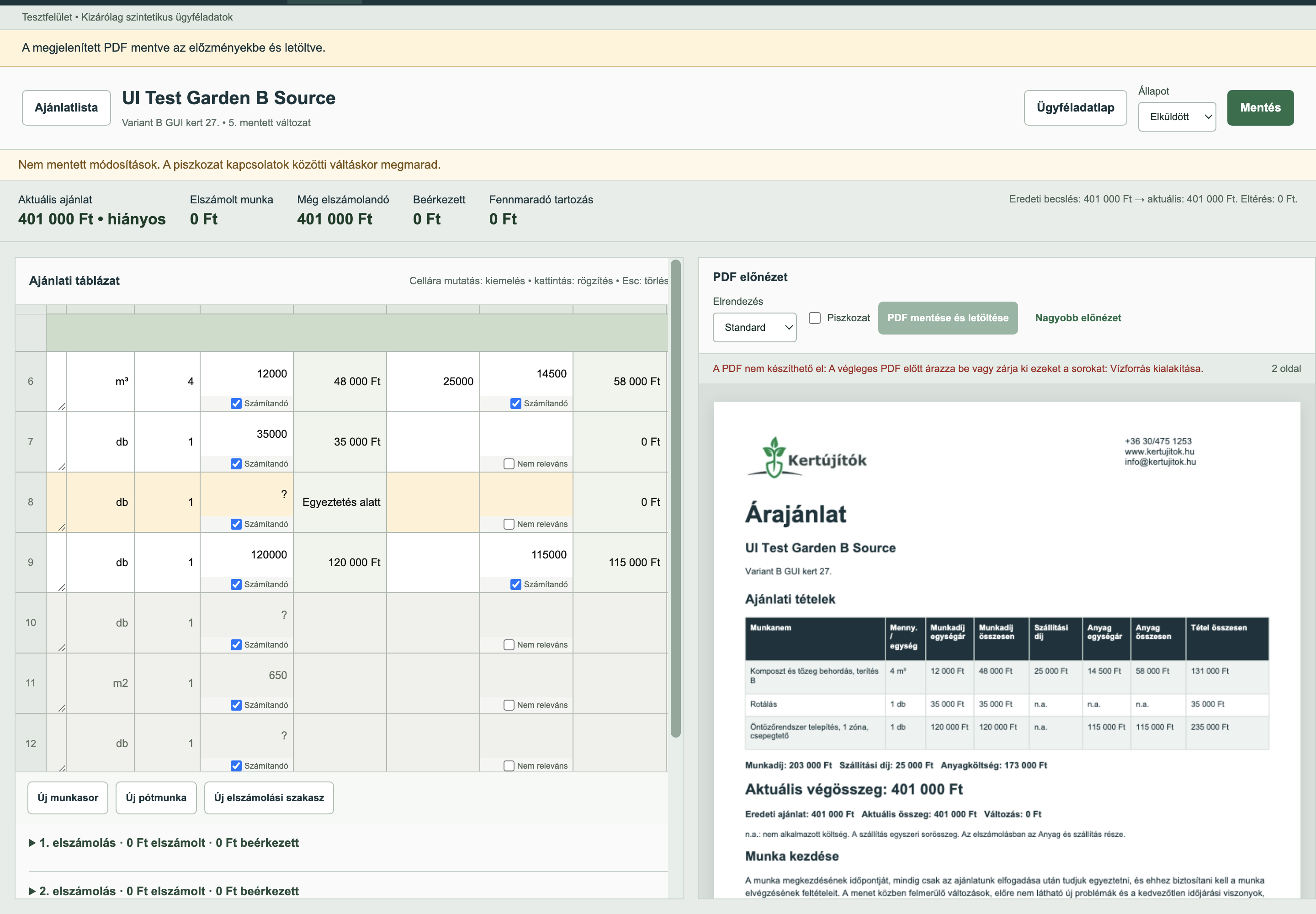
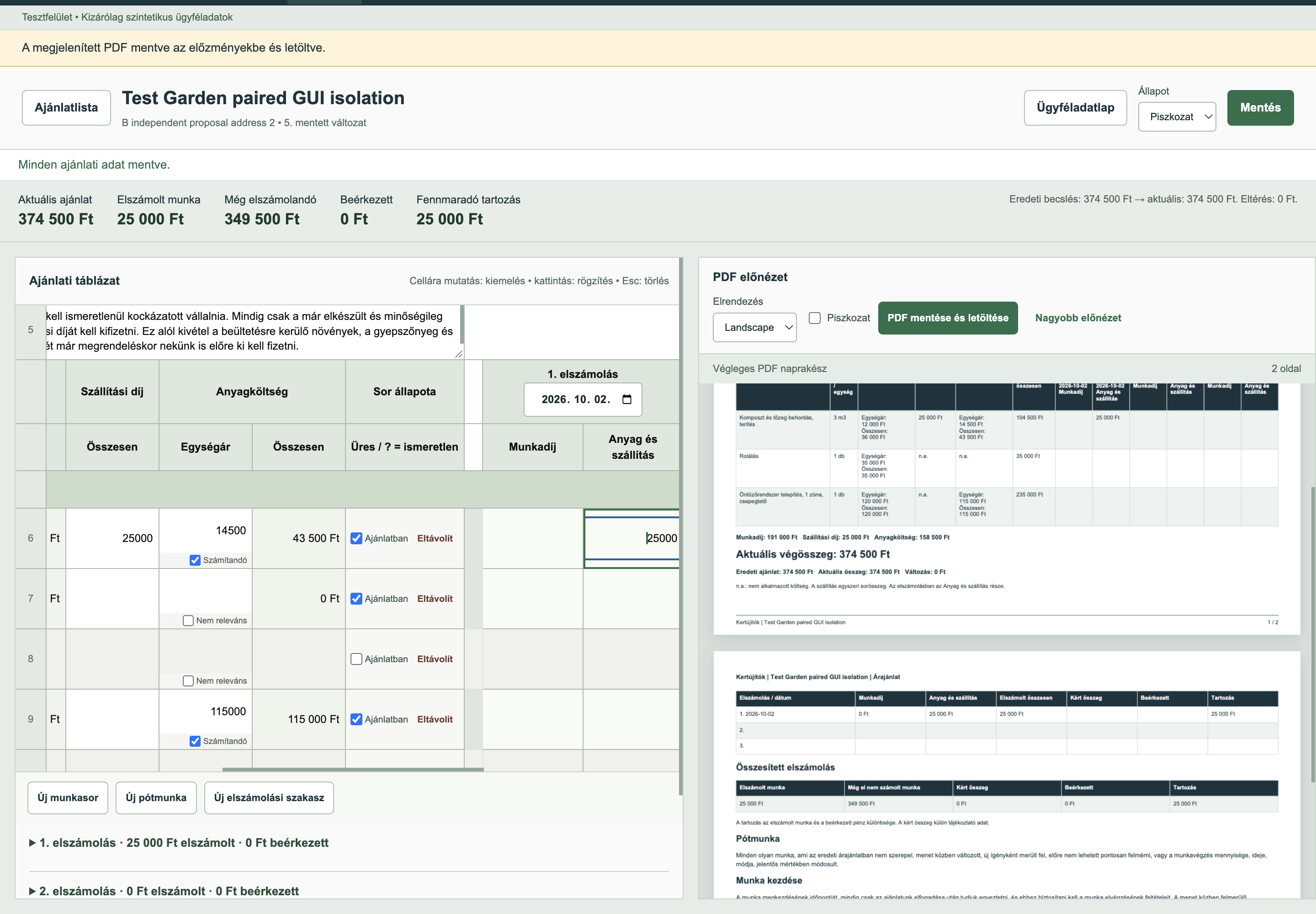
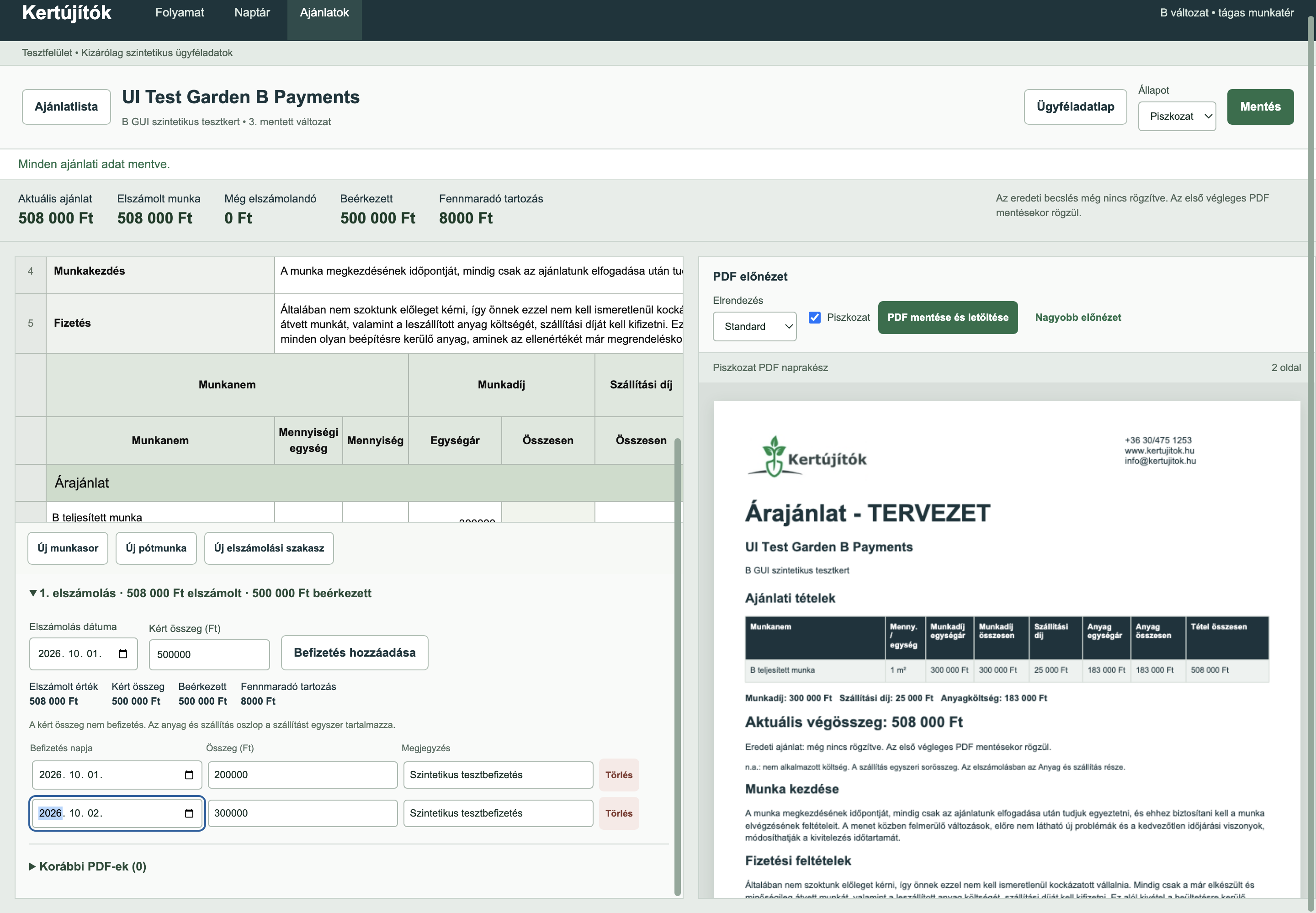
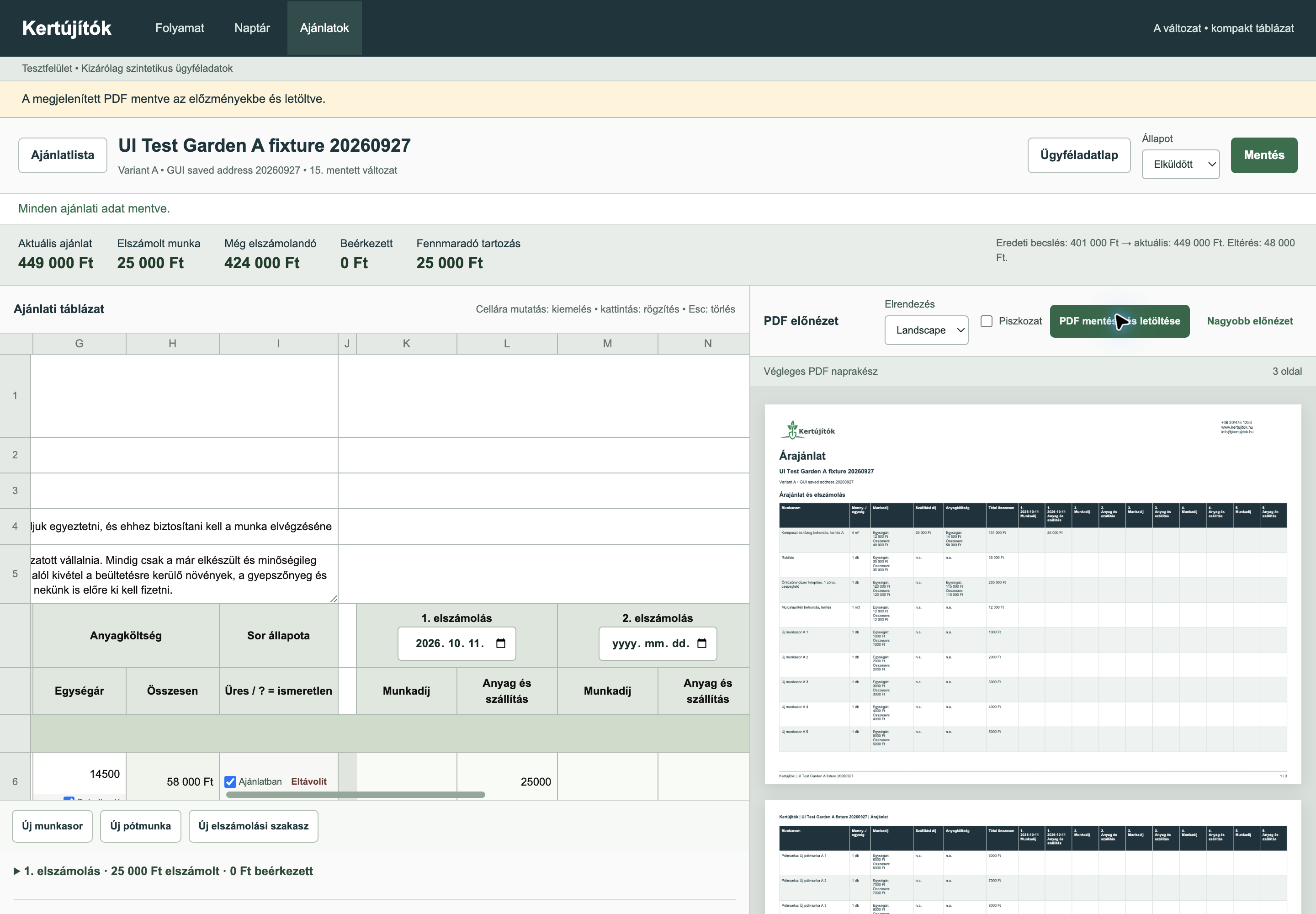
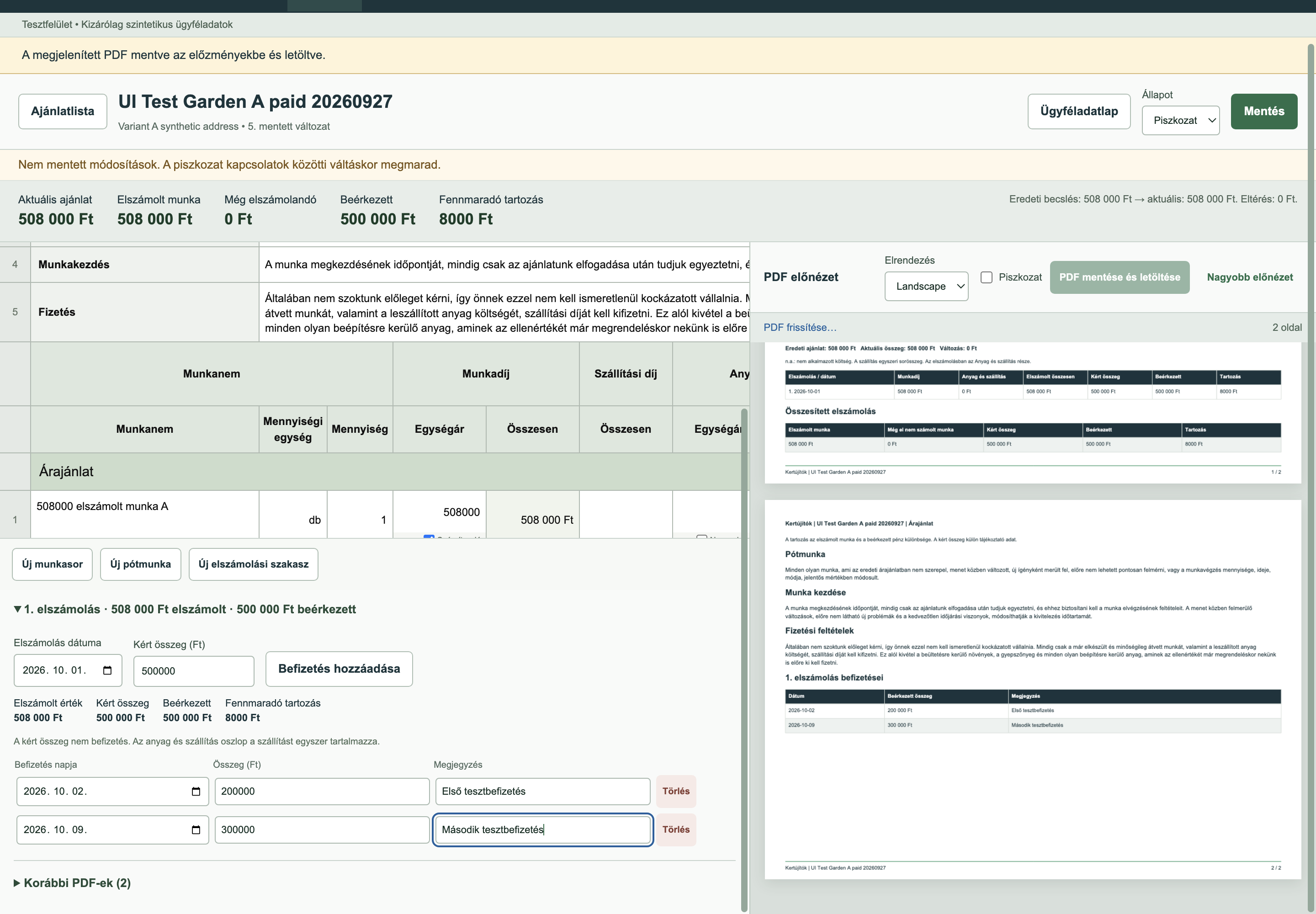
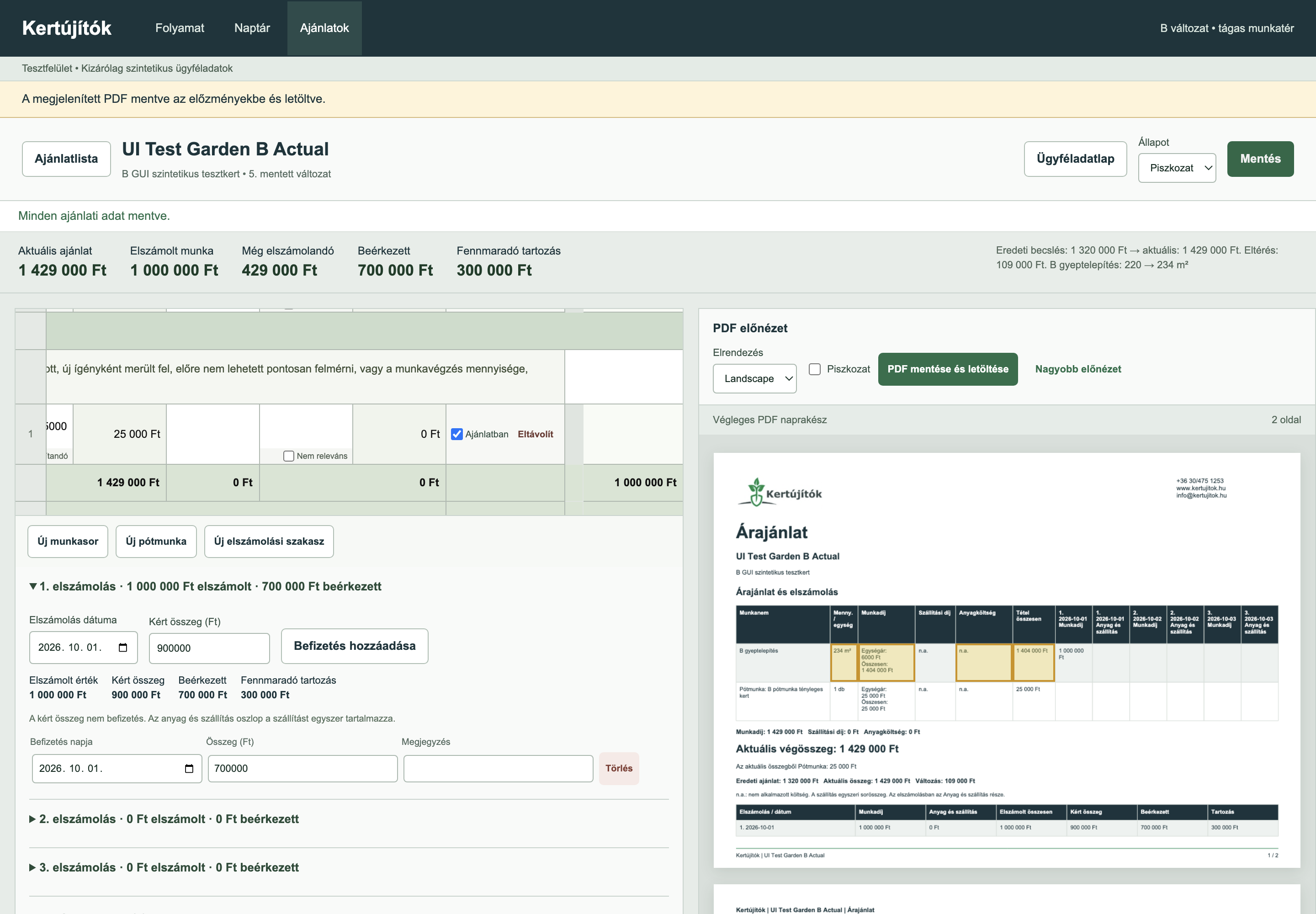
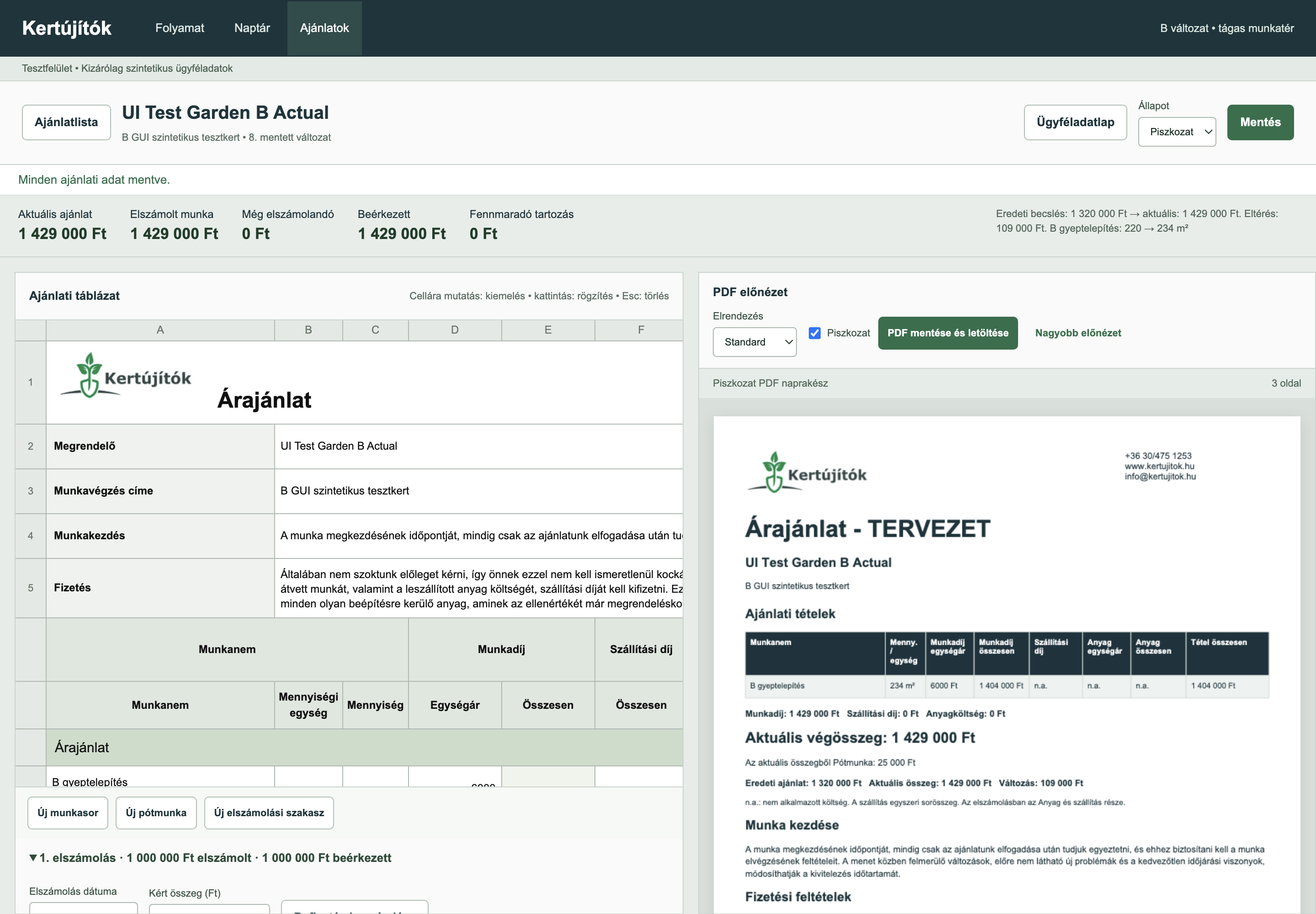
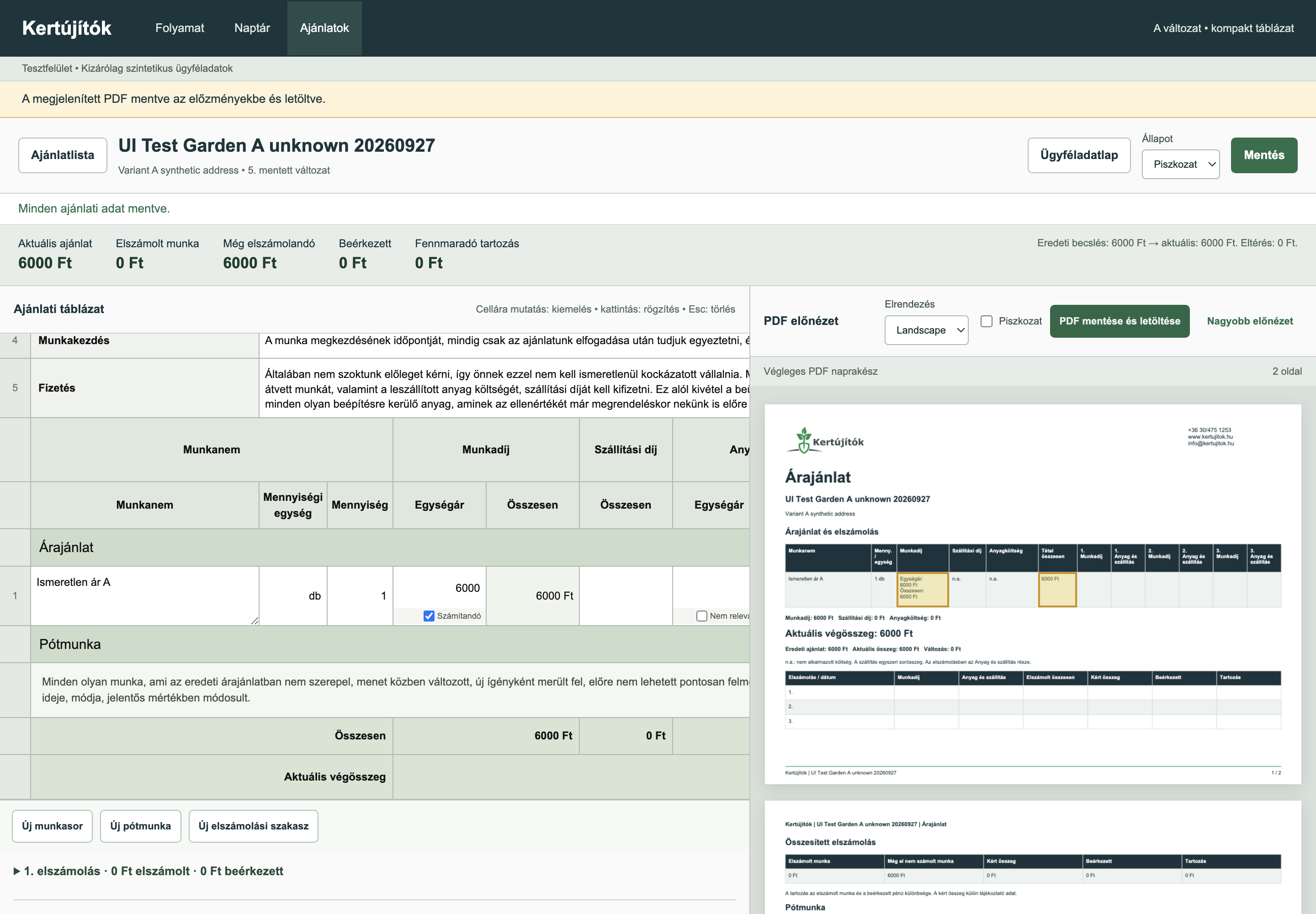
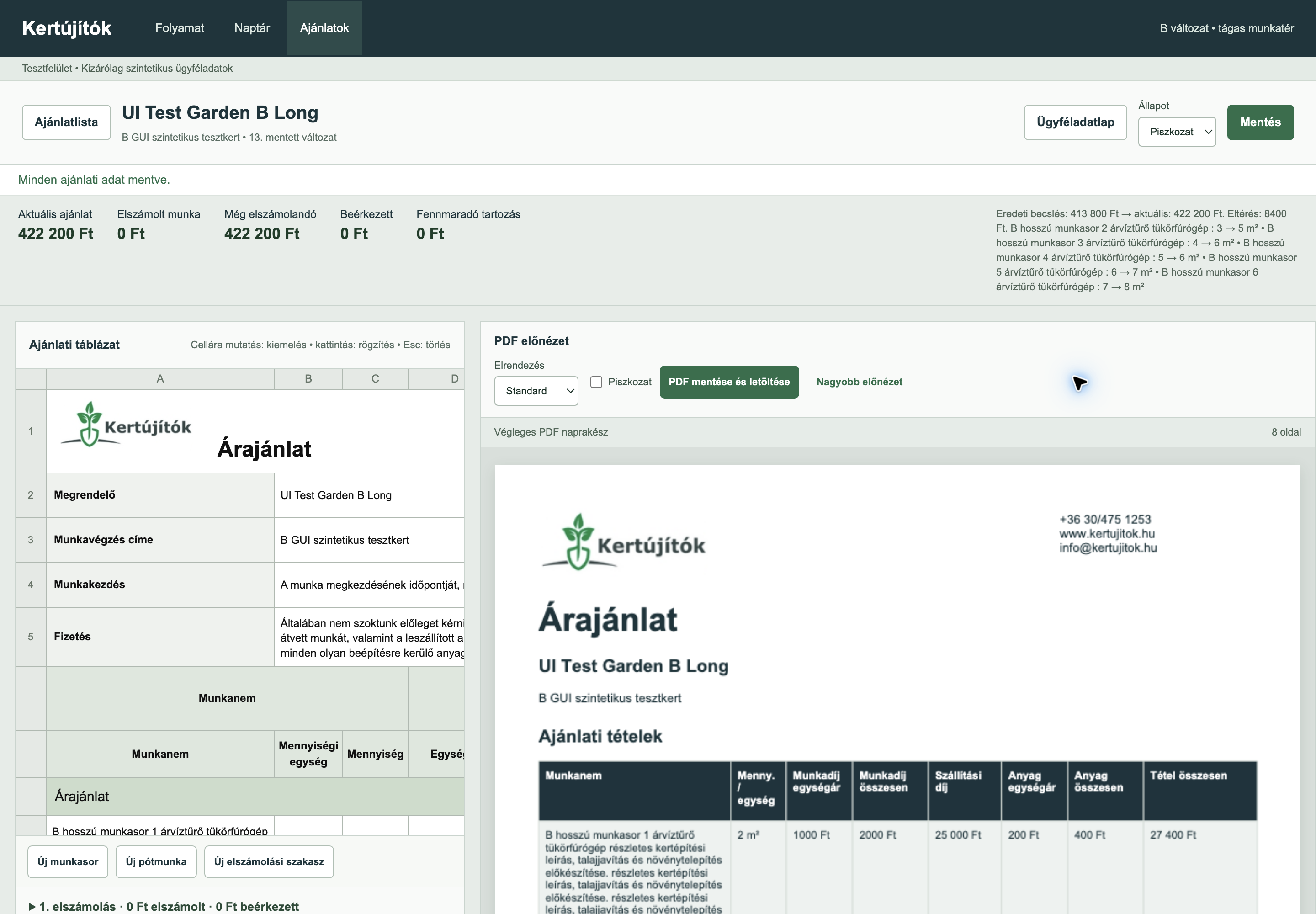
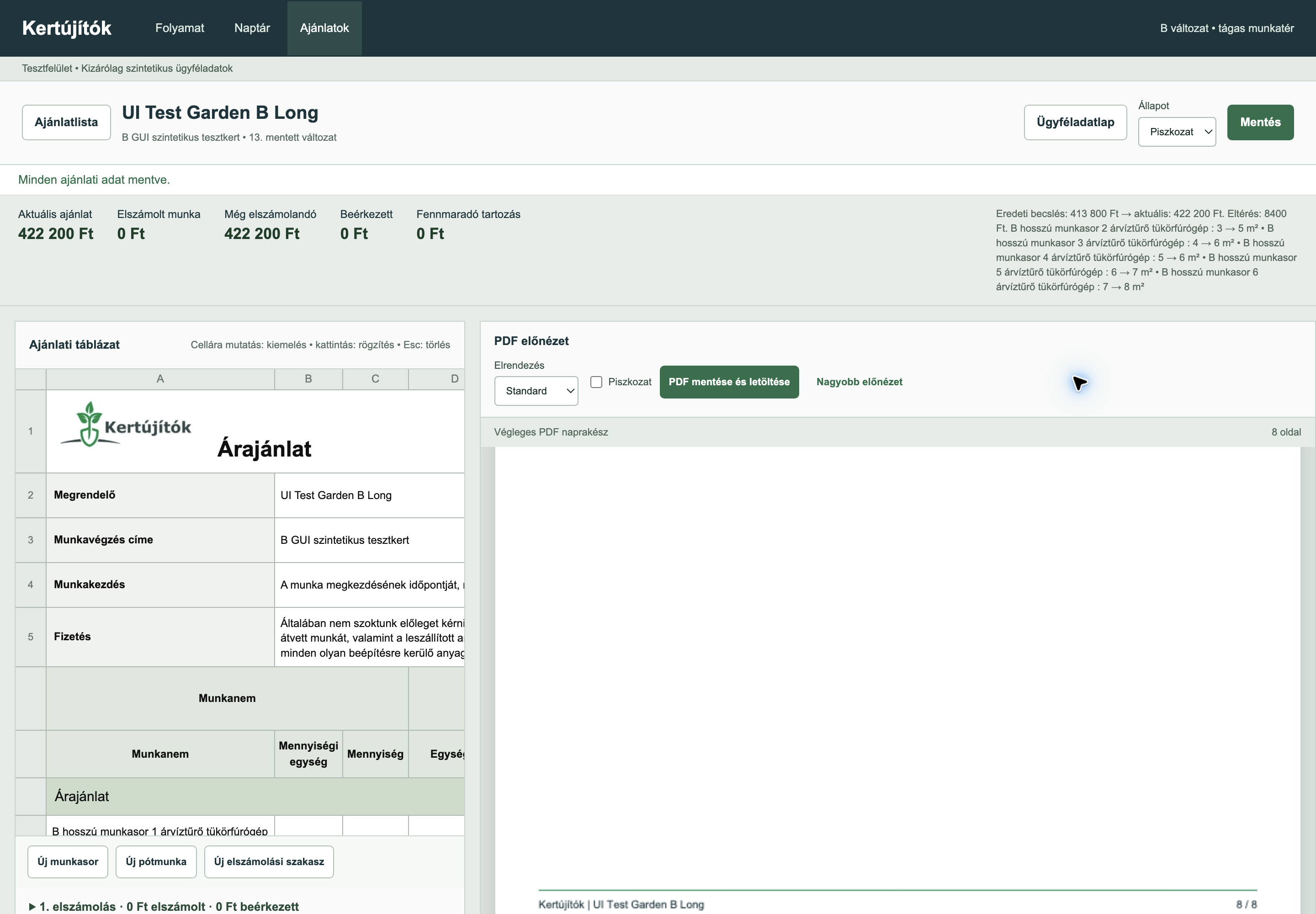
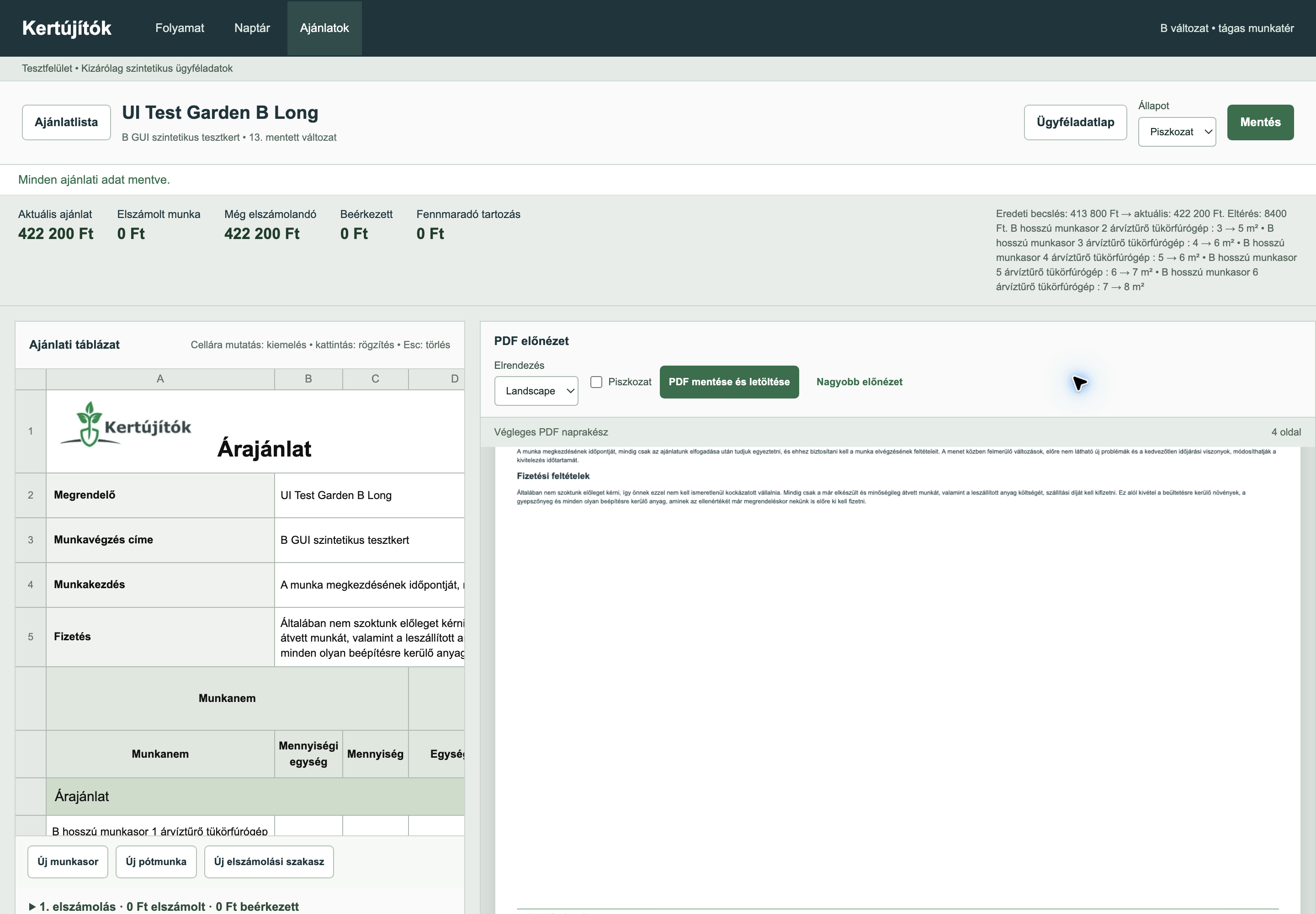
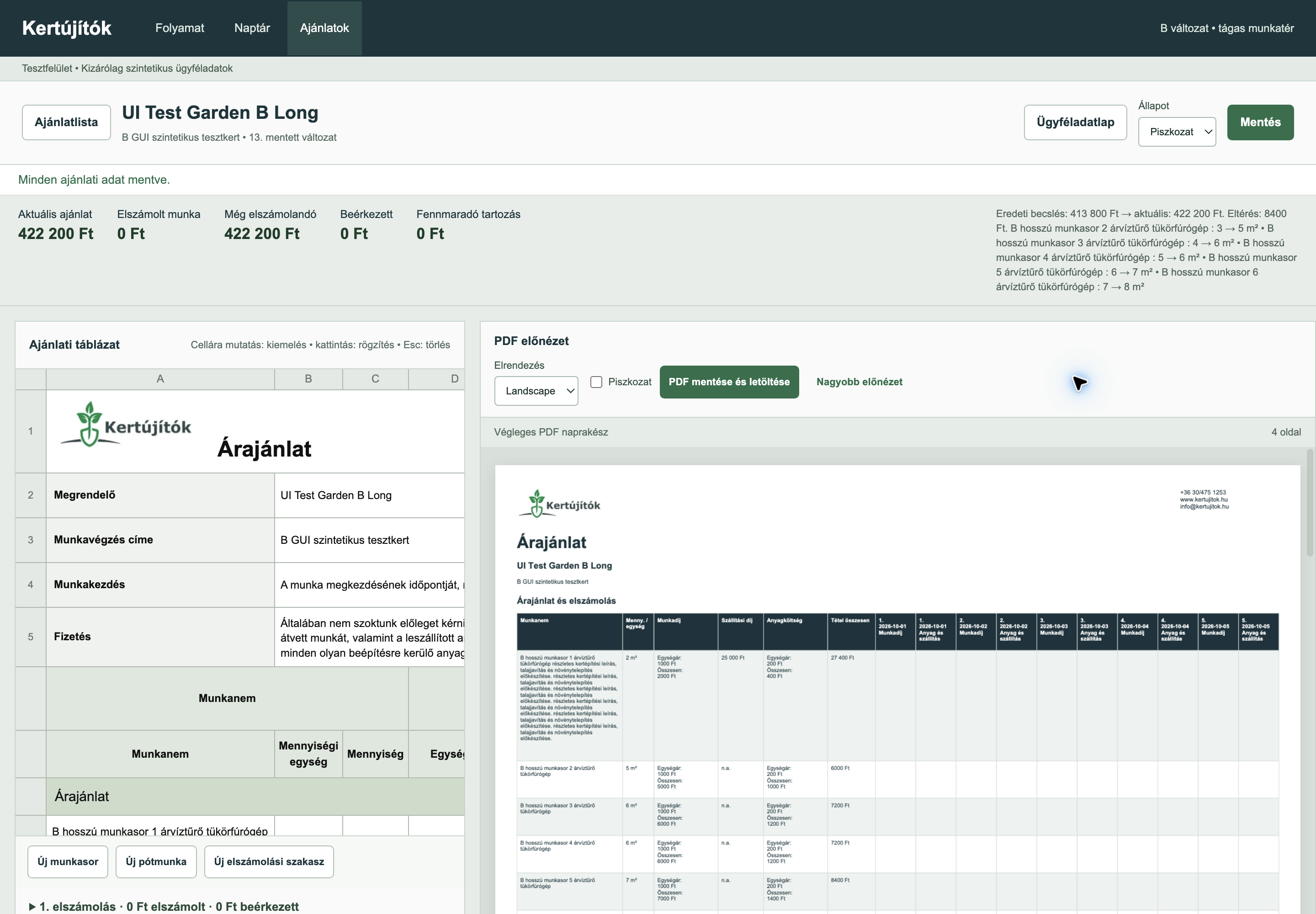
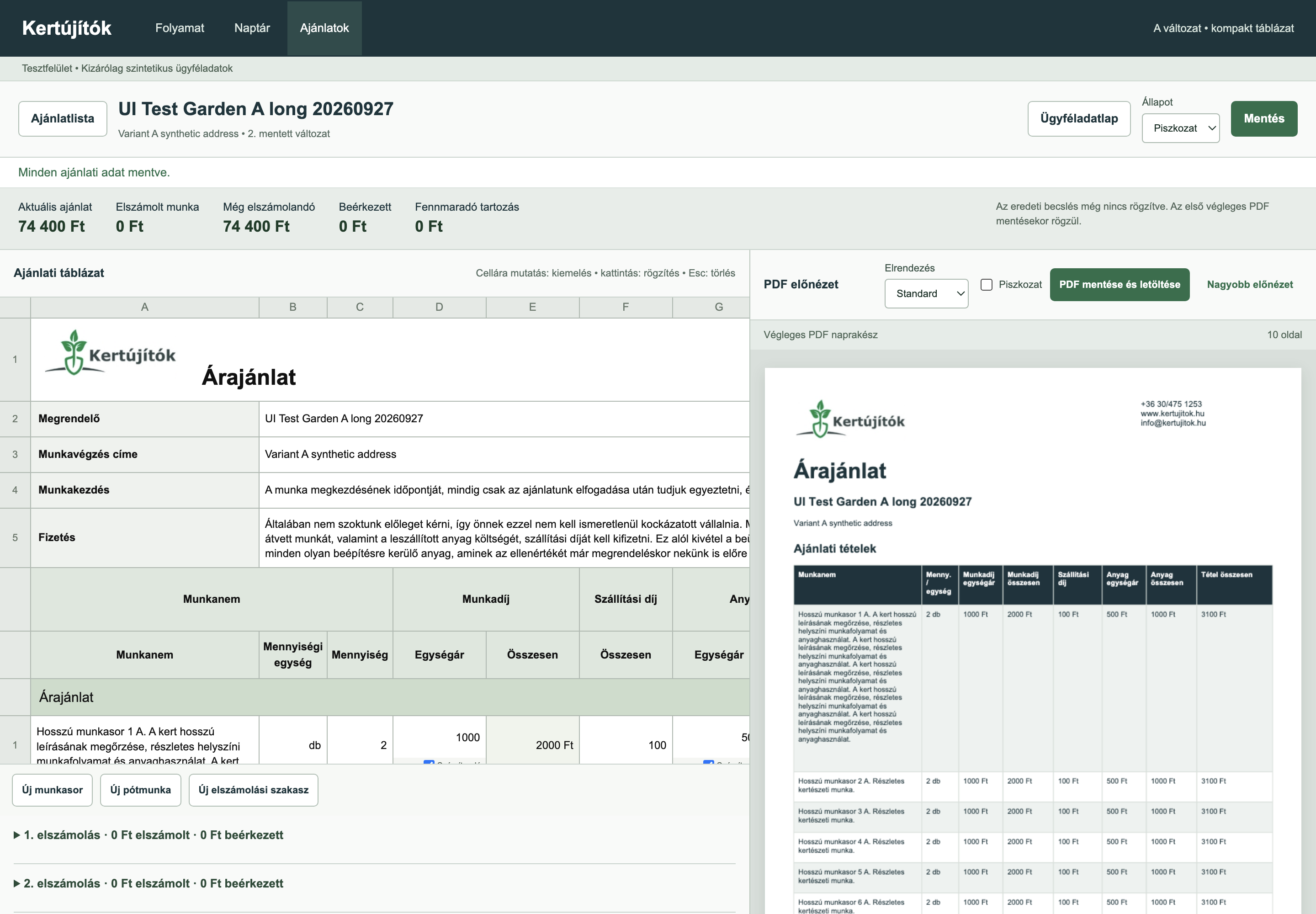
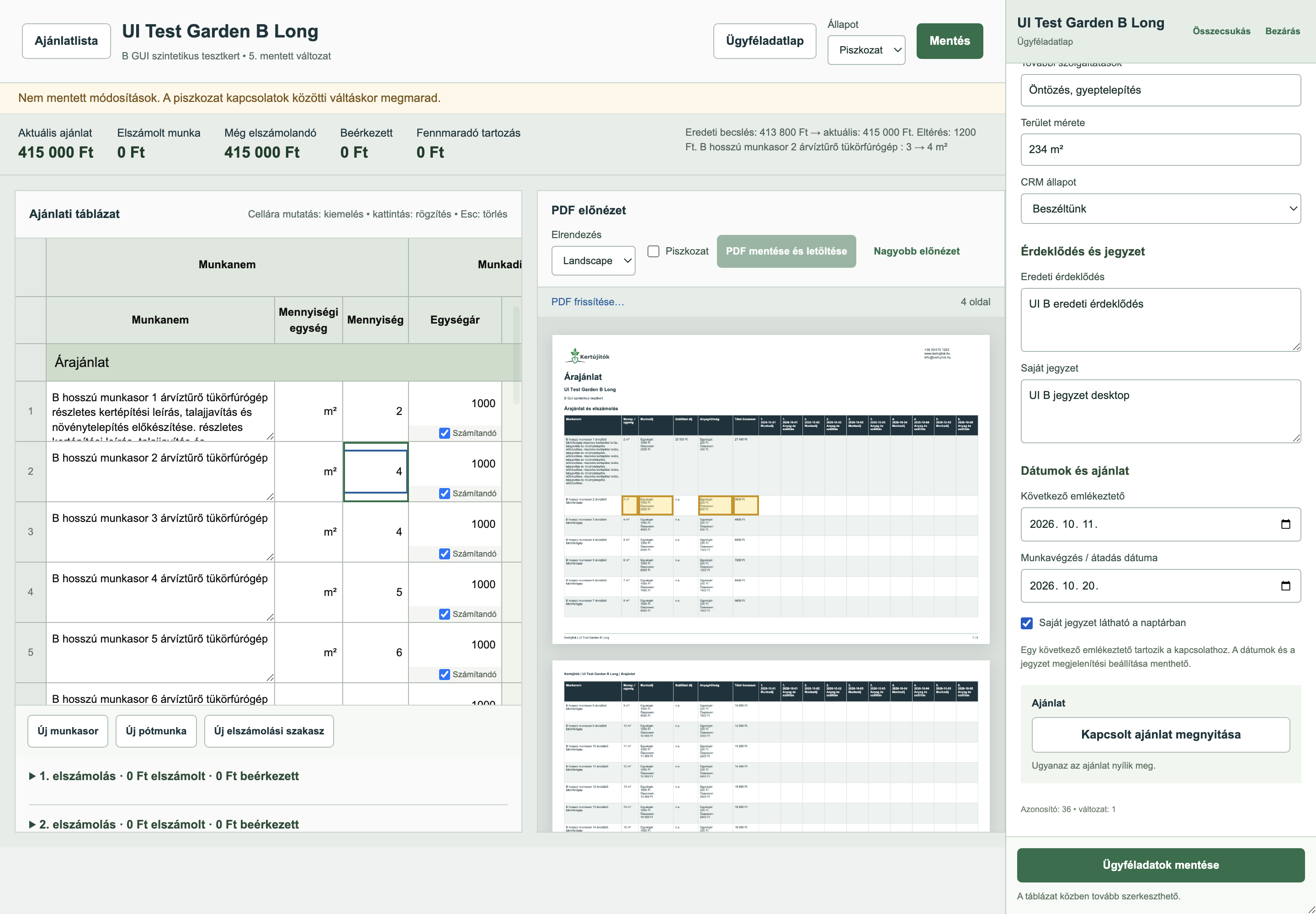
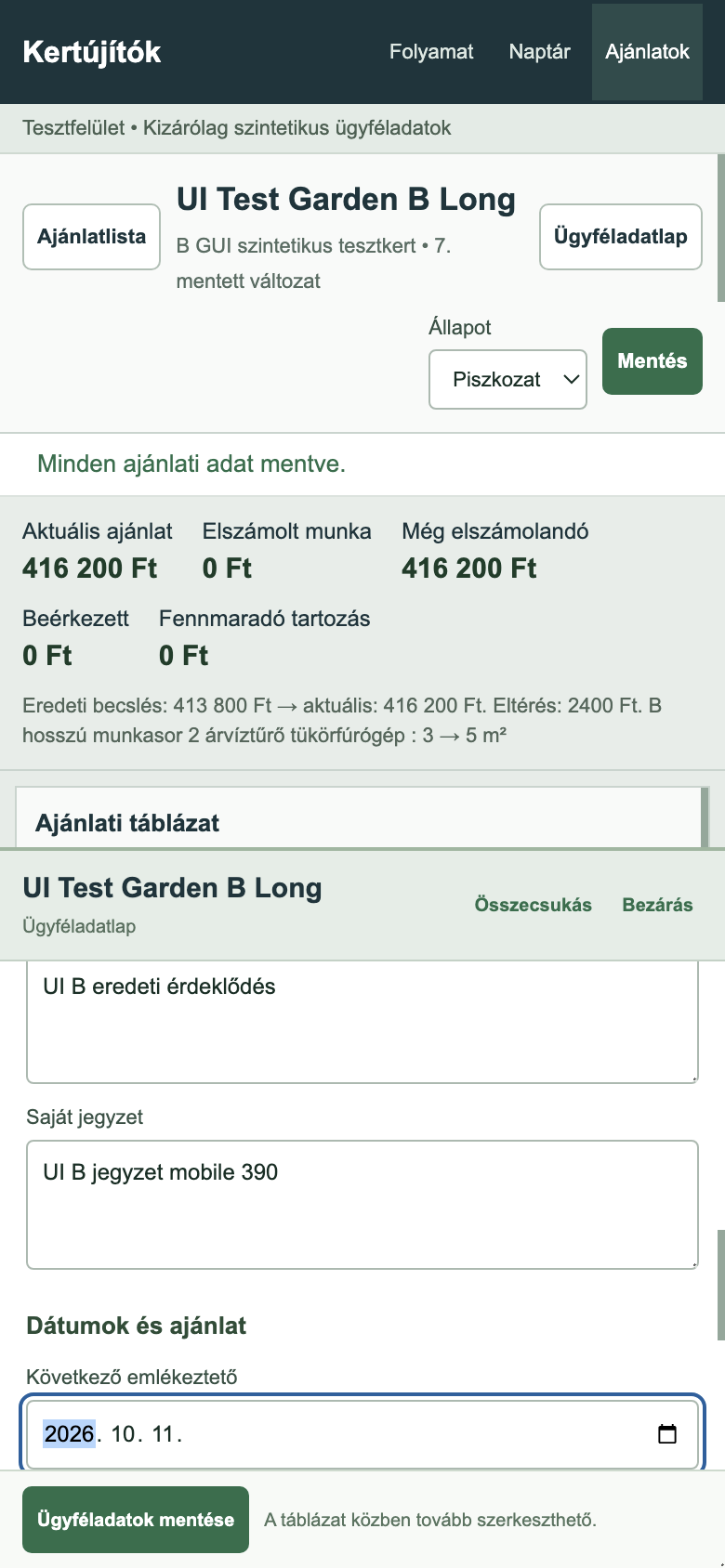
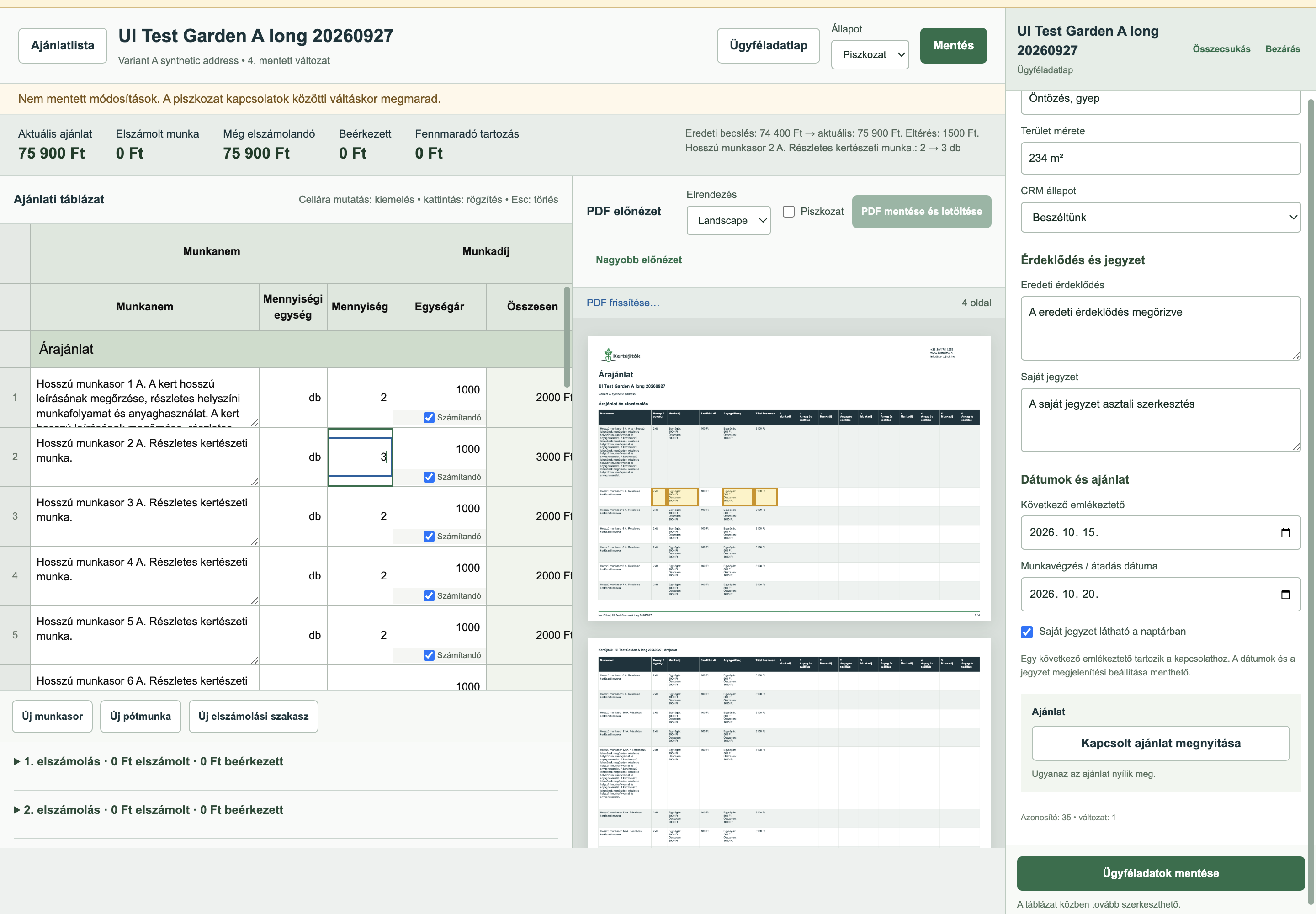
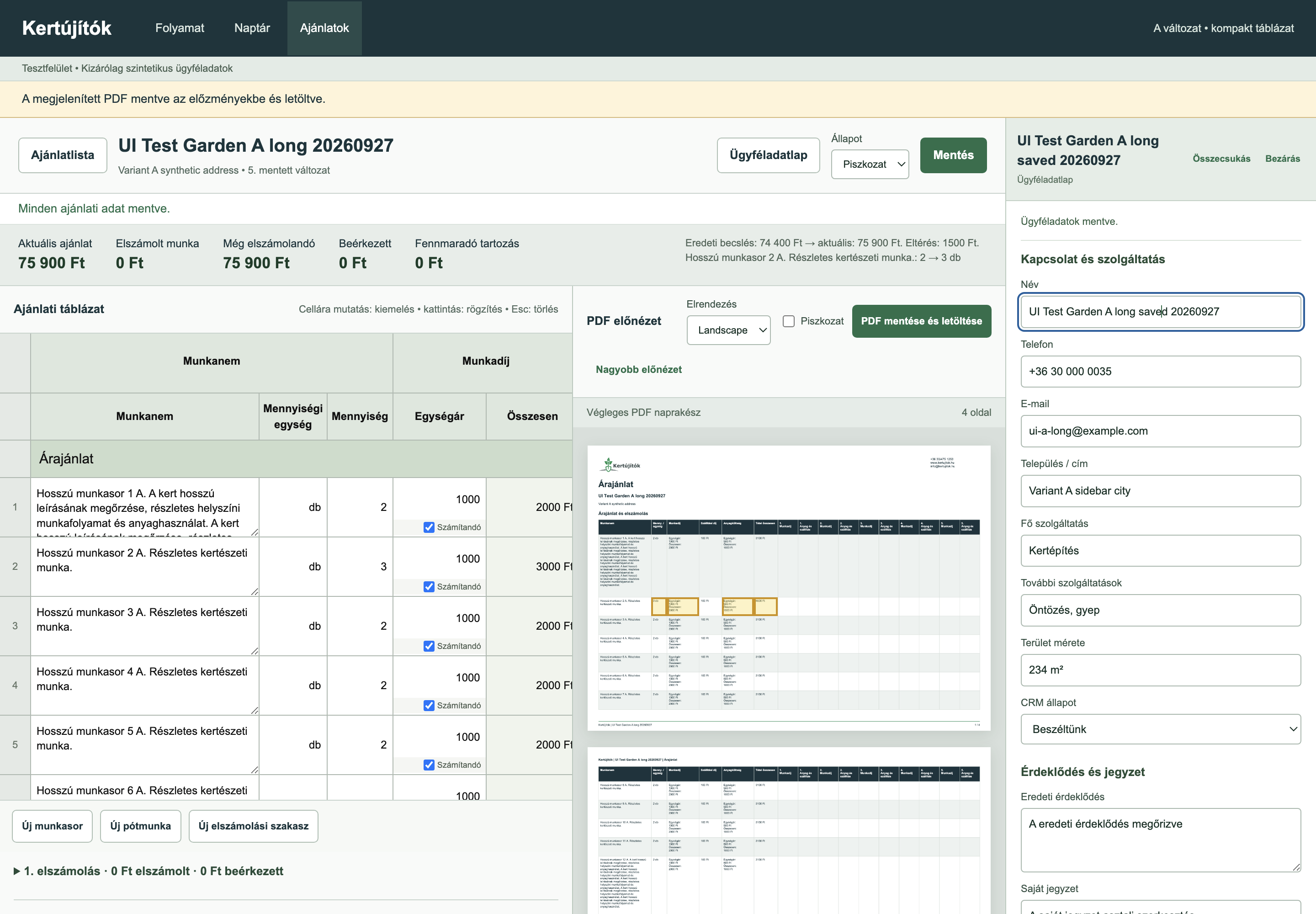
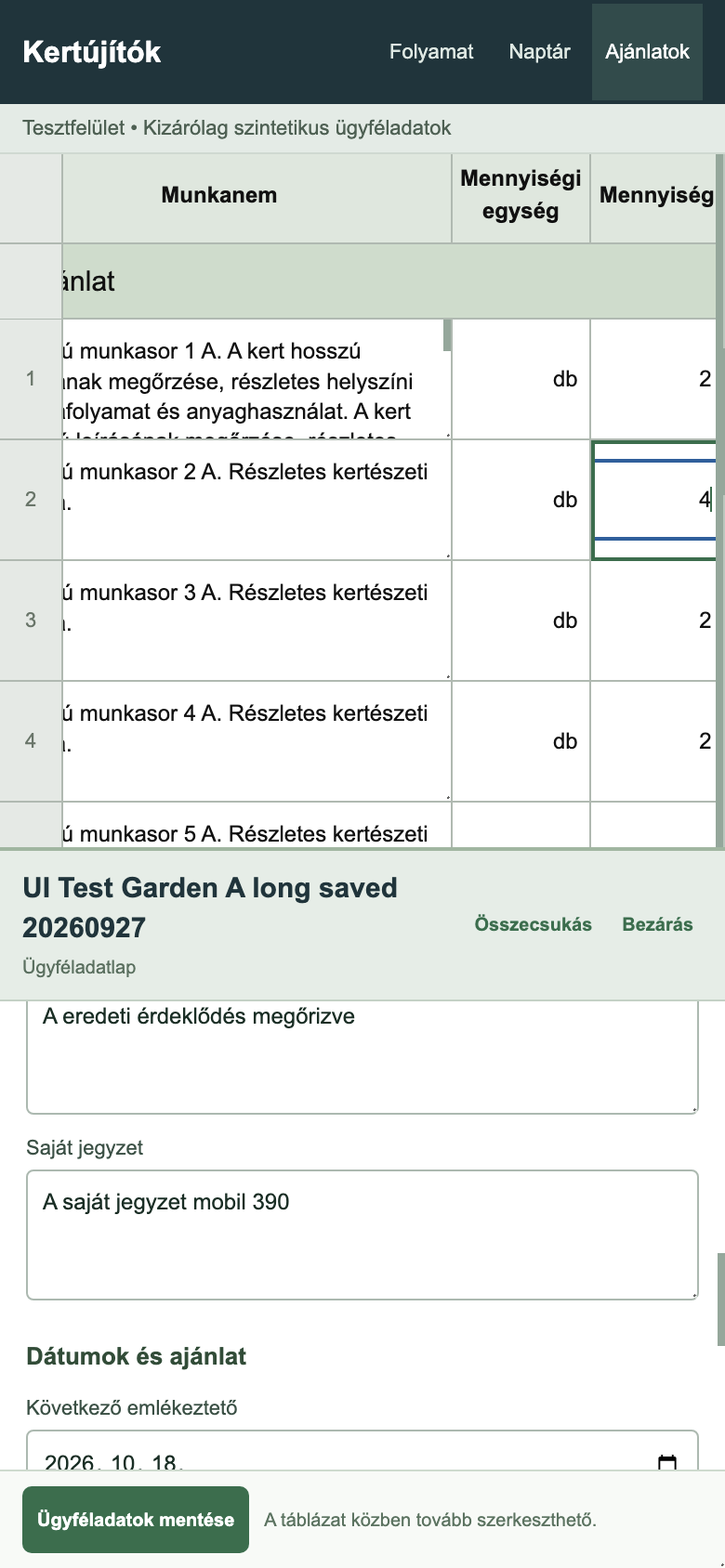
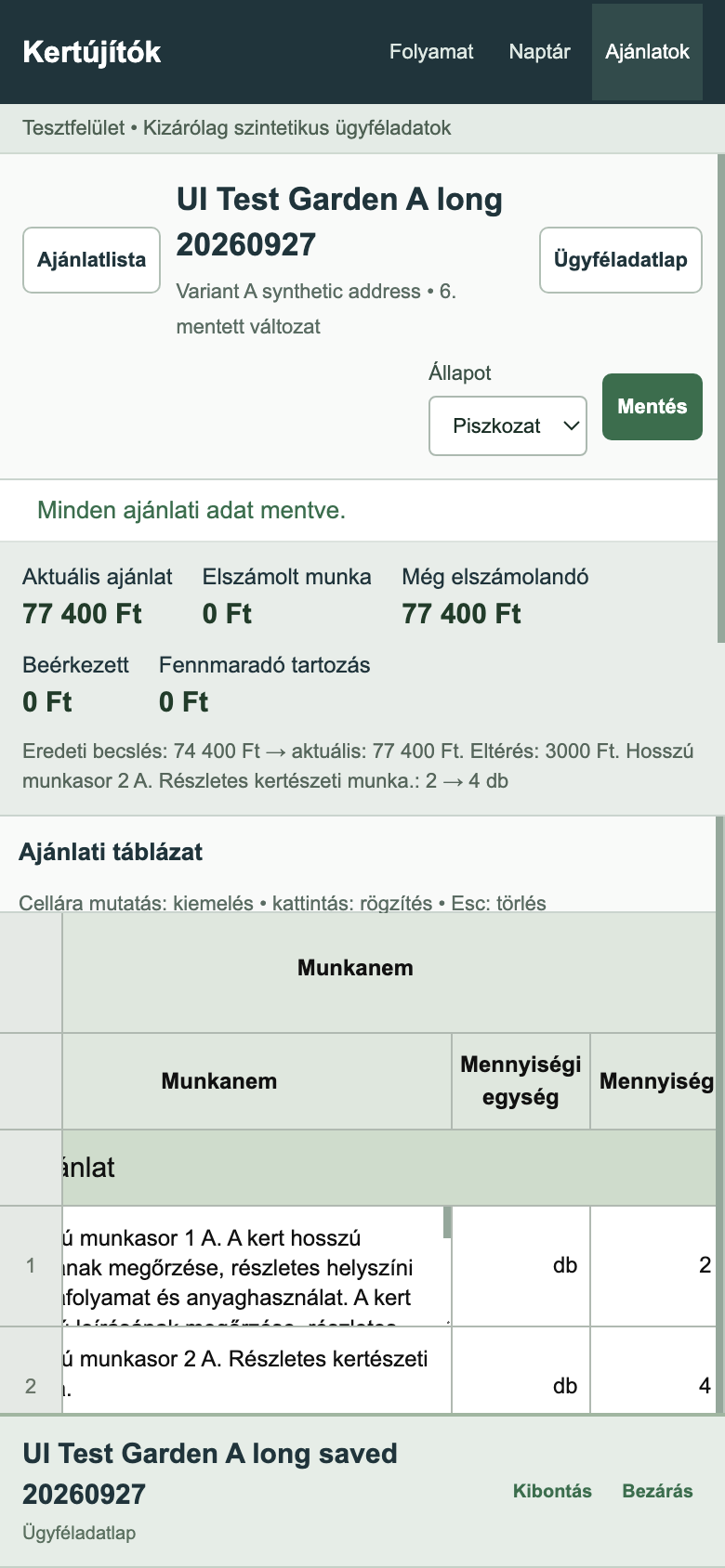
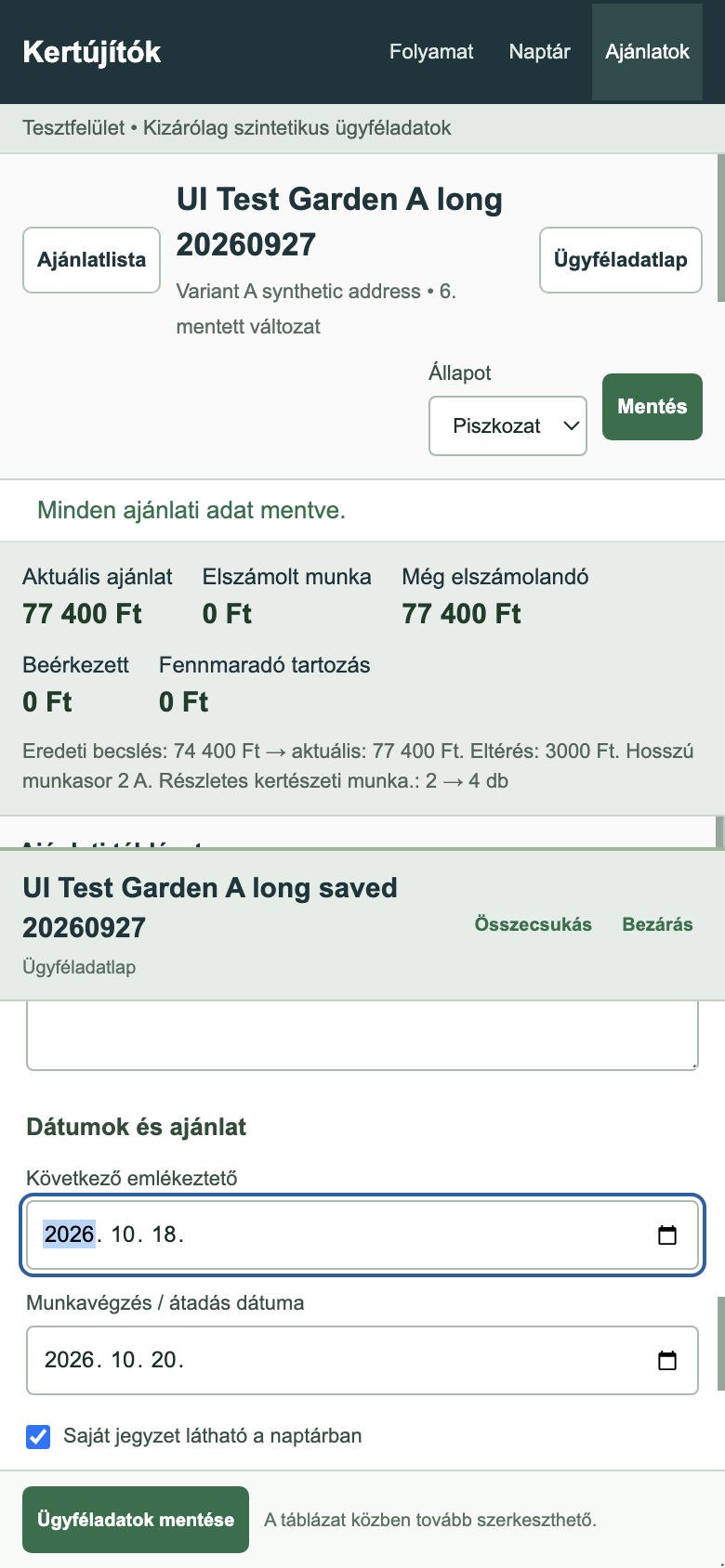
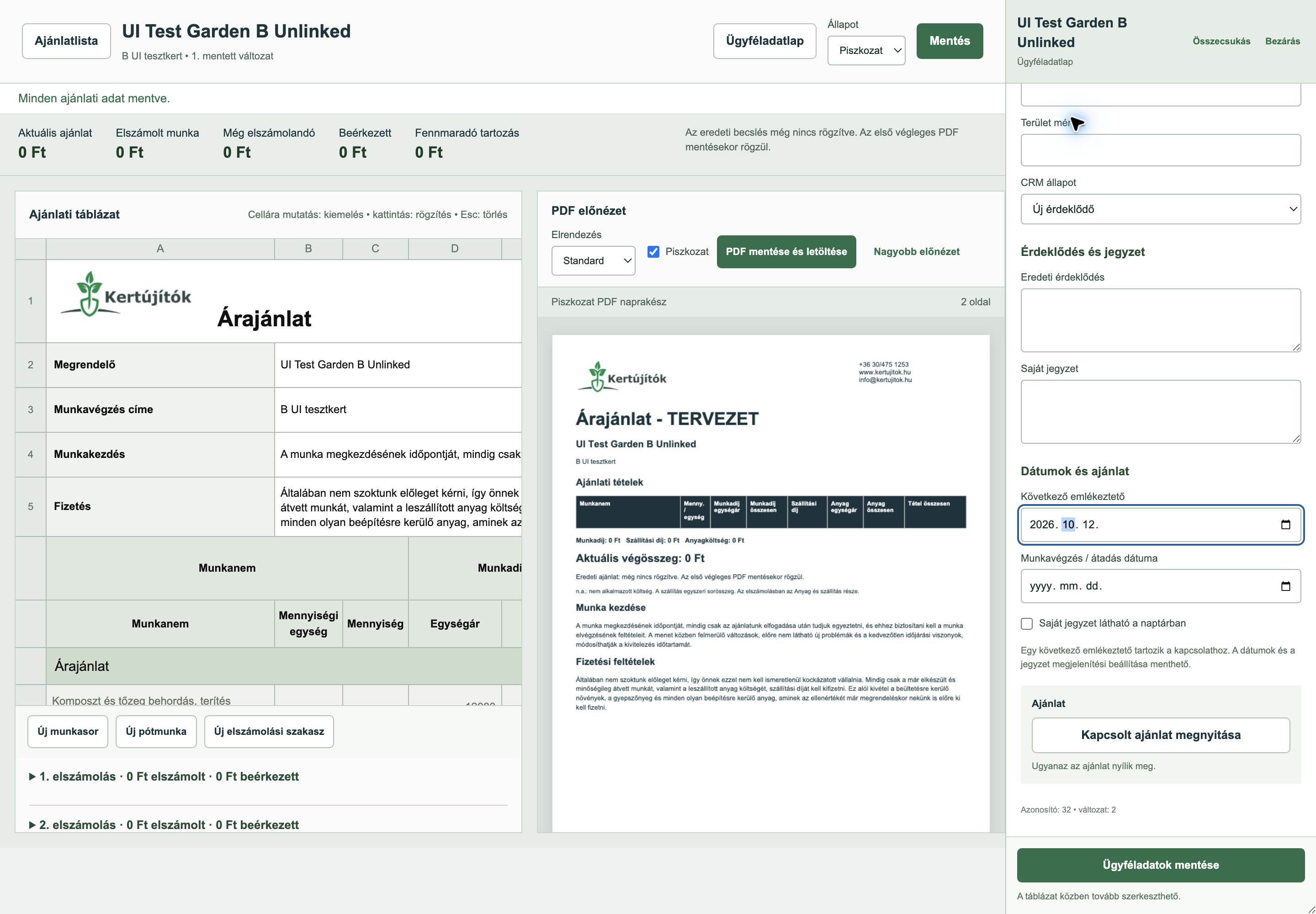
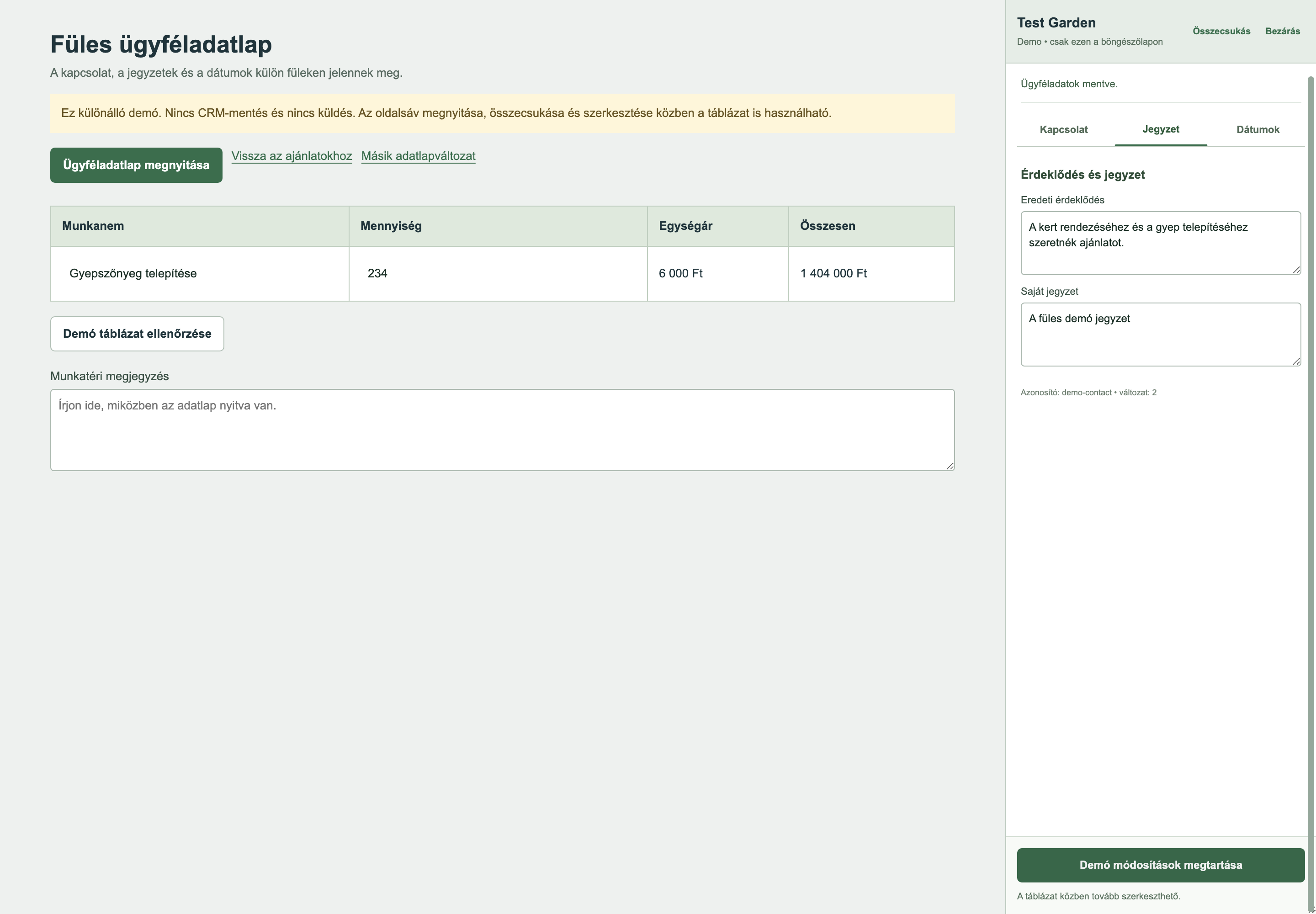
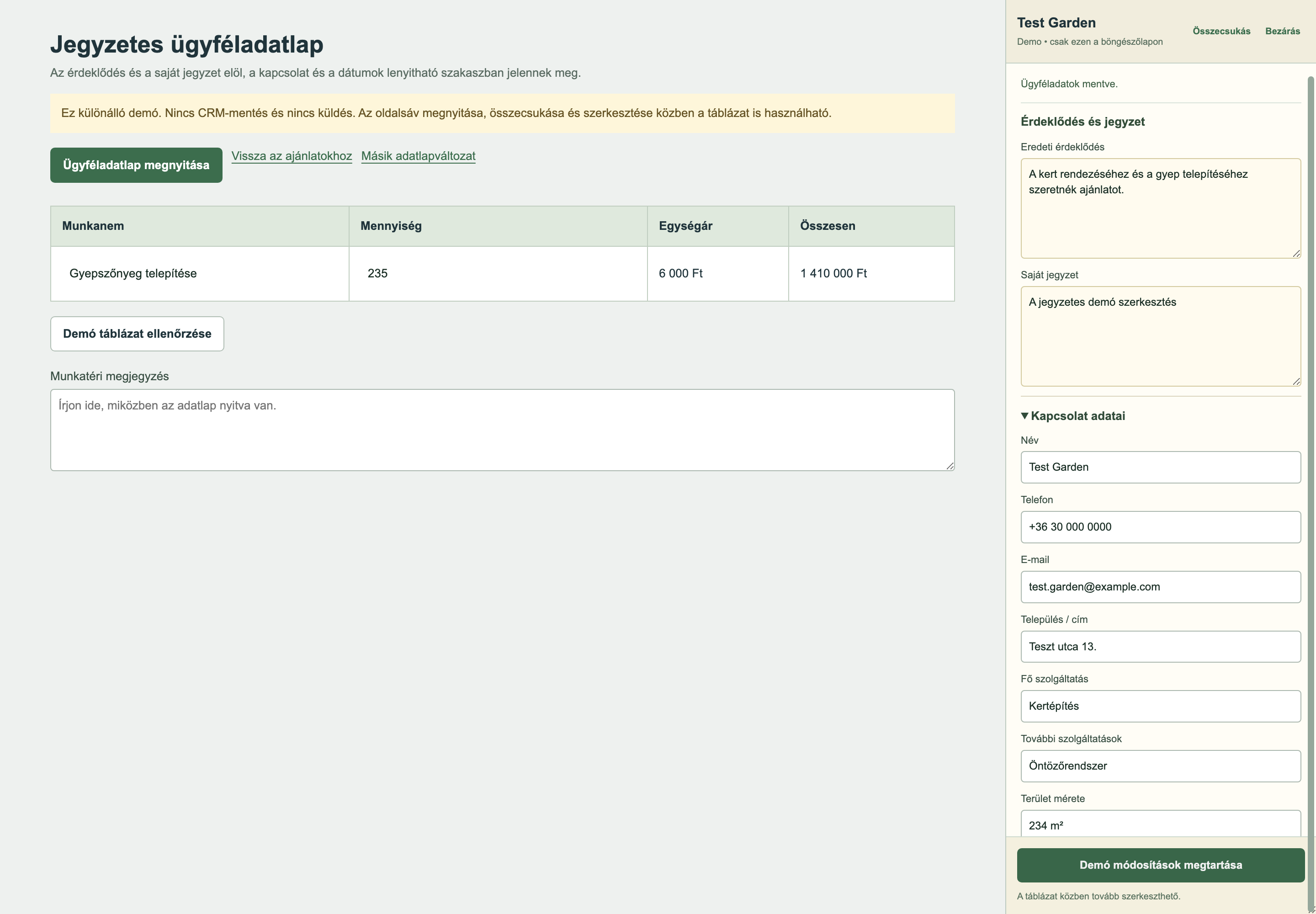
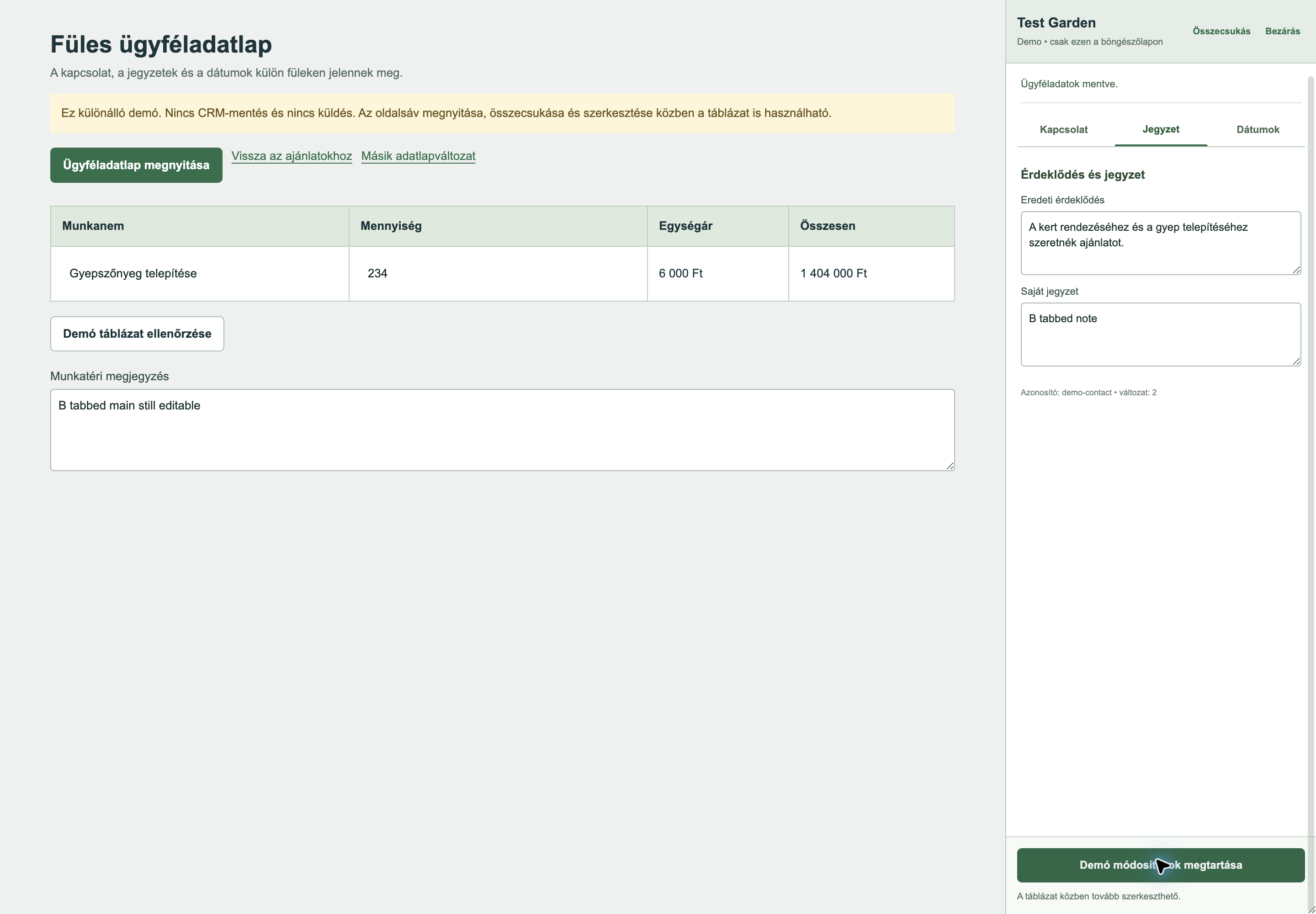
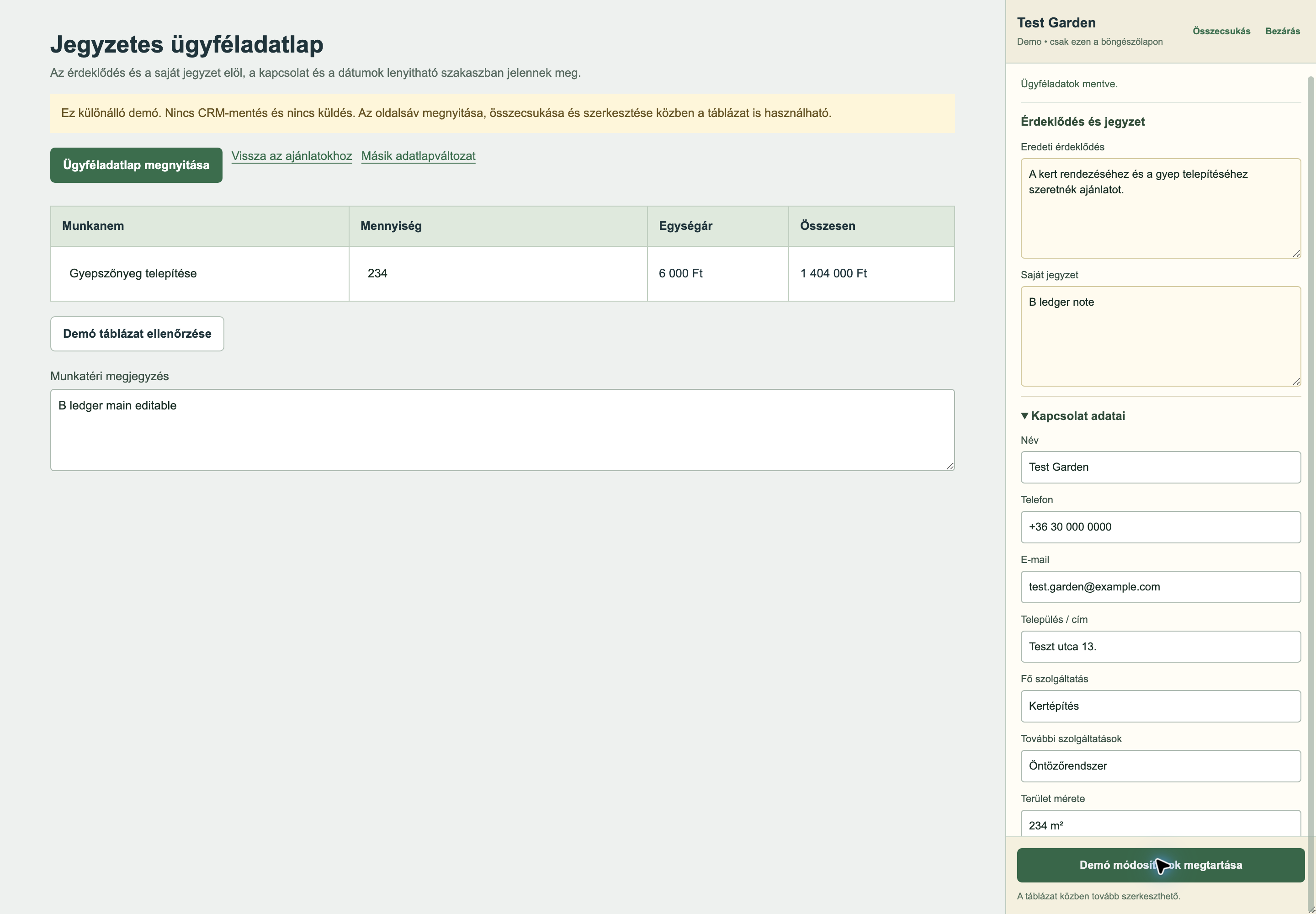
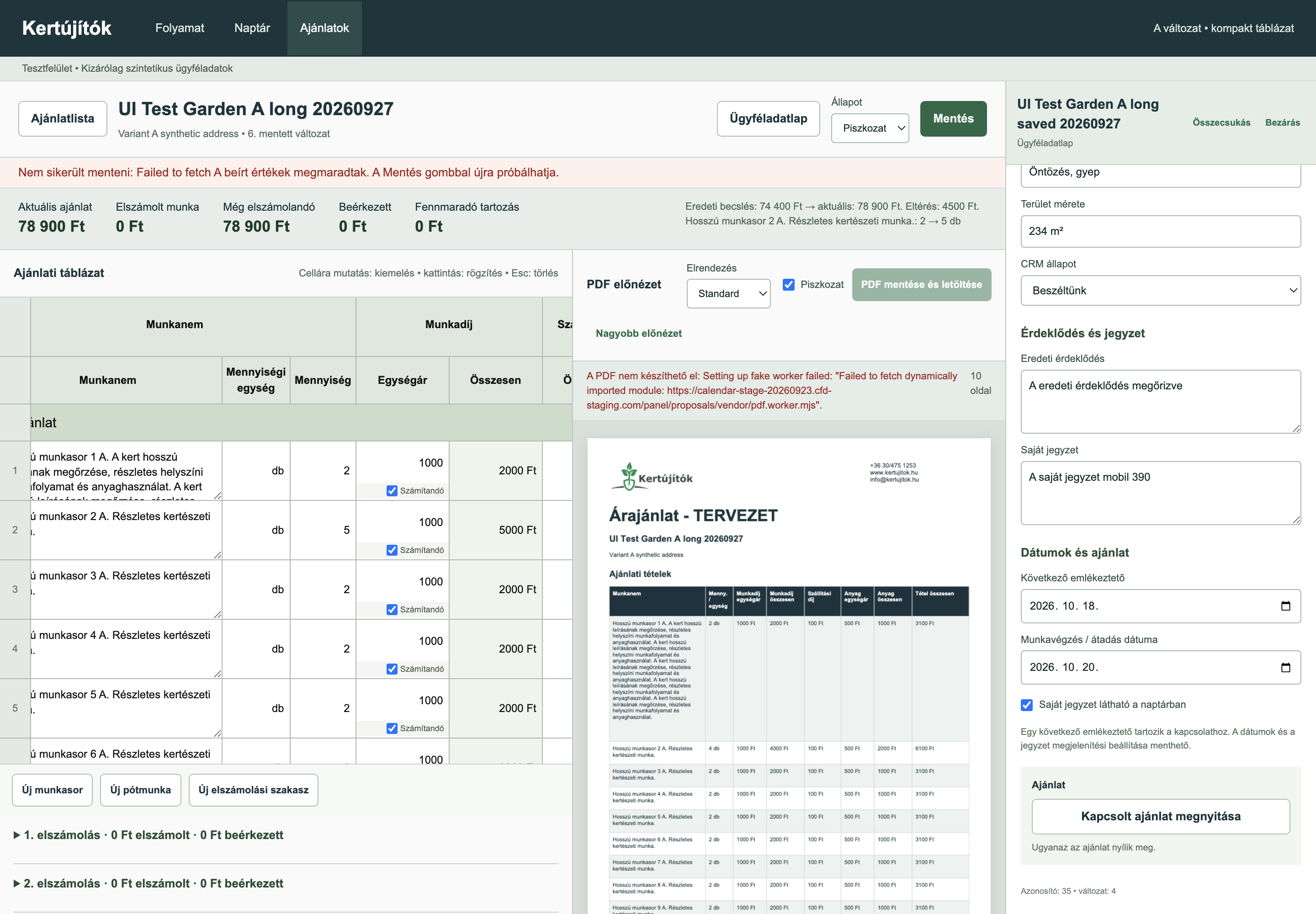
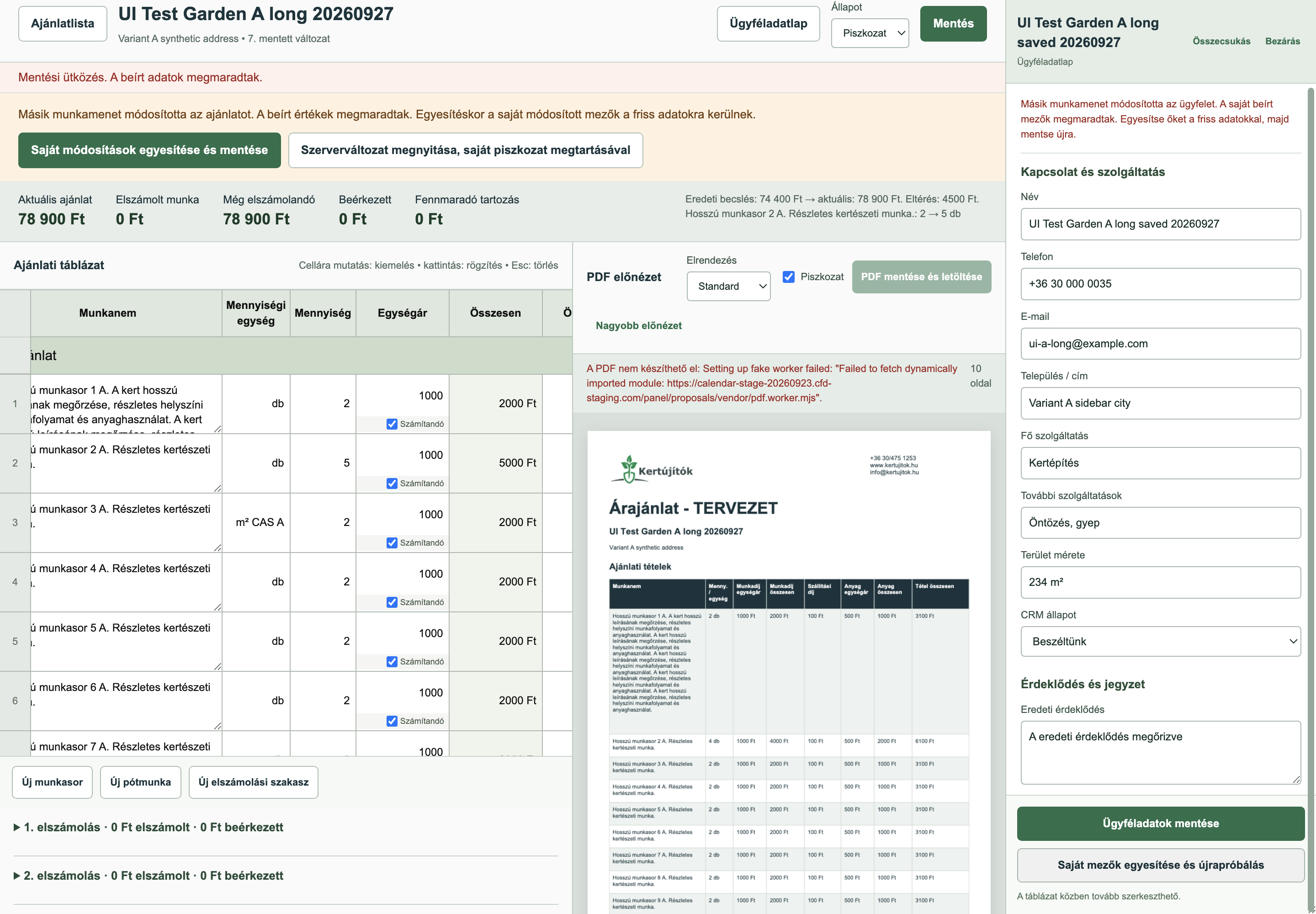
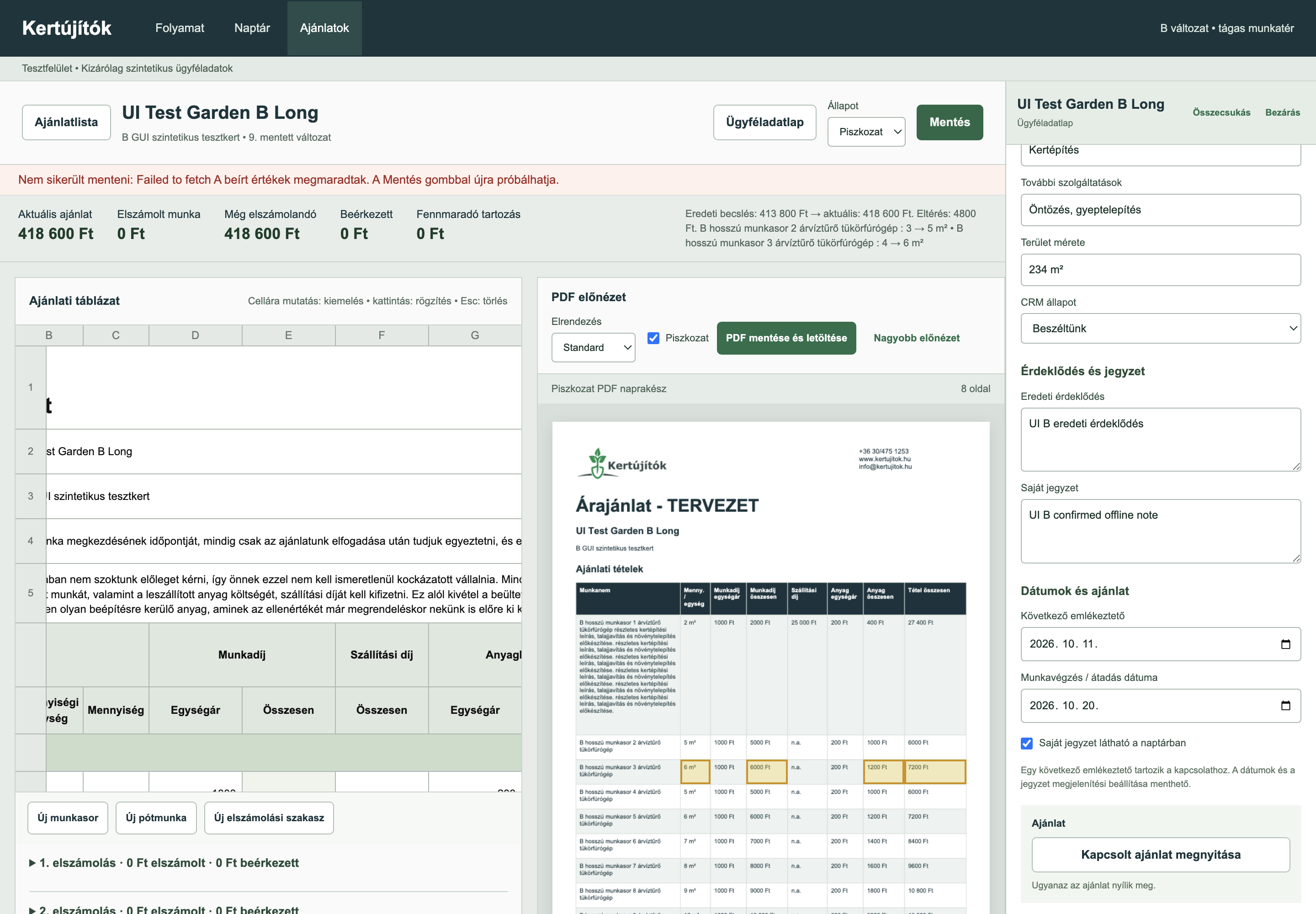
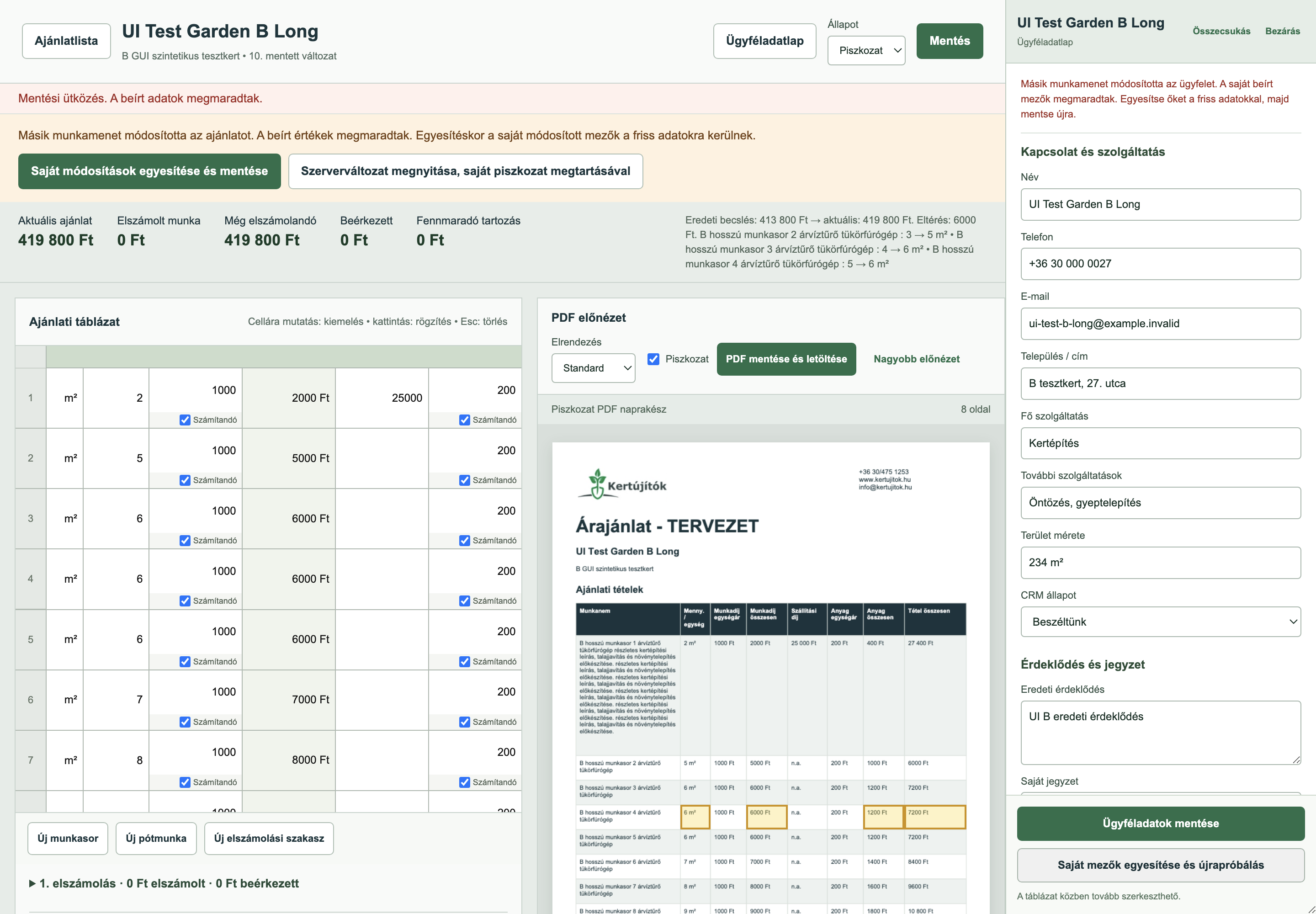
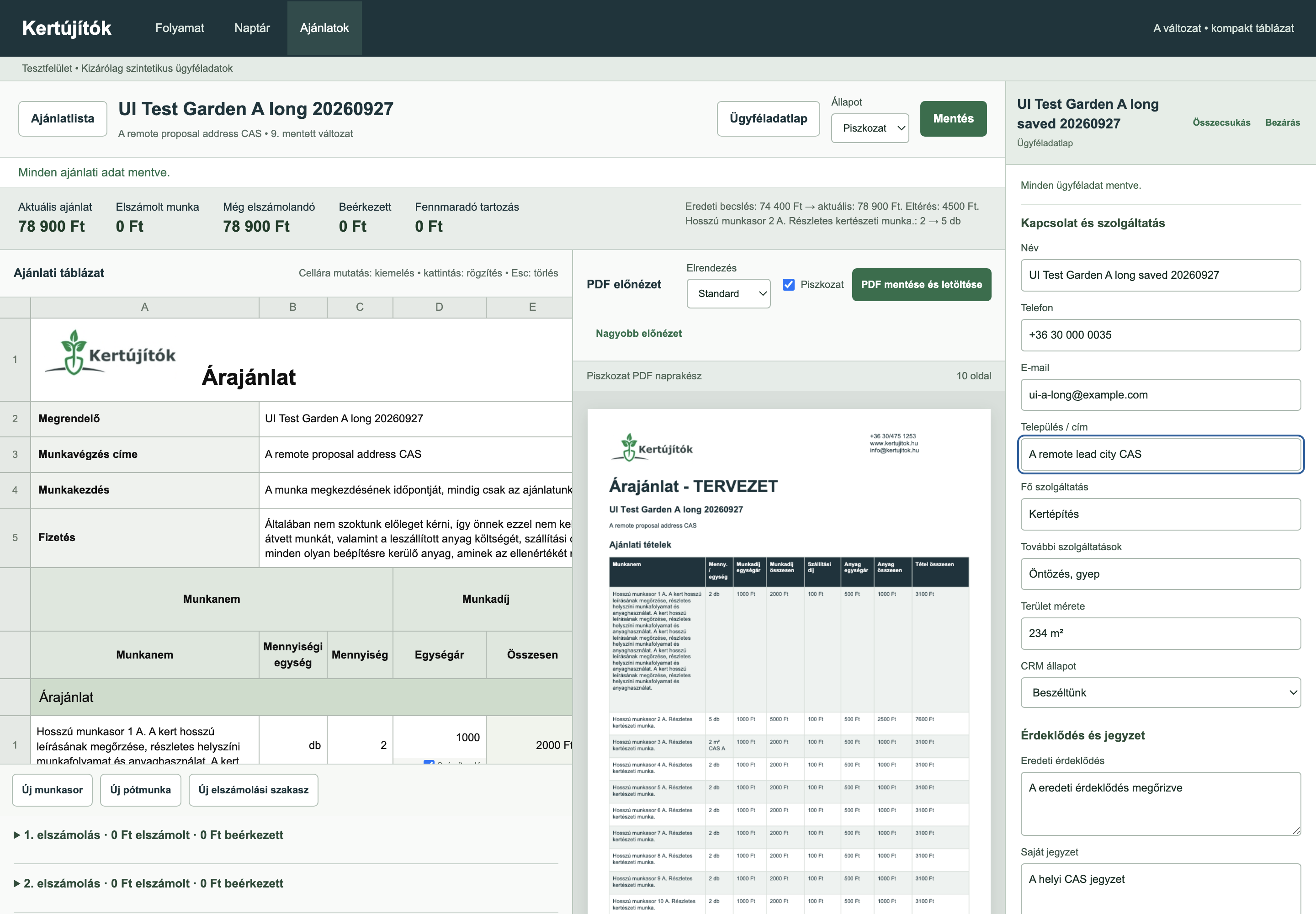
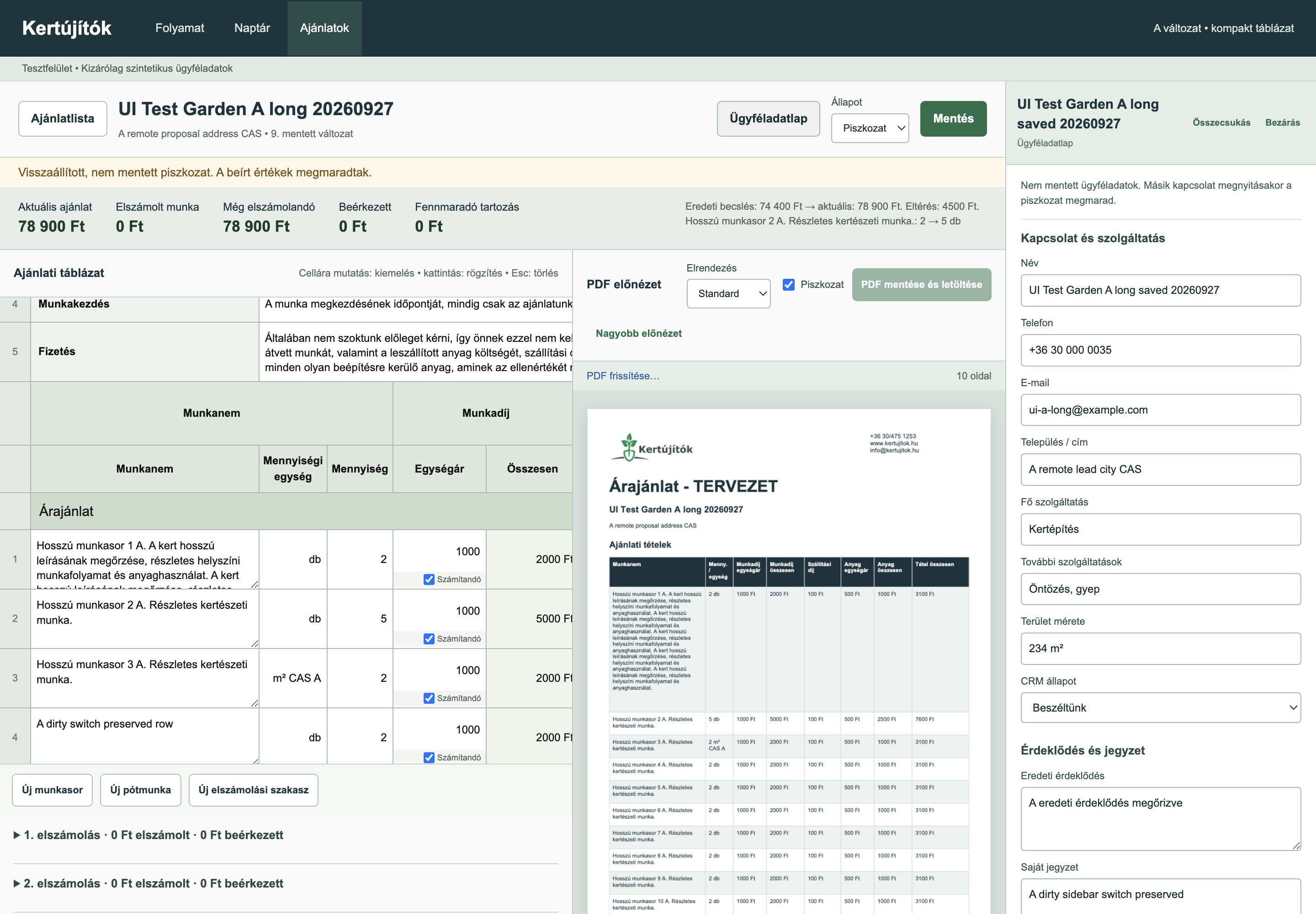
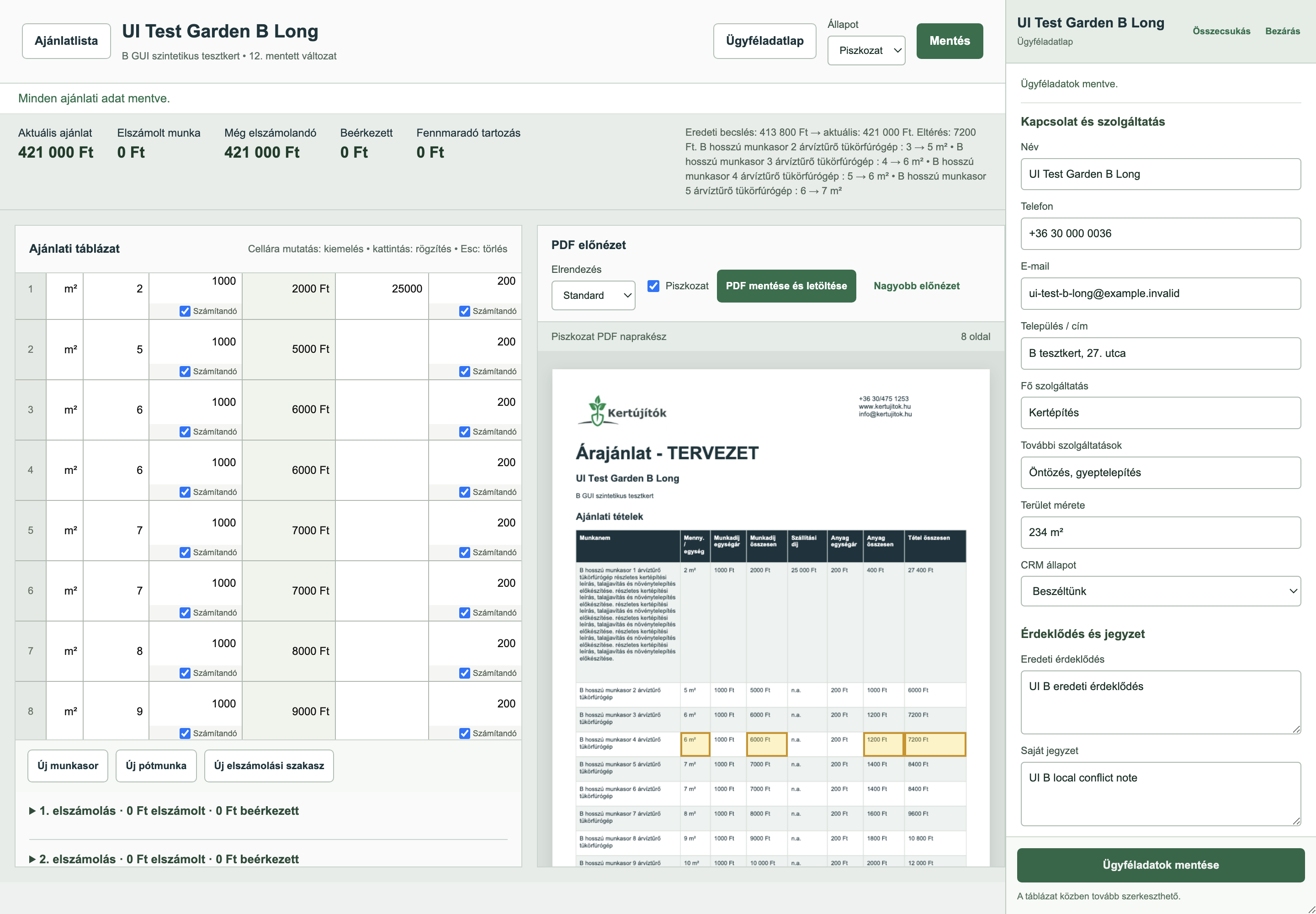
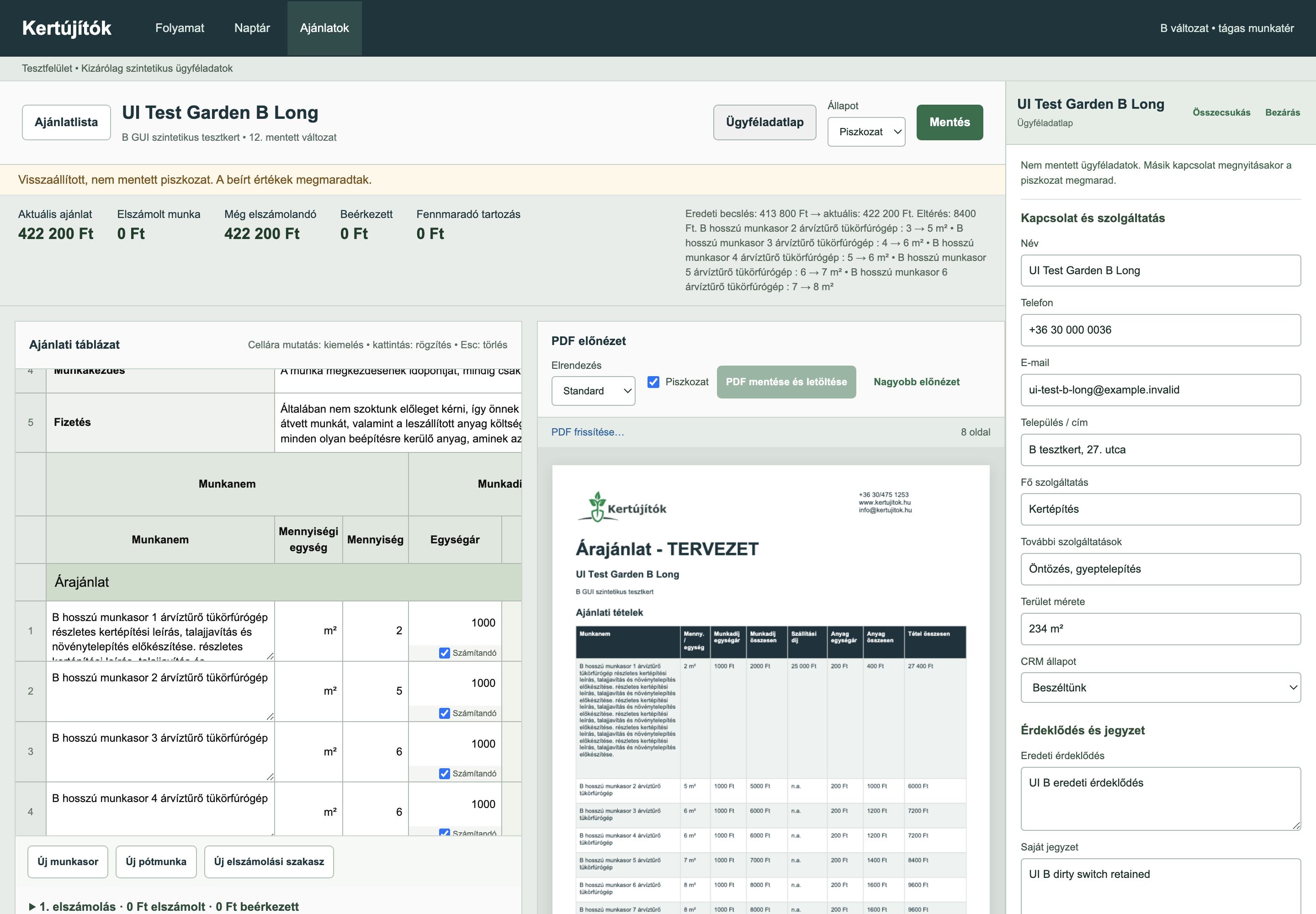
Proposal generator · two working variants · three lead-sidebar designs · verification complete
Proposal executor · verification completeRun: kertujitok-proposal-20260927-v1Updated: 27 September 2026
Goal and finish line
End goal: Let Péter create, reopen and settle a customer proposal in his familiar sheet-style interface while seeing and downloading the matching PDF immediately.
Done means: Two independently saved, fully working proposal UI variants live inside isolated staging copies of the client panel. Each has an Ajánlatok list/create screen and the familiar sheet editor with live cell-to-PDF highlighting, editable Pótmunka and settlement columns, two PDF layouts, dated payments and saved document history. One non-modal lead-sidebar design works in both proposal variants, and two alternative sidebar designs are separate interactive frontend prototypes. All published demos use synthetic data and bare URLs. Execution authorized by Matt on 27 September 2026.
25 / 25criteria verified
7deliverables
0open decisions
Rules that stay fixed
Proposal generator only now. Calendar redesign, global Folyamat redesign and universal sidebar rollout across unrelated panel views are deferred, not cancelled.
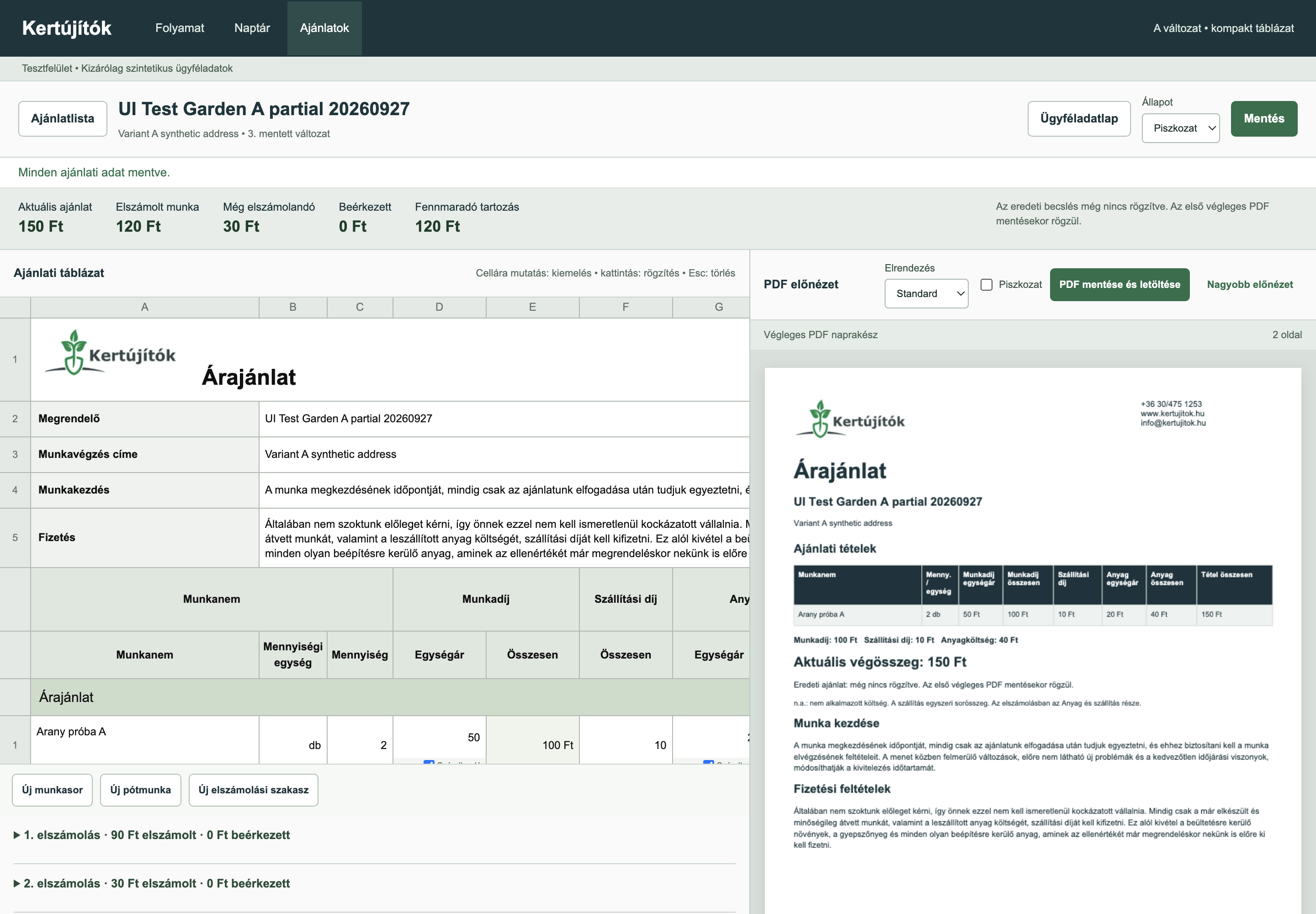
Keep the spreadsheet's look, terminology, column relationships and interaction. It is our custom app, not Excel, Google Sheets or an embedded spreadsheet service. Both UI variants preserve this.
Matt explicitly authorized one new Sol xhigh orchestrator, followed by calendar integration in a second sequential thread.
Proof standard: Behavior, saved-data readback, matching PDF bytes, and screenshot / independent description / parent comparison. All 25 criteria are verified with linked evidence.
End goal system
Green = confirmed requirement · Pink = assumption · Dashed = open step. Confirmed requirements are not completed product tests.
flowchart TD
 L["<b>Ajánlatok</b><br/>Find or create the lead's proposal"]:::confirmed
 S["<b>Lead sidebar</b><br/>Edit contact details beside the workspace"]:::confirmed
 T["<b>Familiar custom sheet</b><br/>Quote rows + extra work + dated settlements"]:::confirmed
 P["<b>Live PDF preview</b><br/>Highlight matching cells and totals"]:::confirmed
 F["<b>Final or draft PDF</b><br/>Standard or landscape from the same data"]:::confirmed
 H["<b>Saved record and history</b><br/>Reopen work without rewriting old PDFs"]:::confirmed
 L --> T
 L <--> S
 S <--> T
 T --> P --> F
 T <--> H
 F --> H
classDef confirmed fill:#E8F5E9,stroke:#2E7D32,color:#173B25;
classDef assumption fill:#FCE4EC,stroke:#C2185B,color:#5B1430;
classDef open fill:#FFFFFF,stroke:#94A3B8,color:#475569,stroke-dasharray:5 5;
Route to the end state
flowchart LR
 I["Inputs: contract, workbook, prototype"] --> B["Verified staging backup"] --> E["Implement A/B and sidebars"] --> V["Deployed journeys and PDFs"] --> Q["Independent screenshot QA"] --> D["Evidence and calendar handoff"]
 classDef underway fill:#E8F1FF,stroke:#1765BD,color:#174578;
 class E underway;
Diagram rendering failed. The written contract below remains available.
Deployed review surfaces
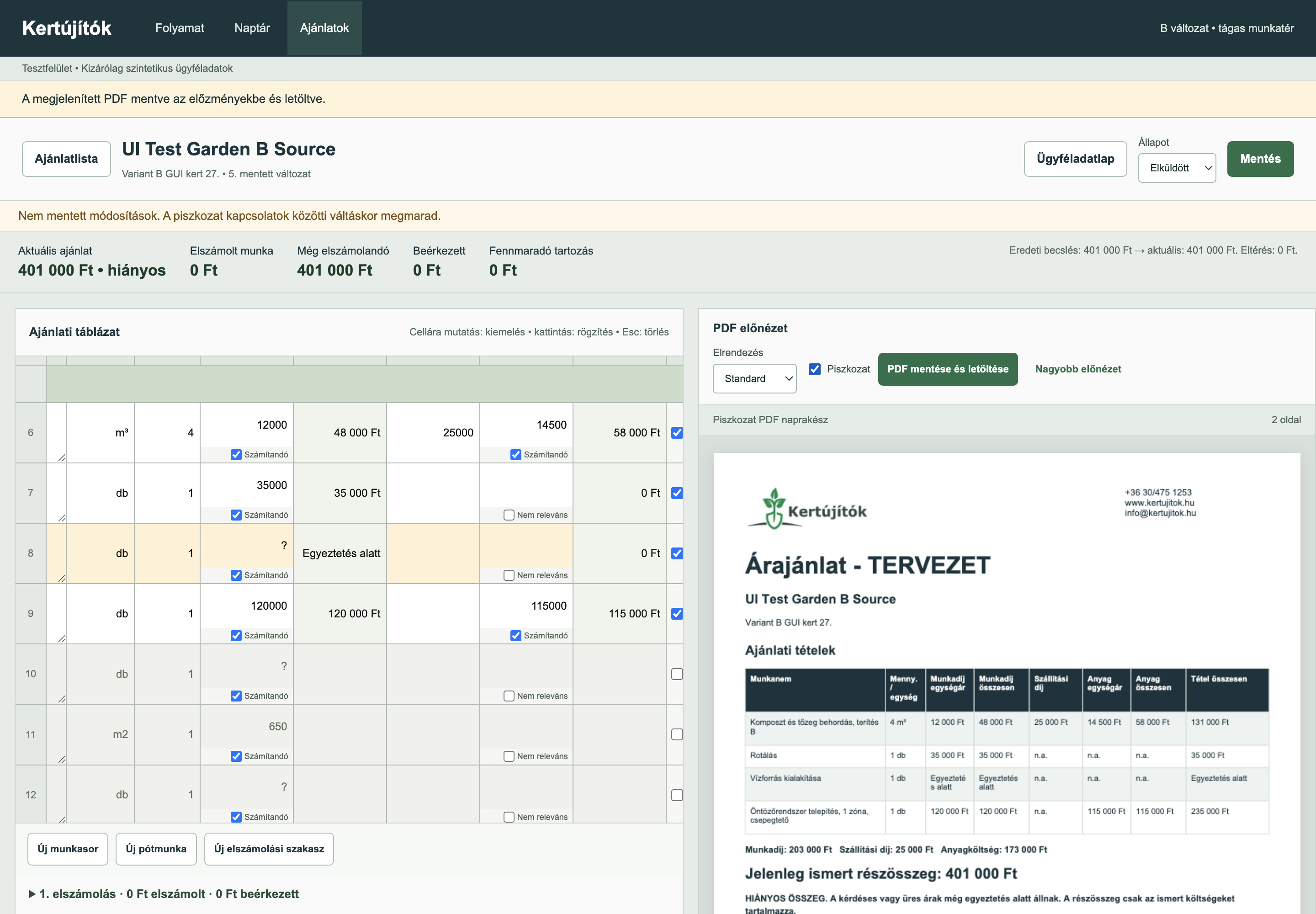
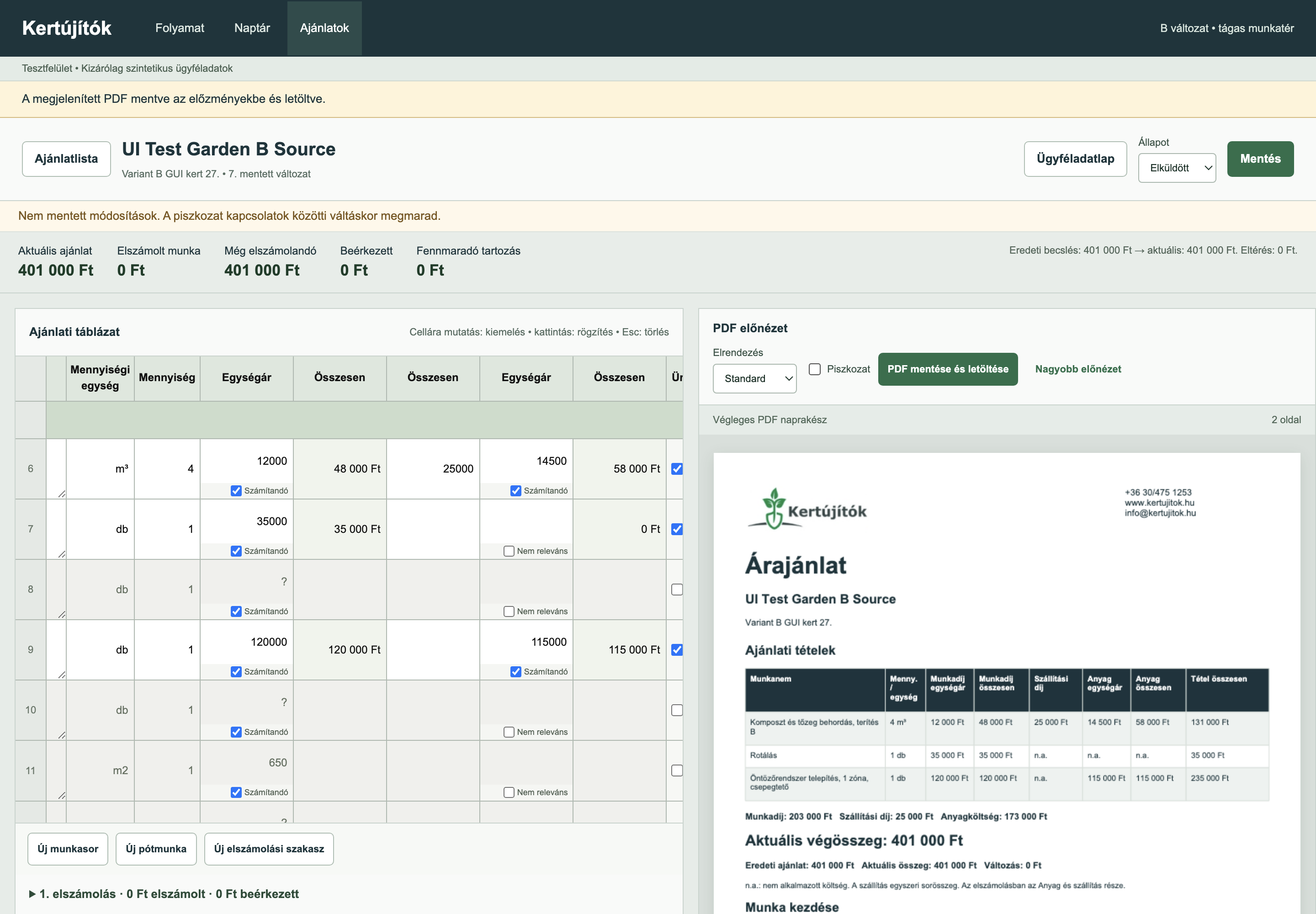
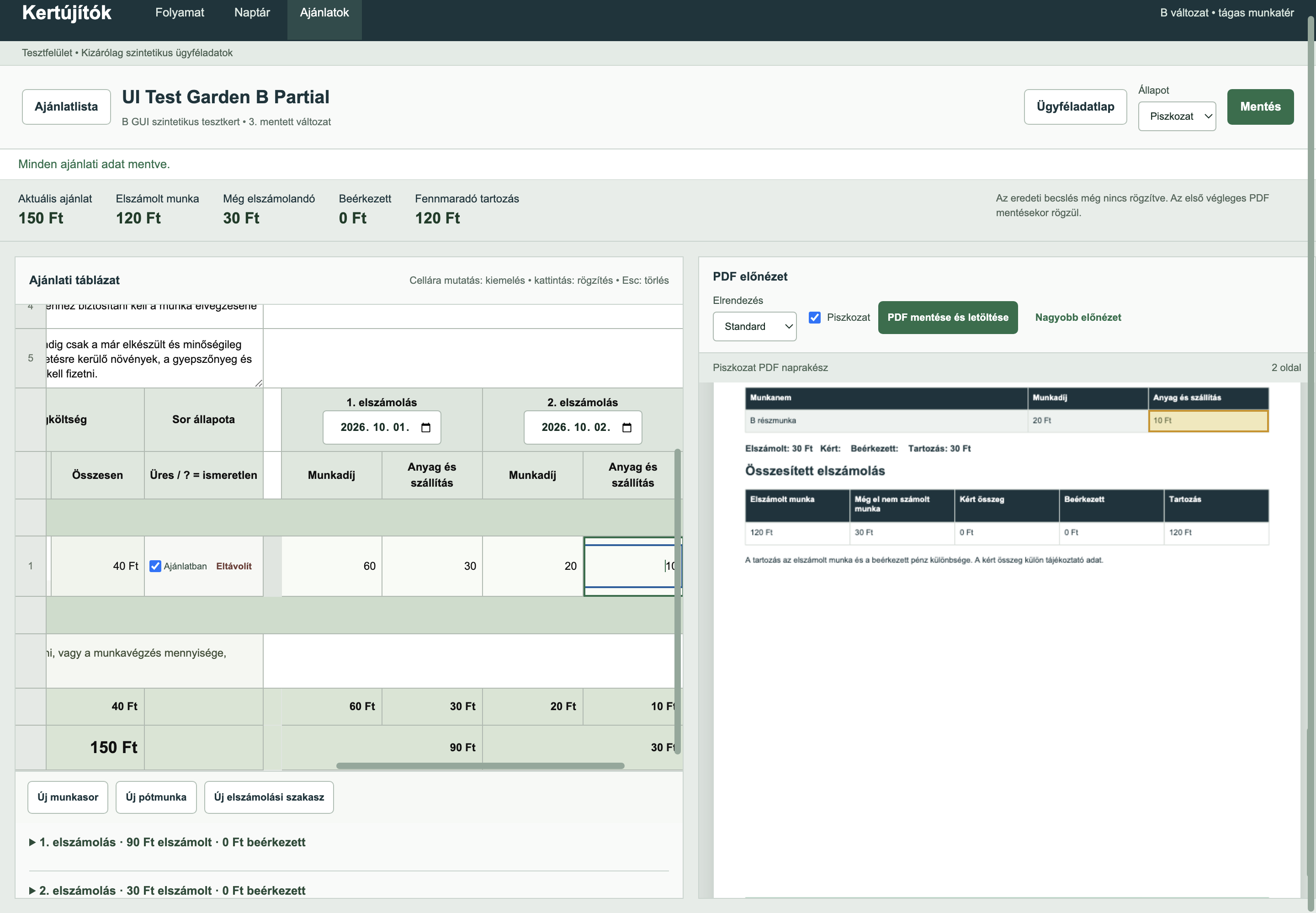
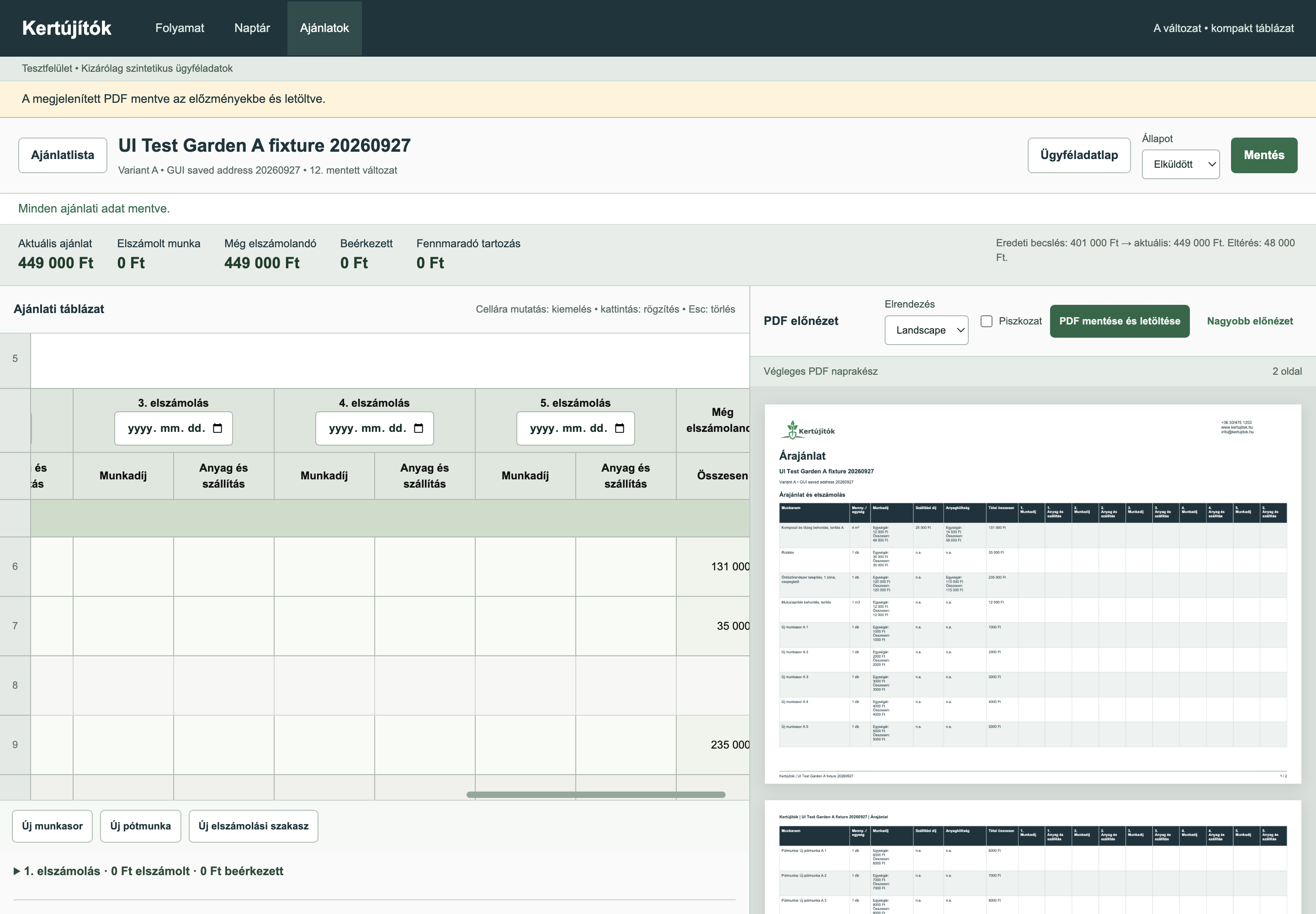
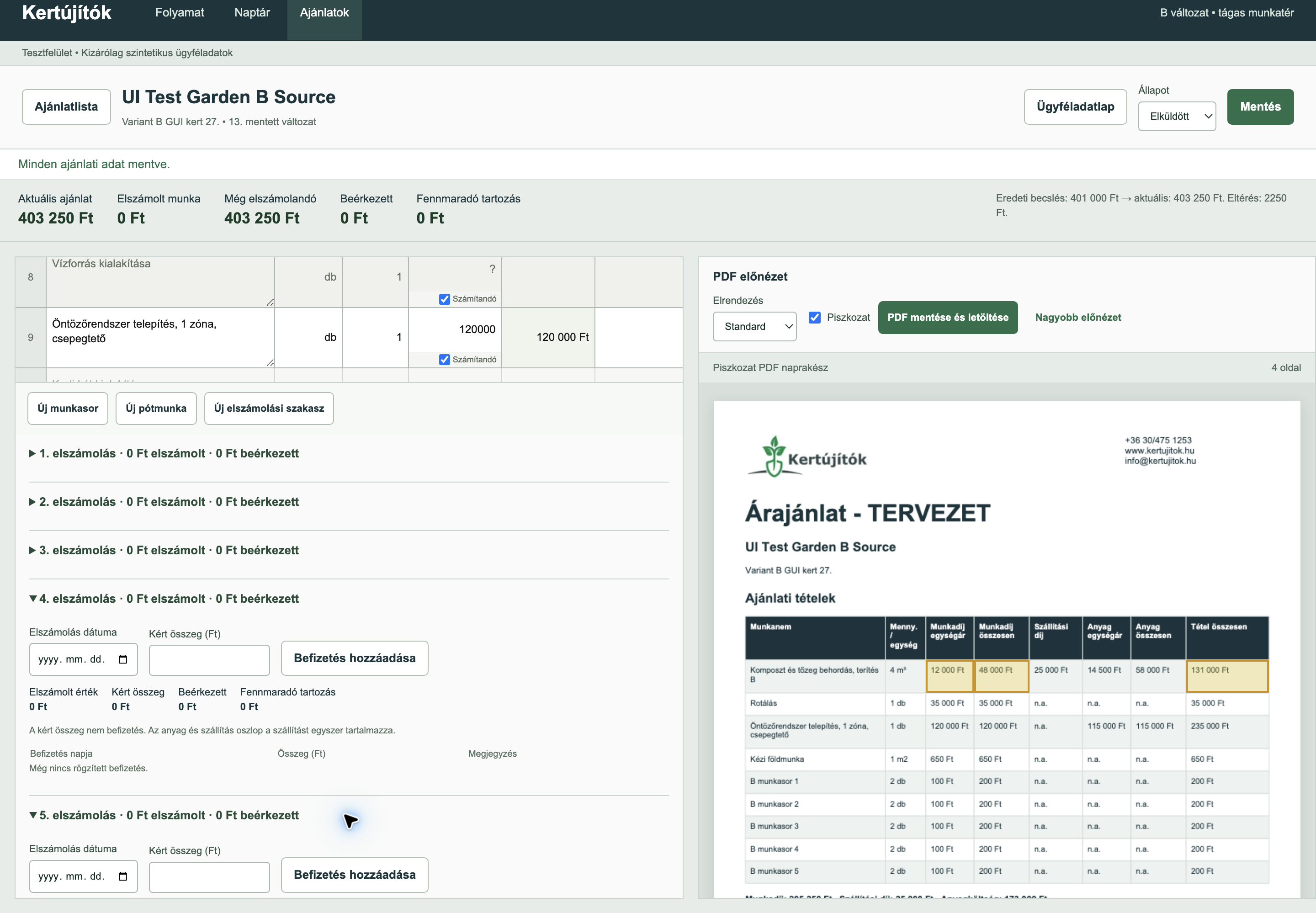
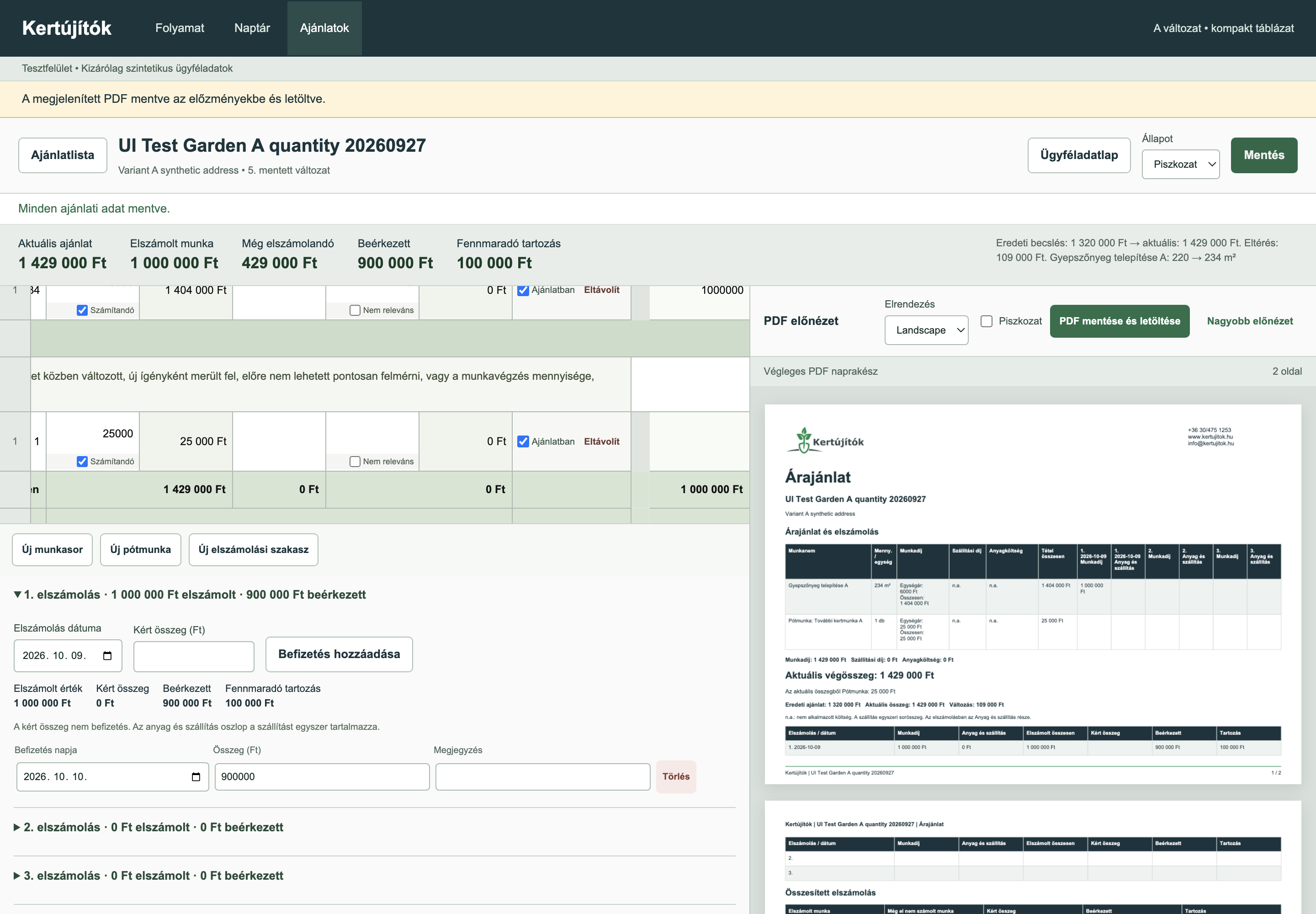
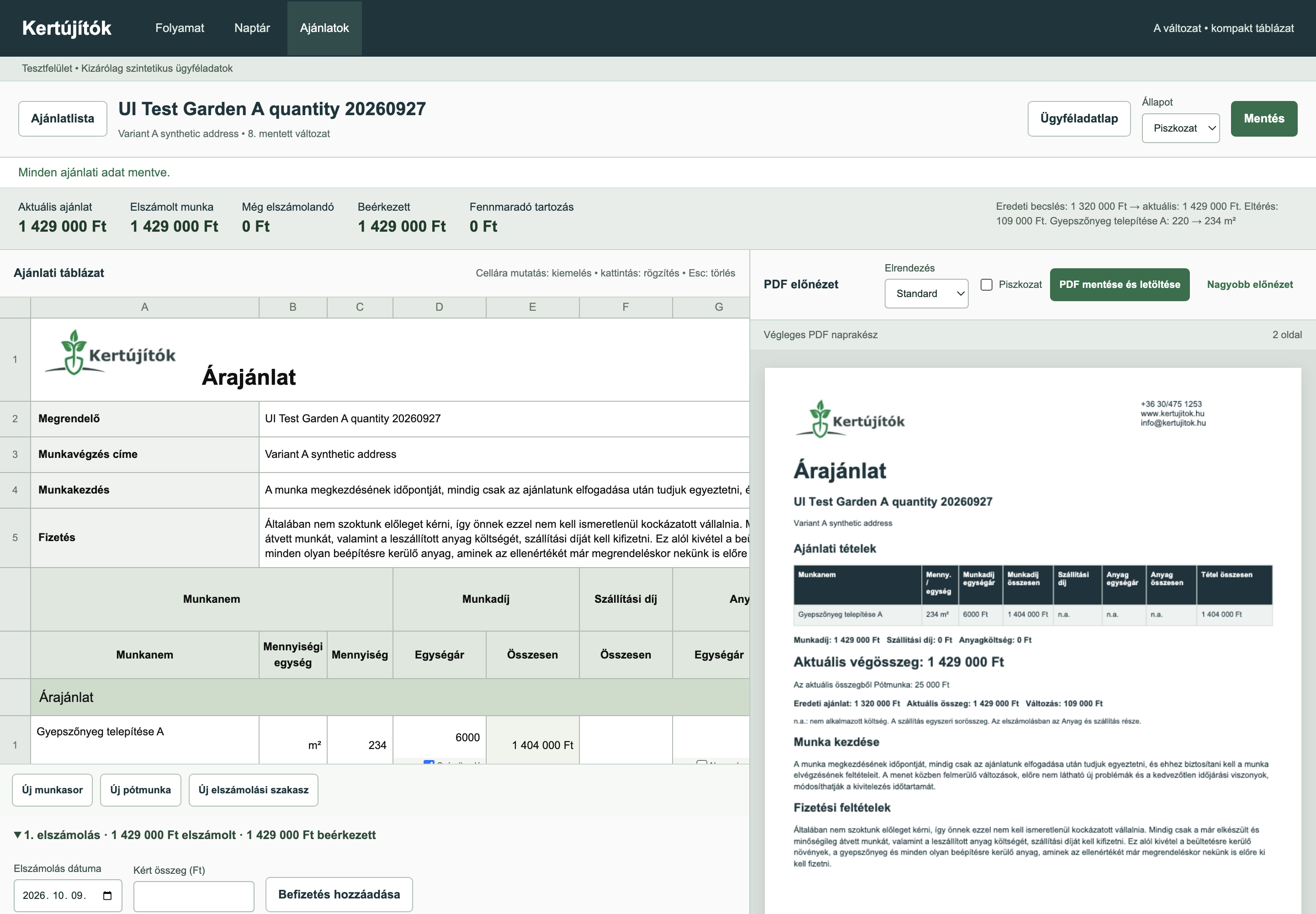
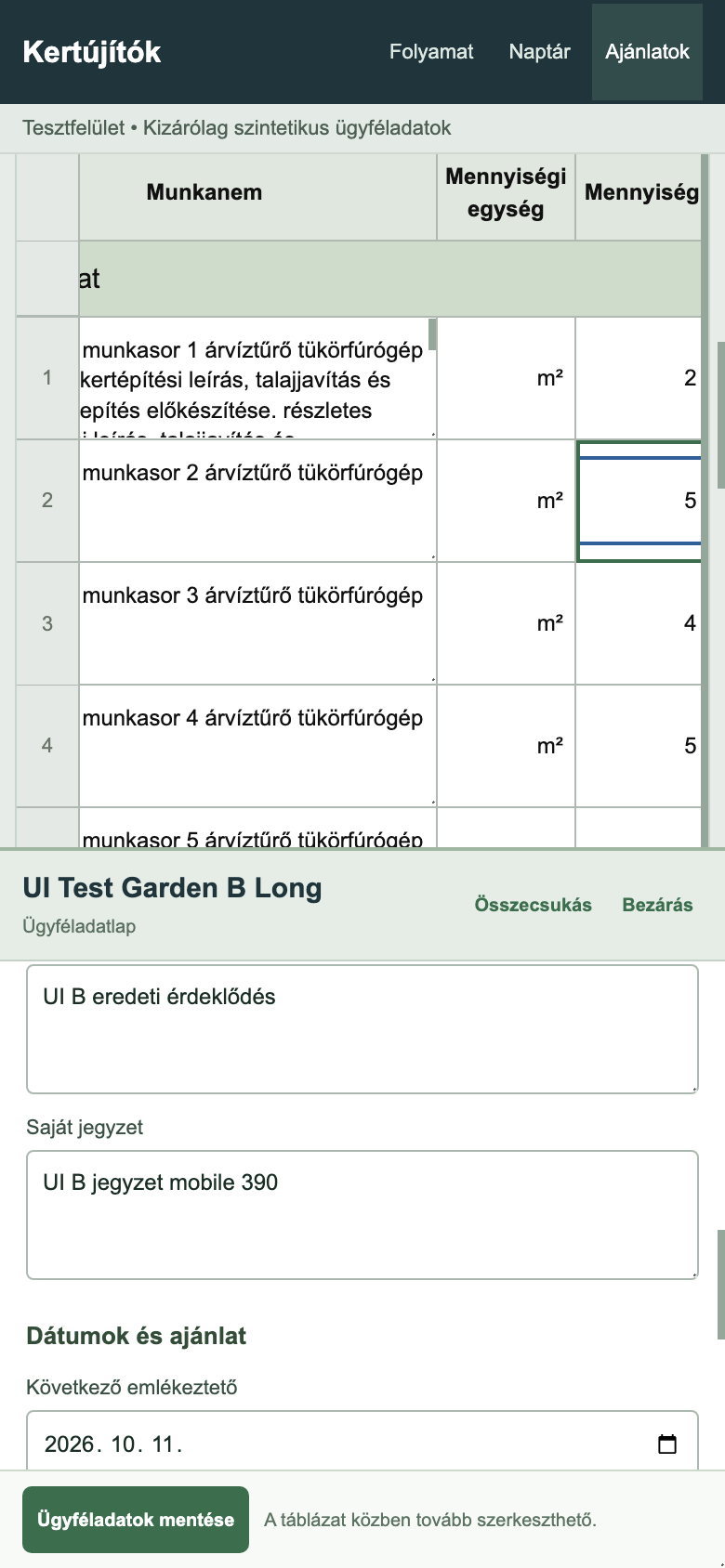
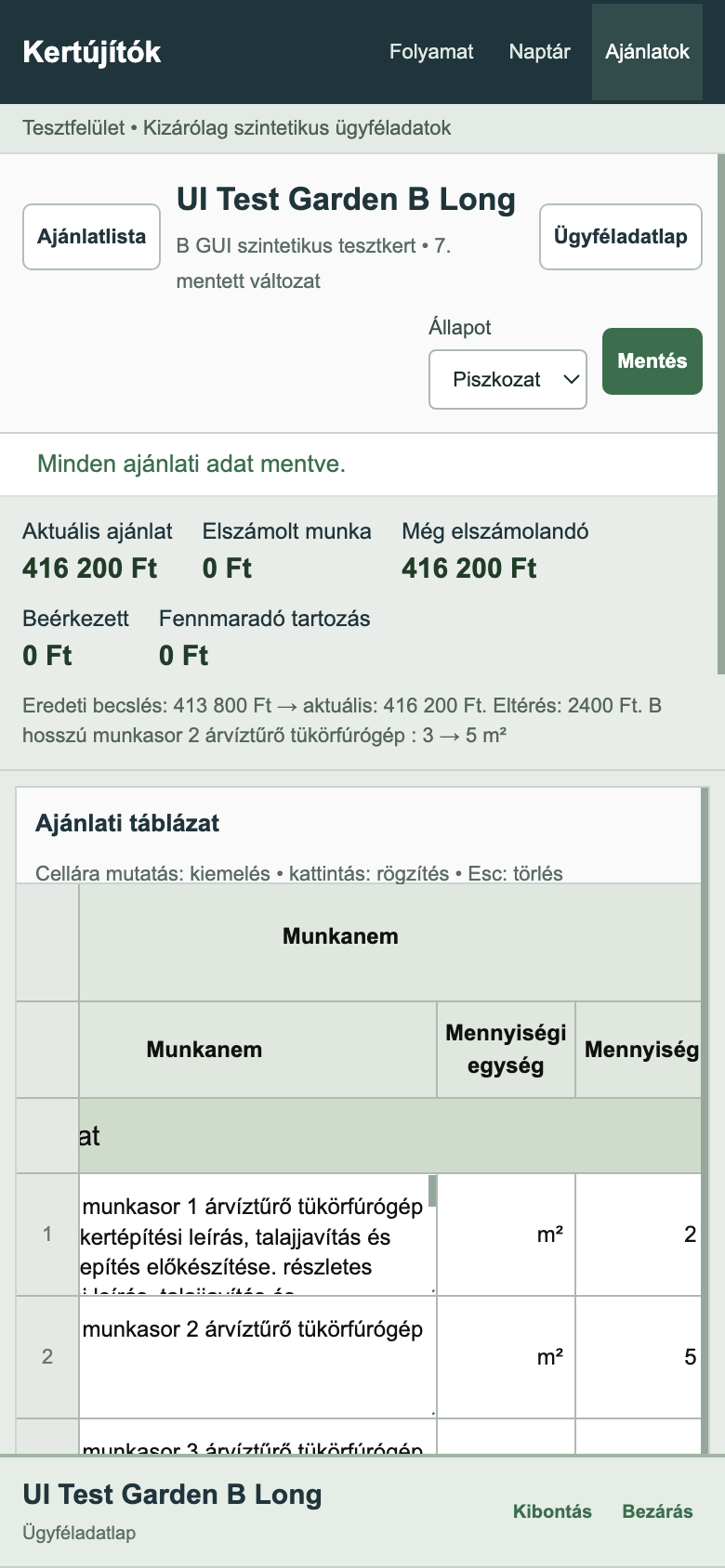
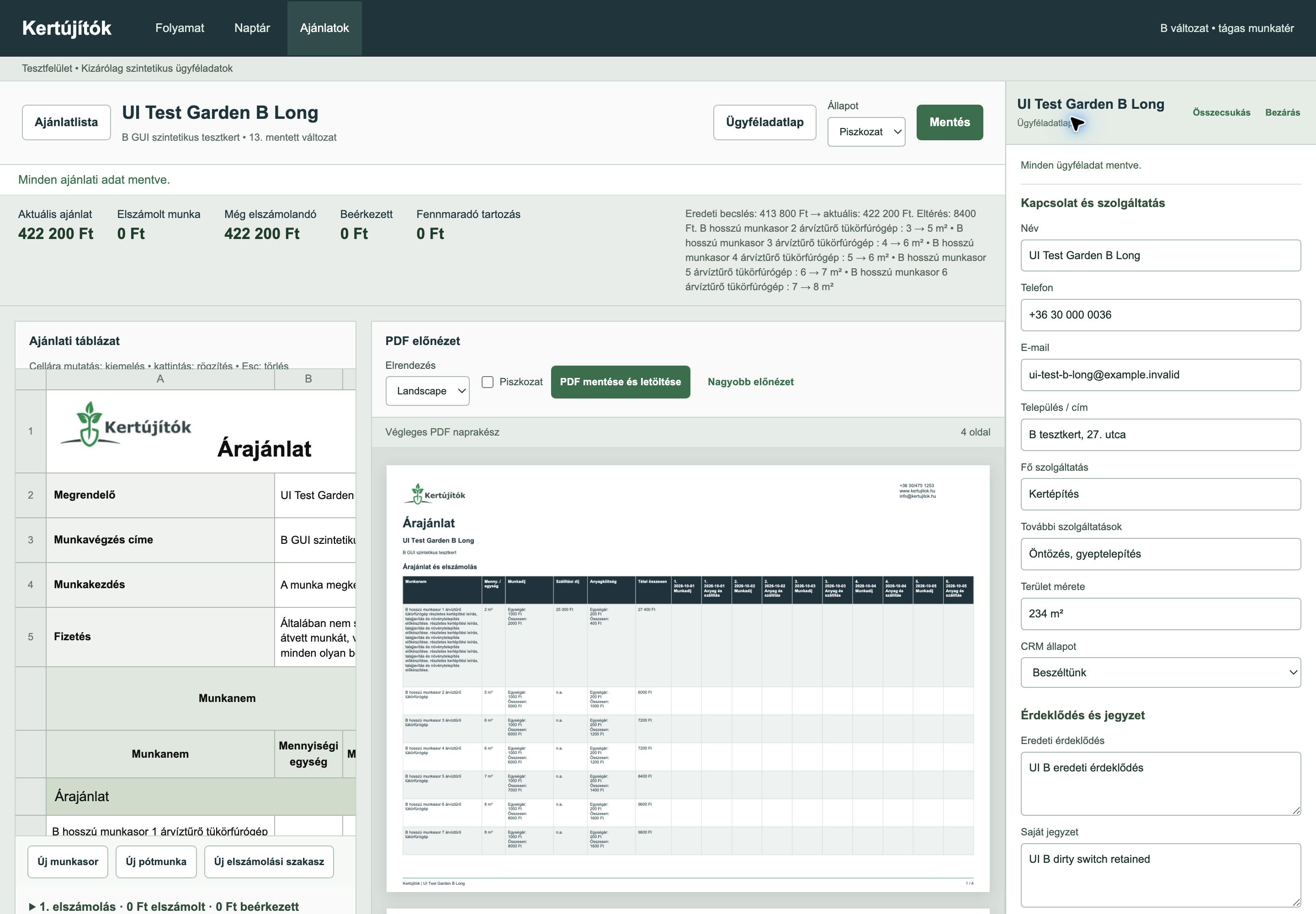
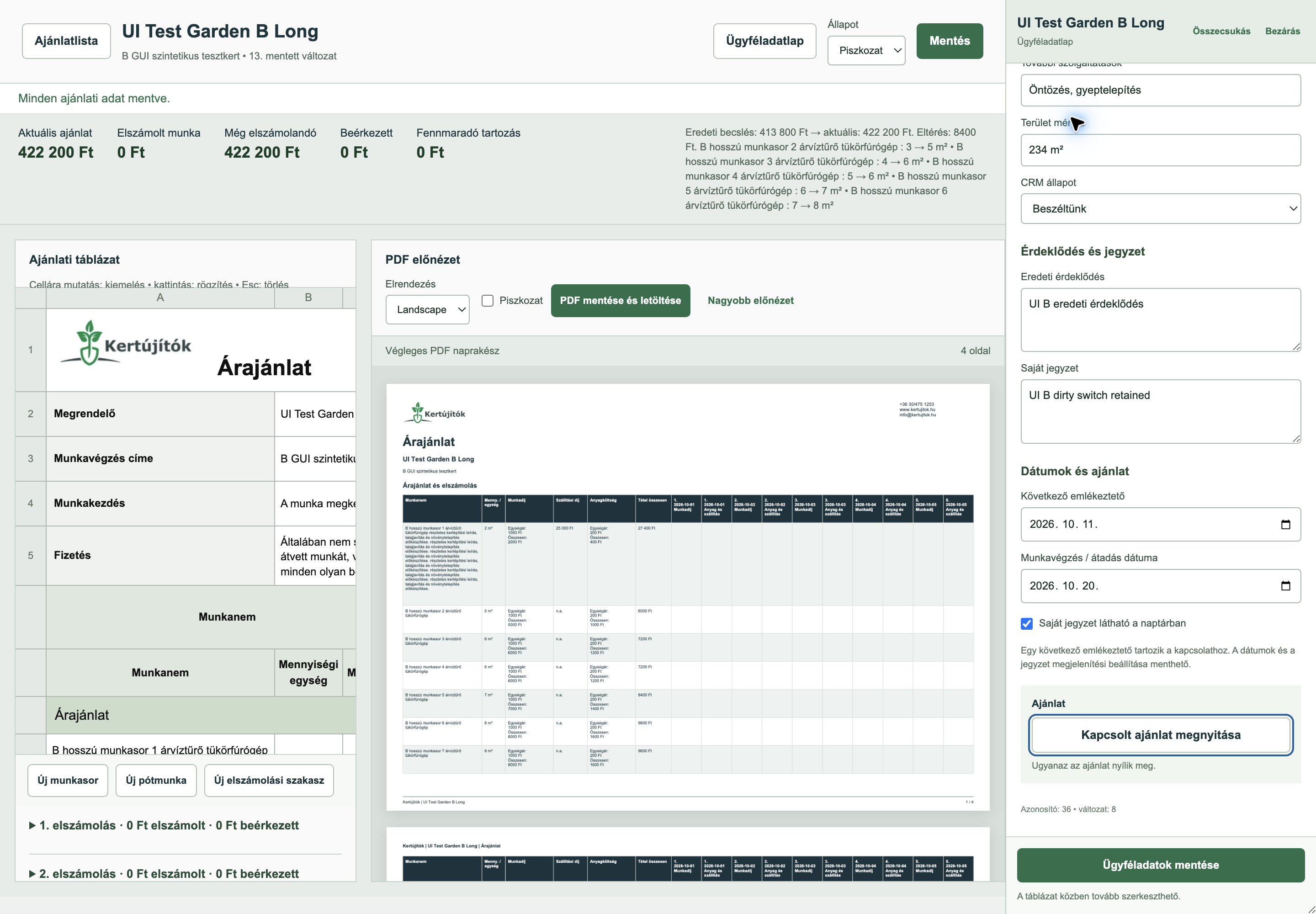
Both variants are deployed and all C01–C25 checks are verified. Eight actual browser journeys per variant, matching preview/download PDFs, saved-data readbacks, 135 desktop and 138 mobile section captures, and 80 fresh independent image comparisons support the result. Verification is distinct from parent or client approval.
The integrated sidebar is inside both proposal variants. The two alternative pages explicitly keep demo-only edits. No client messages or production changes were made.
Confirmed scope and decisions
Proposal generator only now. Calendar redesign, global Folyamat redesign and universal sidebar rollout across unrelated panel views are deferred, not cancelled.
Keep the spreadsheet's look, terminology, column relationships and interaction. It is our custom app, not Excel, Google Sheets or an embedded spreadsheet service. Both UI variants preserve this.
One ongoing proposal record per lead. Do not introduce multiple-project, multi-property, team, invoice or automatic-email systems. Reopening a linked proposal must not create another.
Both variants retain cell hover/focus highlighting and click-to-pin in the PDF, editable extra-work rows, labor/material settlement stages and cumulative reconciliation. Do not split quote and settlements into separate editors.
No new login, token, VPN, IP restriction or security layer. Publish non-sensitive synthetic staging views at bare URLs. Do not expose production CRM or private source transcripts. Leave existing production systems unchanged.
Matt explicitly authorized one new Sol xhigh orchestrator, followed by calendar integration in a second sequential thread.
Q1-AVariant A and B use independent saved copies of identical test data.
Q2-A + sidebar correctionRetain one upcoming reminder per lead. A lead opens in a non-modal editable side panel. Provide three sidebar designs, with two allowed as standalone frontend prototypes.
Q3 + final scope correctionDo not invent extra project information for the PDF. Calendar work-period questions are deferred. Preserve the sheet's data and the specifically accepted settlement fields.
Q4 correctionThe lead sidebar exposes editable lead information, original enquiry and own note, separate reminder/work-delivery dates, a persisted calendar-note visibility checkbox and a proposal property. Empty proposal means Create, which creates and opens the editor. Existing proposal means a link opening that same proposal.
Q5-BCreating a proposal for a new customer automatically creates the linked CRM contact.
Q6 correctionDo not add complexity for multiple unrelated jobs per customer.
Q7-AAllow clearly marked draft PDFs with unresolved prices. Final export requires pricing or explicit exclusion.
Q8-ASettlement materials include transport once, visibly labelled Anyag és szállítás.
Q9-AShow current quantities and a compact original-estimate to current-total summary. Earlier exported PDFs remain unchanged.
Q10-AStore dated payments under each settlement and calculate received totals and outstanding balances.
Assumptions and facts to verify
Reversible defaults
UI variant A uses a compact sheet-first workspace. Variant B changes list organization and workspace spacing/preview controls, not the familiar sheet template or accounting behavior.
The working sidebar is shared by both proposal variants. The two standalone sidebar alternatives have clearly labelled demo-only state, so they are not mistaken for saved CRM integrations.
The original-estimate baseline is captured on the first final quote export. Later exports create immutable document versions. This is a reversible product default, not a new approval workflow.
The calendar visibility preference and work-delivery date are persisted lead properties here. Their calendar rendering is deferred. Existing calendar/reminder behavior must not regress.
An explicitly excluded row is omitted from the final PDF and all included totals. A zero price is an explicit numeric value, not a substitute for an unknown price.
Each included regular or Pótmunka row uses quantity × labor unit rate, one row-level transport amount, and quantity × material unit rate. Store blank/unknown, explicit zero, not-applicable and excluded distinctly. Preserve existing unit rates when only quantity changes.
The historical fixture reproduces its selected/formula-populated rows explicitly. Rows with a unit rate but no source total are not permanently disabled: newly included rows use the normal formula. Do not silently turn source question marks into numeric zeros.
Before the first final quote export, the original-estimate comparison is labelled not yet captured. Draft exports never freeze the baseline. First final quote export captures row identities, quantities, rates and included totals once, including when reached from a settlement workflow. Subsequent edits never reset it.
Executor discovery, not extra approval gates
Before implementation, verify the current staging repository, branch, Worker routes and D1 bindings from current source/provider readback. Prior reports and local export folders are navigation evidence only.
Inventory existing staging proposal data and save a restorable backup before replacing Ajánlatok. Keep a task-owned route/config rollback. Removal means retiring the old UI, not silently purging stored records.
Verify every original sheet row/formula and the unexplained 180,000 Ft reference cell against the source workbook. Do not interpret that reference value as a payment or include it in new-proposal templates. Inventory non-row content across workbook and demonstrated template: customer/header fields, work-start/payment terms, Pótmunka wording and branding. Preserve verified content, resolve differences from the latest source precedence, and do not fabricate missing values.
Read the latest user prompt, annotations and inline rewrites immediately before launch. Record the check time and a zero-comment result when applicable. Material revisions return for review.
Authority and proof
Under Matt’s explicit execution instruction, the executor may inspect access/source, implement, migrate isolated staging data, run tests, publish both staging variants and the two sidebar prototype pages, and maintain this stable review board. Shared paid budget is USD 20 combined across proposal and calendar including all agents and services. No client messages, invoice issuance, production release, commercial commitments or irreversible data deletion. Use a verified restore path before replacing old staging behavior. Deployment proof includes anonymous fresh-client access and exact provider readback.
For each GUI criterion, save an actual screenshot after the named action for each applicable functional variant. A fresh independent gpt-6-luna high agent receives only that screenshot, describes what is visible, and the parent compares it with the criterion. Attach screenshot, description and comparison. Screenshots supplement behavior, arithmetic, persistence and PDF-byte checks. Leave any missing evidence unverified. Run the required Luna section screenshot/fix/fresh-QA cycle on deployed app pages. All product criteria remain unchecked in Prepare.
Work and proof
25 of 25 criteria are verified. Checkboxes indicate evidence, not reviewer approval.
D1 · Replace staging with two working variants
Provide fair, independently editable comparisons without changing production.
3 / 3
Show criteria, constraints and evidence
Preserve these constraints
Preserve unrelated panel modules and production routes/data. Never access or restore GAJA/GHL.
Replace the rejected staging Ajánlatok UI only after a verified recoverable backup. Use synthetic data and no added access gate.
The Ajánlatok entry at the user-requested calendar-stage-20260923.cfd-staging.com/panel/ must open functional variant A after retiring the old proposal interface. Variant B has its own independent staging URL. Preserve the rest of that existing panel.
Observable tests
Proof: Anonymous HTTP receipt, deployed URLs, provider bindings readback, desktop/mobile screenshots and independent descriptions. Before public deployment, inventory exposed routes/assets/APIs/documents and enumerate their staging records. Read back exact staging-only bindings and prove all exposed data is synthetic, including PDFs and exports; do not publish if production/private data remains reachable. This is data isolation and content verification, not a new access/security layer.
Proof: Create/retry behavior check, record-count readback and editor/sidebar screenshots. Inject a lost response after contact commit before successful proposal linkage, then retry and repeat/concurrently attempt creation in each variant; verify one linked contact/proposal and no orphan.
Let Péter type as before and immediately see the affected PDF content.
4 / 4
Show criteria, constraints and evidence
Preserve these constraints
Preserve original row relationships, Hungarian headings, units and calculations. Do not substitute cards or a wizard for the sheet.
No Google Sheets dependency or prototype-only two-row limit. Unknown values cannot silently become zero.
Observable tests
Proof: Workbook-to-model comparison, arithmetic report, extracted PDF text and sheet/PDF screenshots. Verify source fixture before treating baseline as authoritative. Record source row/formula mapping and included/excluded/unknown status. Source cached totals are 191,000 + 25,000 + 158,500 = 374,500 Ft; M5 is an unmapped 180,000 value outside the summed settlement rows. Its meaning is unverified, so do not count it as a payment or carry it into new proposals without another cited source establishing its meaning.
Keep quoted work, performed work and money received distinct in the same sheet.
5 / 5
Show criteria, constraints and evidence
Preserve these constraints
Use dated settlement stages with labor and Anyag és szállítás columns. Count transport exactly once, with no new invoice/tax system.
Keep quote, Pótmunka and settlement in one editor. Never force received money to equal the initial estimate or mark requested money as paid.
Observable tests
Proof: Golden arithmetic fixture, row-to-stage reconciliation and sheet/PDF screenshots, including partially settled items. Independent oracle: one included row has quantity 2, labor unit rate 50, material unit rate 20 and row transport 10, total 150. Stage 1 labor 60 plus Anyag és szállítás 30 (20 material + 10 transport) totals 90. Stage 2 labor 20 plus material 10 totals 30. Cumulative settled is 120, remaining unsettled is 30 (labor 20 + material 10). Requested amounts and received payments do not alter these work-value totals.
Proof: Before/after arithmetic, old PDF SHA-256 comparison, current PDF extraction and rendered screenshots. Use an originally quoted 6,000 Ft unit-rate fixture and verify a quantity-only edit leaves that rate unchanged in both PDF layouts. Manual rate edits remain available.
Give Péter a readable customer document directly from the current sheet.
3 / 3
Show criteria, constraints and evidence
Preserve these constraints
Both functional UI variants offer both PDF layouts. The UI alternatives are not substitutes for the PDF layout selector.
PDF content comes from sheet fields and explicitly accepted summary/payment fields only. Do not include internal CRM notes or hover overlays in customer PDFs.
Observable tests
Proof: Both downloaded PDF files per variant, text extraction and all-page render screenshots. Compare the workbook and demonstrated template content inventory against each PDF layout.
Keep lead information at hand without blocking the proposal workspace.
4 / 4
Show criteria, constraints and evidence
Preserve these constraints
One sidebar design is integrated and persisted in both proposal variants. Two alternatives may be standalone interactive HTML prototypes clearly marked as demo-only.
Opening a sidebar must not apply a modal backdrop, lock scrolling or make the remaining UI inert. Broader unrelated-panel rollout and calendar rendering remain deferred.
Observable tests
Proof: Field inventory versus actual lead schema, click/open screenshots in A and B, save/reload readback. Generated technical IDs may be displayed read-only.
Proof: Read/write/readback plus existing reminder smoke checks, screenshot of all saved properties. No claim of new calendar behavior. Explicitly reschedule a synthetic lead with an existing upcoming reminder and verify exactly one upcoming reminder remains at the new date.
The user narrowed this run to the proposal generator and requested LLL. Review this contract. Matt has now explicitly authorized execution.
Executor verification complete: C01–C25 all pass. Both public variants and all three sidebar arrangements are usable. Original staging records and immutable PDF history are preserved. Eighty independent image descriptions and parent comparisons accompany the primary visual evidence. Final audit confirms empty outboxes, exact A/B versions and unchanged production. The report and integration handoff preserve the offline-preview reload limitation and resolved navigation observation.
Review and next action
Open either variant, inspect the supplied Test Garden fixtures and use the comment toolbar for feedback. All 25 contract criteria have evidence. The calendar integration handoff is ready for the parent-owned sequential phase.
Latest user authority supersedes the default launch/model rule: execute with one Sol xhigh orchestrator, then integrate the calendar through a second sequential orchestrator. No additional review gate.
No implementation work remains in the proposal phase. Calendar execution was not started here.
The executor brief contains the exact local sources, transcript gists, workbook and provider discovery steps. Private transcripts and contact data are not published on this board. After launch the private read set holds the deliverable list, main prompts and session identity.
Recovery state
Recovery and deployment evidence
0consecutive stalls
Restore verifiedrecovery state
Calendar handoff readyresume point
Latest execution note: Proposal verification is complete. Production is unchanged. The calendar handoff is ready, and this proposal executor has not launched the calendar phase. See known limits for the offline-preview reload recovery.
Parent action: Review the completed proposal result and continue the sequential calendar phase from the tested integration handoff.